
How to Identify Magpie-lark Feathers
A guide to recognizing the bold black-and-white pied feathers of the Magpie-lark, a common Australian songbird.
Read the full Magpie-lark encyclopedia entry →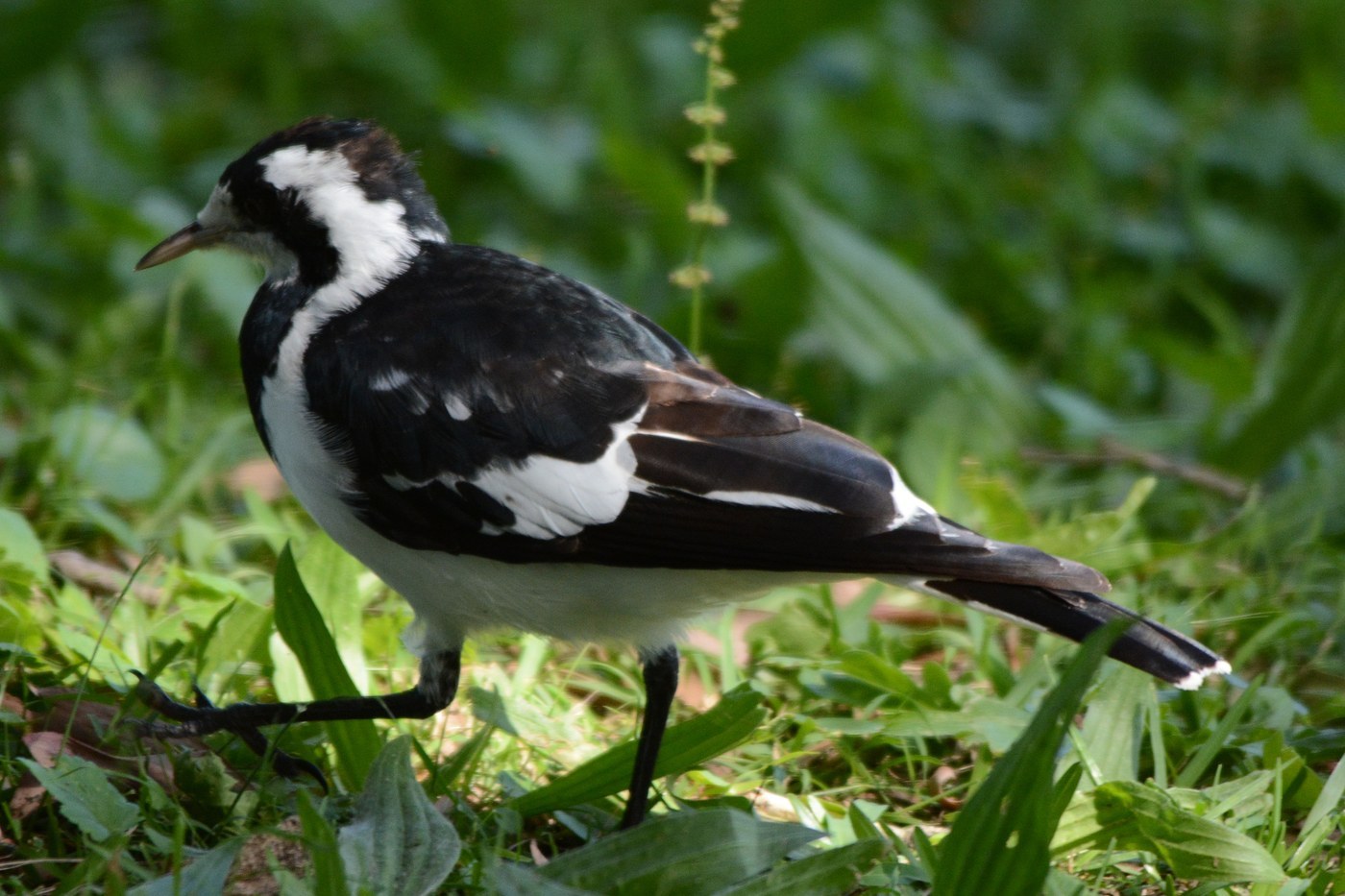
What Magpie-lark's Feathers Look Like
The Magpie-lark, sometimes called the Peewee, is an Australian songbird with a striking pied (black-and-white) plumage pattern that makes many of its feathers easy to place into a general category, though sex-specific detail helps narrow things further. Back and crown feathers are glossy black, while wing feathers show a bold mix of black and white, with white patches forming a visible panel across the closed wing. Underpart feathers are crisp white, contrasting sharply with the black upperparts. The clearest sex-specific clue comes from the face and throat feathers: males show an all-black throat and face with a white stripe over the eye area, while females show a white throat and face with black restricted to behind the eye — so a small feather from this area, whether black or white, can indicate the bird's sex. Tail feathers are black with clean white tips or corners, moderately long, and the legs (if leg material is attached) are notably long and dark, reflecting the bird's ground-foraging habits.
Step-by-Step: Is This Feather From a Magpie-lark?
- Check for a bold, clean black-and-white pattern with no gray, brown, or streaking. This pied simplicity is a strong starting match for Magpie-lark.
- Look at throat/face feathers for sex clues. An all-black throat feather suggests a male, while a white throat feather suggests a female.
- Confirm white tail-tip or tail-corner feathers. Black tail feathers with a crisp white tip or corner patch fit this species.
- Assess size. Feathers should suit a bird about 26–30 cm long, roughly robin-to-small-magpie sized, smaller than a true Australian Magpie.
- Consider range. Any bold black-and-white feather found across mainland Australia away from coastal cliffs (ruling out seabirds) fits this common, widespread species well.
Similar Species & How to Tell Them Apart
The Australian Magpie shares the black-and-white theme but is considerably larger, with more extensive white on the back and nape rather than confined mostly to the wings and underparts, and its feathers are noticeably bigger and heavier. Willie Wagtail, another common Australian black-and-white bird, is smaller still, with black upperparts and white underparts but no white wing panel and no sex-based face pattern difference. Australian Pied Oystercatcher and other black-and-white shorebirds share the pied theme too, but their feathers are stiffer and more suited to coastal wading, and they occur in coastal habitats rather than the inland farmland and wetland edges Magpie-larks favor. The specific combination of moderate size, white wing panel, and a face pattern that differs between black-throated and white-throated individuals is distinctive to Magpie-lark.
Where & When You'll Find Them
Magpie-larks are extremely common and adaptable across most of Australia (and parts of southern New Guinea), found in farmland, woodland edges, parks, gardens, and around wetlands and rivers, often seen walking on lawns and mudflats. Because they are non-migratory and breed across an extended season depending on region, feathers can be found scattered through most of the year, with the highest concentration near mud-based nest sites (this species builds a distinctive bowl nest of mud and grass) during the breeding season. Molt typically follows breeding, so late in the local breeding season is often the most productive time to look, especially near favored ground-foraging areas like open lawns and shorelines.
Frequently asked questions
How can I tell if a feather came from a male or female Magpie-lark?
Check throat and face feathers — an all-black throat feather indicates a male, while a white throat feather indicates a female, since the species shows this sex-based facial pattern difference.
How is this different from an Australian Magpie feather?
Australian Magpie is considerably larger with more extensive white across the back and nape, while Magpie-lark's white is concentrated in a wing panel and the underparts, with correspondingly smaller feathers.
Could this be confused with a Willie Wagtail feather?
Willie Wagtail is smaller and lacks the bold white wing panel and sex-based face pattern that Magpie-lark shows, making the two distinguishable with a close look.
Why would I find feathers near mud on a riverbank?
Magpie-larks build a distinctive mud-and-grass bowl nest, often on a horizontal branch near water, so feathers often turn up near these nest sites and the muddy foraging areas the birds favor.
Is there a specific season for finding feathers?
Not a strict one — as a non-migratory species with an extended regional breeding season, feathers can be found through much of the year, with more activity near nest sites during breeding.
Magpie-lark identified by the community
Recent Magpie-lark feathers identified with Feather Identifier.


