
How to Identify Marsh Tit Feathers
A guide to recognizing the glossy black cap, small black bib, and plain unmarked wings that distinguish Marsh Tit feathers from the very similar Willow Tit.
Read the full Marsh Tit encyclopedia entry →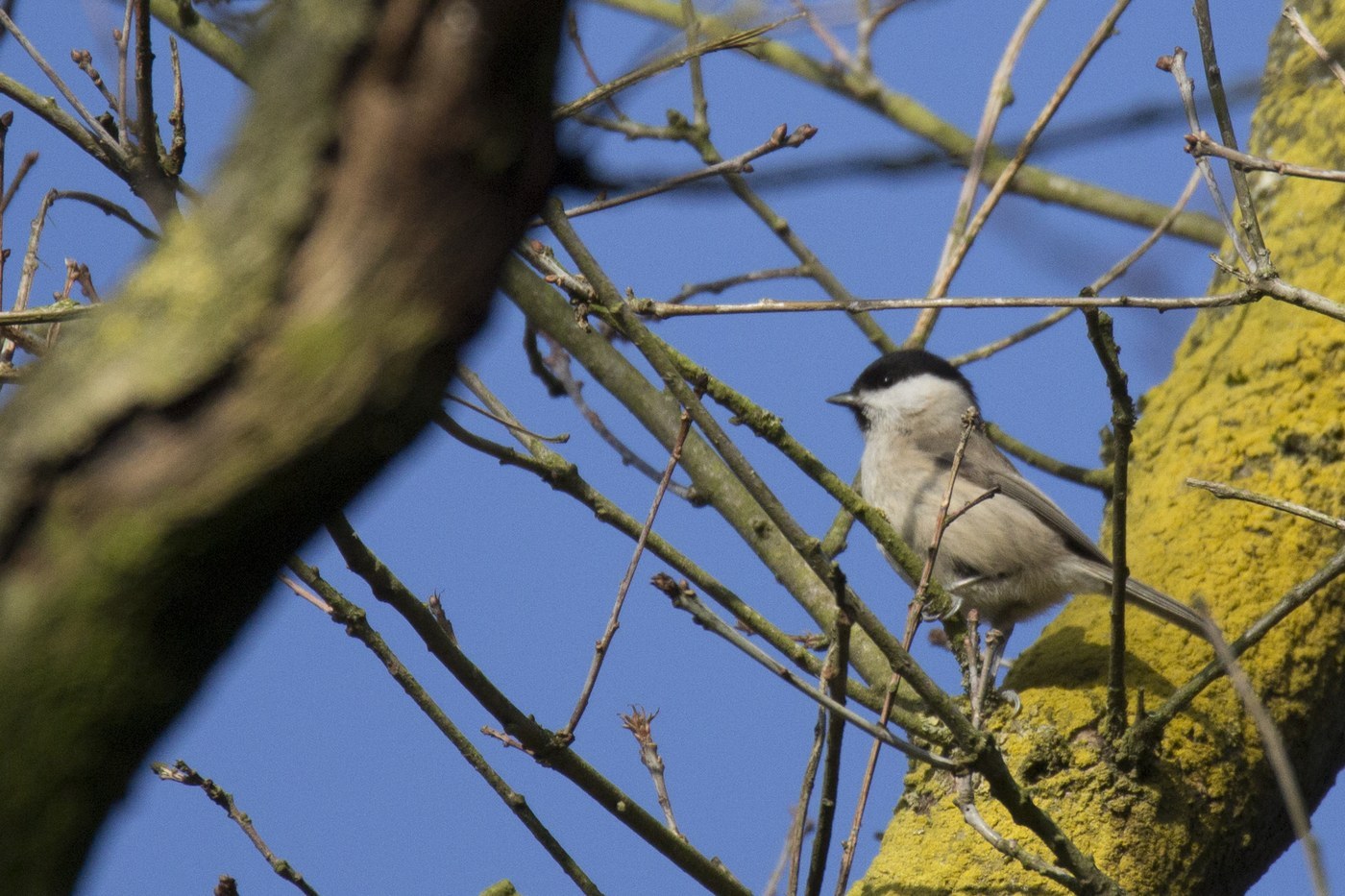
What Marsh Tit's Feathers Look Like
The Marsh Tit is a small European woodland songbird whose feathers are subtly patterned but carry a few precise diagnostic details. Crown feathers form a neat, glossy black cap, distinctly shinier than the matte black cap of its closest relative — a crown feather with a visible sheen under good light is a useful clue for this species specifically. A small, compact black bib (chin patch) sits below the bill, notably smaller and more sharply defined than in some relatives. Back and wing feathers are a plain grayish-brown to buffy-brown, importantly showing no pale wing panel — the wing feathers are uniform in tone without a lighter patch standing out among the darker flight feathers. Underpart feathers are pale buffy-white, unmarked, fading gently from a whiter throat area toward warmer buff on the flanks. Overall feather size is small, consistent with a bird under 12 cm, similar in scale to other small European tits.
Step-by-Step: Is This Feather From a Marsh Tit?
- Check the crown feather for glossiness. A cap feather with a distinct glossy sheen, rather than a flat matte black, supports Marsh Tit over its closest look-alike.
- Look at the bib size. A small, neatly bordered black throat patch fits this species; a larger, more diffuse or bib extending further down the throat suggests a different tit.
- Confirm the wing feathers show no pale panel. Uniform grayish-brown wing feathers, without a lighter patch among the flight feathers, are a key distinguishing feature for this species.
- Assess underpart tone. Pale buffy-white fading to warmer buff on the flanks, without streaking, matches this species.
- Consider habitat context. Feathers found in deciduous woodland with mature trees (rather than boggy conifer woodland) slightly favor Marsh Tit over some relatives.
Similar Species & How to Tell Them Apart
Willow Tit is the classic, notoriously difficult look-alike, and the two are best separated using exactly the features above: Willow Tit shows a duller, matte black cap (no gloss), a slightly larger, more extensive black bib, and — most usefully — a pale panel on the wing feathers created by pale fringing on the secondaries, which Marsh Tit lacks entirely. If a wing feather clearly shows a lighter patch standing out from the rest of the wing, that points to Willow Tit; a uniformly toned wing feather points to Marsh Tit. Coal Tit, another small relative, has a white patch on the back of the head (nape) that neither Marsh nor Willow Tit shows, making it easier to rule out. Great Tit and Blue Tit are both larger with much bolder yellow, green, or blue coloring, easily distinguished by color alone.
Where & When You'll Find Them
Despite the name, Marsh Tit is not particularly associated with marshes — it favors mature deciduous woodland, especially with a good shrub understory, across much of Europe and temperate Asia, and is often a non-migratory resident holding a territory year-round. Feathers are most likely found in broadleaf woodland with old trees (which provide the natural cavities this species prefers for nesting) rather than in wet or boggy habitat. The single annual molt occurs in late summer after breeding, making July through September the most productive window for finding fresh feathers, though as a non-migratory resident, feathers from preening and minor feather loss can turn up near favored foraging and roosting areas throughout the year.
Frequently asked questions
What is the single best feature for telling Marsh Tit and Willow Tit feathers apart?
A wing feather with no pale panel favors Marsh Tit, while a wing feather showing a lighter patch among the flight feathers (from pale fringing on the secondaries) favors Willow Tit.
Does the glossiness of the black cap really make a difference?
Yes — Marsh Tit's cap feathers have a distinct glossy sheen, while Willow Tit's cap is duller and more matte, a subtle but genuine difference visible in good light.
Is Marsh Tit actually found in marshes?
Not particularly — despite the name, it favors mature deciduous woodland with good shrub cover rather than marshy or boggy habitat, which is more typical of Willow Tit.
How do I rule out Coal Tit?
Coal Tit shows a distinctive white patch on the nape (back of the head), which neither Marsh Tit nor Willow Tit has, making it straightforward to exclude.
When is the best time to find fresh Marsh Tit feathers?
July through September, during the single annual post-breeding molt, though as a year-round resident species, feathers can also be found near foraging and roosting areas at other times.