
How to Identify Moluccan Cockatoo Feathers
A guide to the salmon-pink plumage and large recurved crest feathers that make the Moluccan Cockatoo one of the most recognizable cockatoo feathers.
Read the full Moluccan Cockatoo encyclopedia entry →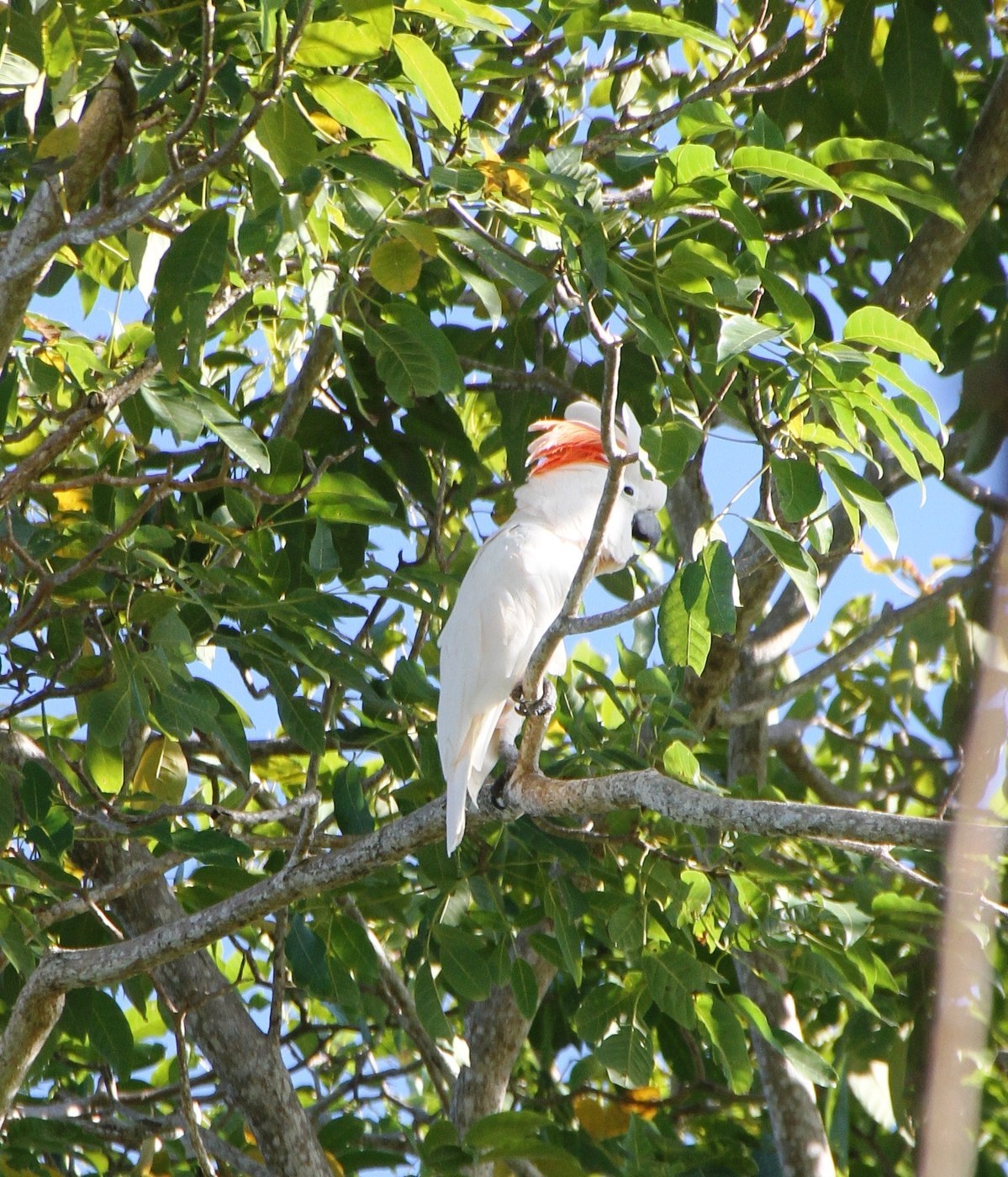
What Moluccan Cockatoo Feathers Look Like
Moluccan Cockatoo feathers are large, soft, and suffused with a distinctive warm color that sets this species apart from whiter cockatoos. Body feathers across the head, neck, back, and underparts are a pale salmon-pink to peachy-white, with the pink tone typically strongest and most saturated on the head and underside of the wings and tail rather than uniformly across the whole body. The crest feathers are the single most diagnostic feature: elongated, broad, and deep salmon-pink to orange-red, forming a large recurved crest that the bird can raise into a dramatic fan — even a single loose crest feather is usually identifiable by its size, shape, and saturated pink-orange color, much deeper than the paler body feathers. The underside of the flight feathers and tail feathers shows a wash of yellow-to-salmon color that is far more visible when the wing or tail is spread than when folded, so an isolated underwing or undertail feather may show more color than a similarly-positioned overwing feather. Overall feather size is large, reflecting the species' status as one of the largest cockatoos (around 46–52 cm body length).
Step-by-Step: Is This Feather From a Moluccan Cockatoo?
- Check for a large, elongated crest feather with deep salmon-pink to orange-red color — if you have this, it's close to diagnostic on its own given the size and saturation.
- Assess body feather tone. Pale salmon-pink to peachy-white rather than pure white is characteristic; pure white body feathers suggest a different, whiter cockatoo species.
- Look at underwing/undertail feathers for a yellow-salmon wash, more visible on the underside than the exposed upper surface.
- Measure overall size. Large feathers throughout, consistent with one of the biggest cockatoo species.
- Consider captive origin strongly. This species is popular and long-lived in aviculture worldwide, so a matching feather found outside its native Indonesian range is far more likely from a pet or aviary bird than a wild one.
Similar Species & How to Tell Them Apart
- Salmon-crested confusions aside, compare to Umbrella Cockatoo: Umbrella Cockatoo is essentially pure white with only a pale yellow wash on the underwing/undertail and a white (not pink) crest, a much cooler-toned bird than the pervasively pink-tinged Moluccan Cockatoo.
- Sulphur-crested Cockatoo: Shows a bright yellow (not pink) crest and yellow underwing/undertail wash, an easy color separator.
- Rose-breasted Cockatoo (Galah): Has a gray back and wings contrasting with a rose-pink breast and face, a very different two-tone pattern compared to Moluccan Cockatoo's more uniformly salmon-washed plumage.
- Pink Cockatoo (Major Mitchell's Cockatoo): Shows a much bolder banded crest of red, yellow, and white, unlike the more uniformly salmon-pink crest of the Moluccan Cockatoo.
Where & When You'll Find Them
Moluccan Cockatoos are native to lowland and hill forest on Seram and a few neighboring islands in the Moluccas (Maluku) region of Indonesia, where the wild population is restricted and increasingly limited to remaining forest tracts. Because the species is also extremely popular in aviculture worldwide due to its striking appearance, feathers matching this description found outside Indonesia are overwhelmingly more likely to come from a captive pet or aviary bird than a wild individual. In its native range, molt is not tied to a sharply defined season, and feathers can be found in and around forest canopy foraging areas throughout the year; for captive birds, feathers may be found any time given typical year-round molt patterns in a controlled environment.
Frequently asked questions
What's the most identifiable Moluccan Cockatoo feather?
A large, elongated crest feather in deep salmon-pink to orange-red — its size and saturated color are close to diagnostic on their own.
Is the body plumage pure white or tinted?
It's tinted — a pale salmon-pink to peachy-white rather than pure white, which helps separate it from whiter cockatoo species like the Umbrella Cockatoo.
How does this compare to Sulphur-crested Cockatoo?
Sulphur-crested Cockatoo has a bright yellow crest and yellow underwing wash, clearly different from the pink-to-orange tones of Moluccan Cockatoo.
If I find this feather outside Indonesia, what does that mean?
It's much more likely to have come from a captive pet or aviary bird, since this species is popular in aviculture worldwide but has a naturally restricted wild range.
Where is the wild population found?
Lowland and hill forest on Seram and a few neighboring islands in the Moluccas (Maluku) region of Indonesia.