
How to Identify Montezuma Oropendola Feathers
How to recognize the chestnut body feathers and bright yellow outer tail feathers of the Montezuma Oropendola, a signature Central American icterid.
Read the full Montezuma Oropendola encyclopedia entry →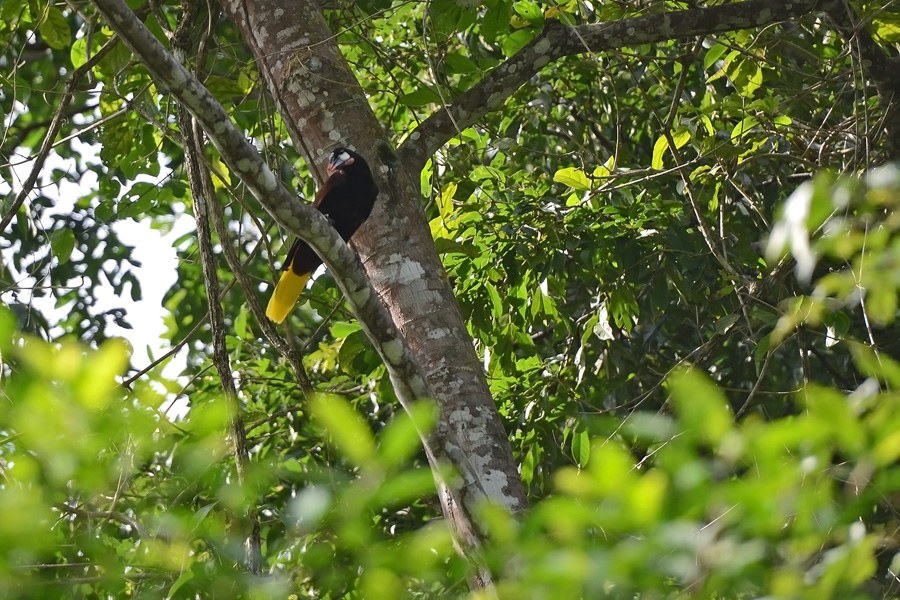
What Montezuma Oropendola's Feathers Look Like
The Montezuma Oropendola is a large, striking icterid of Central American forests, and one feather in particular makes this species almost impossible to mistake: the outer tail feathers are bright, saturated yellow, in sharp contrast to the black central tail feathers. This yellow-and-black tail is the single best clue you can find. Body contour feathers are a rich chestnut-brown, covering the back, belly, and wings, while the head, neck, and upper breast feathers are glossy black. Flight feathers (primaries and secondaries) are blackish-brown with little pattern, built long and strong for a bird capable of powerful, direct flight through forest canopy. Feather size is substantial given the species' large size (males can exceed 20 inches including the tail) — primaries often run 6-8 inches, and the diagnostic yellow tail feathers can be 8 inches or more. Shafts on the yellow tail feathers are pale and contrast against the deep chestnut body plumage.
Step-by-Step: Is This Feather From a Montezuma Oropendola?
- Check for bright yellow color. Any feather that is solid, saturated yellow with a black base or black elsewhere on the same feather almost certainly comes from the outer tail of this species.
- Look at chestnut body feathers. A large, deep reddish-brown contour feather, distinct from the blacker head/neck feathers, fits the body plumage.
- Measure the feather. Large size (flight feathers 6-8 inches, tail feathers up to 8+ inches) matches this oversized icterid.
- Note the black-and-chestnut contrast. A glossy black feather paired nearby with chestnut ones suggests the head/neck versus back distinction typical of this species.
- Consider the setting. Feathers found beneath long hanging colonial nests in tall canopy trees strongly support this species.
Similar Species & How to Tell Them Apart
The closest relative is the Chestnut-headed Oropendola, which is notably smaller and has a chestnut (not black) head, so a black-headed, chestnut-bodied bird with a bright yellow tail points to Montezuma rather than Chestnut-headed. Crested Oropendola and various cacique species share the yellow-tail pattern in some cases, but caciques are much smaller overall with proportionally shorter feathers, and their yellow is often more restricted to just the tail tip rather than the entire outer tail feather. No other bird sharing Montezuma Oropendola's range combines its large size, chestnut body, black head, and full bright-yellow outer tail feathers, making a complete or partial yellow tail feather highly diagnostic on its own.
Where & When You'll Find Them
Montezuma Oropendolas inhabit lowland and foothill rainforest and forest edge from southeastern Mexico through Honduras and Nicaragua to Panama, where they nest colonially, weaving long pendulous nests that hang from the outer branches of tall emergent trees. Because they are non-migratory residents, feathers can be found in any season, but the best places to search are directly beneath active colony trees, which are often reused year after year. Body feather turnover is fairly constant, but worn flight and tail feathers are most likely to accumulate after the breeding season concludes, when adults undergo their main molt and colonies become quieter.
Frequently asked questions
What is the single most reliable feather to identify Montezuma Oropendola?
An outer tail feather that is bright, saturated yellow (often with a black base) is essentially unmistakable and is the strongest single clue for this species.
How is Montezuma Oropendola different from Chestnut-headed Oropendola in feather color?
Montezuma has a glossy black head and neck with a chestnut body, while Chestnut-headed Oropendola's head is chestnut-colored like its body — so an all-black head paired with chestnut back feathers points to Montezuma.
Why is one feather I found smaller with less yellow than described?
Smaller birds with limited yellow restricted to just the tail tip are more likely caciques, which share similar coloring but are considerably smaller than the large Montezuma Oropendola.
Where should I look for these feathers?
Search beneath active colonial nesting trees in tall rainforest canopy, since colonies reuse the same trees for their long hanging nests year after year.
Is there a season when feathers are more common?
Feathers can be found year-round since the species doesn't migrate, but worn flight and tail feathers are most common after the breeding season during the main molt.