
How to Identify Montezuma Quail Feathers
A guide to the harlequin-patterned face feathers and polka-dotted flank feathers that make the Montezuma Quail unmistakable among North American quail.
Read the full Montezuma Quail encyclopedia entry →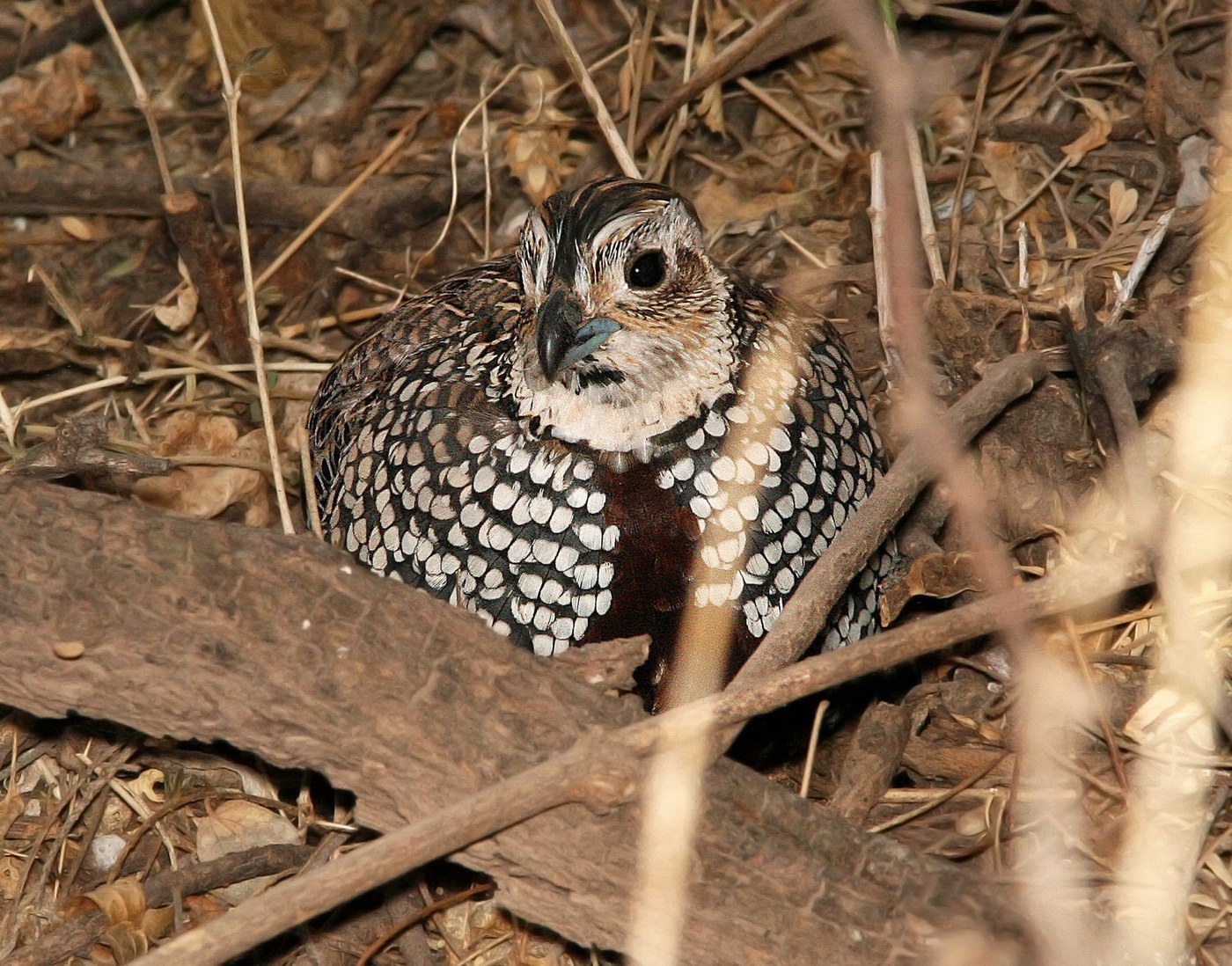
What Montezuma Quail's Feathers Look Like
The Montezuma Quail is a small, secretive gamebird, and males carry one of the most striking feather patterns of any North American bird: a bold black-and-white harlequin facial pattern, with sharply defined white patches on an otherwise black face — feathers here look almost painted, with crisp geometric edges rather than soft blending. The flank feathers are equally distinctive, showing rich chestnut-black background dotted with round white spots, resembling polka dots rather than the streaks or bars typical of other quail. The back and wing covert feathers are cryptically patterned in browns, grays, and blacks with fine vermiculation, providing camouflage against leaf litter. Females are far plainer, cinnamon-buff overall with fine dark mottling and no harlequin face pattern, making them much harder to identify from feathers alone. The species is chunky and short-tailed, so feathers tend to be rounded and compact — body feathers often under 2 inches, flight feathers short and broad for a quail rarely exceeding 9 inches in length.
Step-by-Step: Is This Feather From a Montezuma Quail?
- Look for round white spots on a dark chestnut or black background on a flank feather — this polka-dot pattern is unique among North American quail.
- Check for crisp black-and-white facial patterning with sharp geometric edges rather than gradual shading; this points to an adult male.
- Measure the feather. Short, broad, rounded feathers fit this chunky, short-tailed quail.
- Examine any plain cinnamon-buff feather with fine mottling — this likely comes from a female, which lacks bold facial or flank markings.
- Consider the habitat context. A feather found in oak-grassland or pine-oak woodland understory in the southwestern borderlands fits this specialized habitat.
Similar Species & How to Tell Them Apart
No other quail in the Montezuma Quail's range shares its round-spotted flank pattern — Gambel's Quail and California Quail both show streaked or scaled flank feathers with a curved topknot plume, quite different from the crisp polka dots here. Scaled Quail has uniformly scalloped gray-and-white feathers across the body without any chestnut-and-white spotting. Northern Bobwhite, found in overlapping general region but different habitat, shows bold black-and-white head stripes on males but lacks the rounded polka-dot flank pattern entirely. If a feather shows genuine round white spots against chestnut or black, Montezuma Quail is essentially the only match among North American gamebirds.
Where & When You'll Find Them
Montezuma Quail favor open oak woodlands, pine-oak forest, and grassy mountain slopes with dense ground cover across the southwestern United States (Arizona, New Mexico, west Texas) and highland Mexico, often in areas with bunchgrass that provides both food (tubers, bulbs) and cover. They are non-migratory but can shift locally with rainfall and grass conditions, and feathers are most reliably found where these grasses grow densely on rocky slopes. The main molt follows the summer breeding season, so worn body and flight feathers are most likely to be found in late summer and early fall, right as this famously hard-to-flush bird becomes slightly more active before winter.
Frequently asked questions
What is the single clearest sign of a Montezuma Quail feather?
Round white spots arranged like polka dots against a chestnut-black background on a flank feather are unique among North American quail and are the strongest single diagnostic.
Why does the feather I found look plain and cinnamon-colored with no spots?
That likely came from a female Montezuma Quail, which lacks the male's bold harlequin face and polka-dot flanks and instead shows plain cinnamon-buff feathers with fine mottling.
How is Montezuma Quail different from Scaled Quail in feather pattern?
Scaled Quail feathers show a uniform gray scalloped pattern without chestnut coloring, while Montezuma Quail flank feathers combine chestnut-black background with round white spots.
What habitat should I search for these feathers in?
Look in oak-grassland and pine-oak woodland with dense bunchgrass on rocky mountain slopes in the US-Mexico borderlands, this species' specialized habitat.
When are Montezuma Quail feathers most likely to be found?
Late summer and early fall, after the post-breeding molt, is when worn feathers are most commonly shed and found.