
How to Identify Northern Carmine Bee-eater Feathers
Northern Carmine Bee-eater feathers pair deep carmine-pink body plumage with contrasting turquoise-blue head feathers and elongated central tail streamers.
Read the full Northern Carmine Bee-eater encyclopedia entry →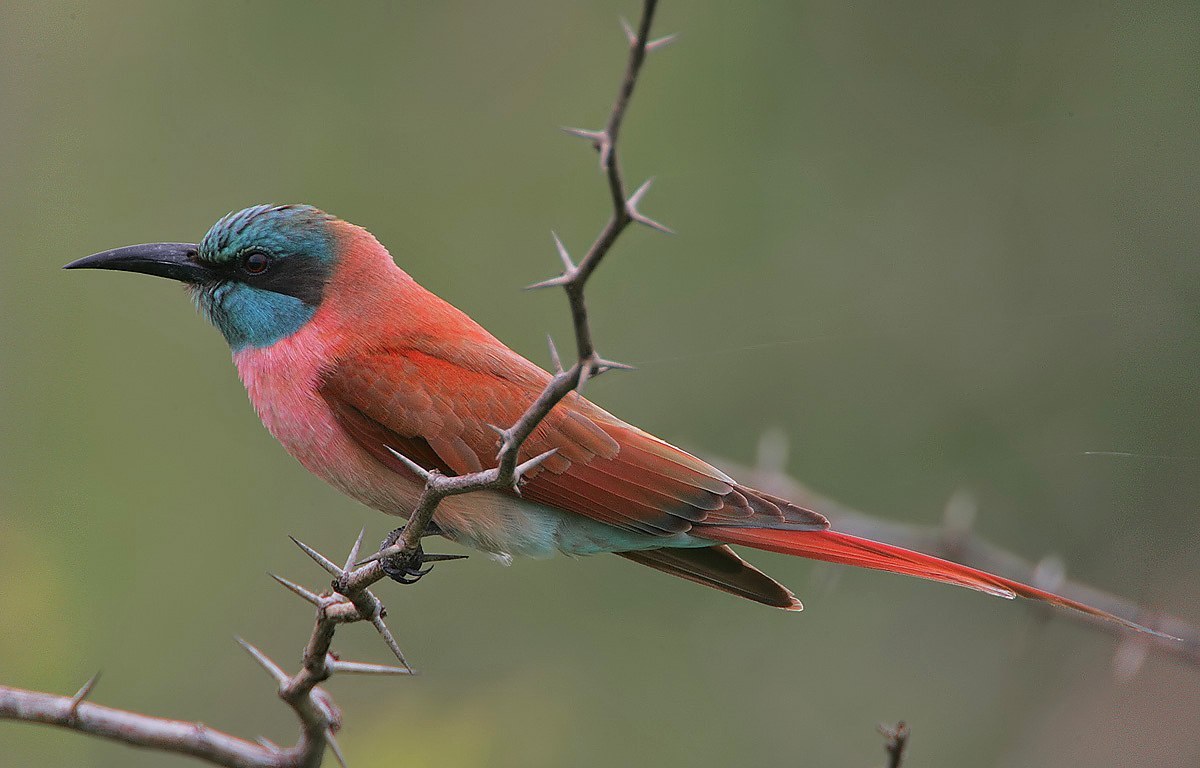
What Northern Carmine Bee-eater's Feathers Look Like
The Northern Carmine Bee-eater is one of Africa's most vividly colored birds, and its feathers are correspondingly striking. Body feathers across the back, breast, and belly are a rich, deep carmine-pink to rose-red, a shade rarely matched by other birds sharing its range. The head, throat, and rump contrast sharply with turquoise-blue feathering, and a black feather mask runs through the eye, finding a small turquoise-blue feather alongside carmine-pink ones from the same source strongly supports this species. Flight feathers are elongated and somewhat pointed, mostly carmine-pink with dark tips, 9-12 cm long, reflecting the bird's streamlined, aerial-hawking lifestyle. The tail carries the species' signature feature: elongated central tail streamers extending well beyond the rest of the tail, often 6-9 cm longer than the neighboring feathers, giving the bird a distinctive pin-tailed silhouette in flight, a single very long, narrow, pointed carmine-pink feather is a strong sign of this central tail streamer. Shafts are typically dark on the pink feathers and paler on the turquoise ones.
Step-by-Step: Is This Feather From a Northern Carmine Bee-eater?
- Check for a deep carmine-pink to rose-red color — a shade of pink-red distinct from typical red, orange, or crimson seen in other birds.
- Look for a contrasting turquoise-blue feather, especially from the head, throat, or rump area, alongside the pink body feathers.
- Look for elongated central tail streamers. A single narrow feather noticeably longer than a typical tail feather, with a pointed tip, suggests this species' signature pin-tail.
- Measure flight feather length. Elongated, somewhat pointed primaries around 9-12 cm fit an aerial-hawking bee-eater build.
- Rule out plain red/orange birds without any turquoise component, since the two-tone carmine/turquoise combination is distinctive.
- Consider range, since this species is restricted to sub-Saharan Africa.
Similar Species & How to Tell Them Apart
Southern Carmine Bee-eater, a closely related and very similar species found further south in Africa, is nearly identical in feather coloring; the main practical distinguishing feature between the two is a slightly different head/throat pattern (blue extent) and range rather than an easily separated feather trait, geographic location is often the more reliable clue. European Bee-eater, which overlaps in parts of Africa during migration/wintering, is far more multicolored, with chestnut, yellow, green, and blue all present rather than the carmine bee-eater's dominant pink-red palette. Rosy Bee-eater and other pink bee-eaters are smaller and lack the elongated central tail streamers to the same degree, plus typically show a whiter throat rather than solid turquoise. The vivid, saturated carmine-pink body combined with turquoise head/throat feathers and elongated tail streamers is a strong combination for this species within its African range.
Where & When You'll Find Them
Northern Carmine Bee-eaters inhabit savanna, riverbanks, and open grassland across a band of sub-Saharan Africa, often nesting colonially in burrows dug into sandy riverbanks and cliffs, and famously riding on the backs of large mammals or vehicles to catch flushed insects. Molt generally follows the breeding season, though as an intra-African migrant that shifts range with rains, exact timing varies by population; feathers are most reliably found near active nesting colonies on riverbanks during and shortly after the breeding season. Given their colonial nesting habits, look for feathers concentrated near burrow entrances in exposed sandy banks.
Frequently asked questions
What is the standout color of this species' feathers?
A deep carmine-pink to rose-red, paired with contrasting turquoise-blue on the head, throat, and rump.
What is the significance of an unusually long, narrow pink feather?
It likely comes from the elongated central tail streamers this species is known for.
How do I tell it from the Southern Carmine Bee-eater?
The two are very similar in feather color; range/location is the most reliable way to separate them.
Are there any black feathers on this species?
Yes, a black mask-like stripe runs through the eye, though most of the head is turquoise-blue.
Where would I find these feathers?
Near colonial nesting burrows in sandy riverbanks across the bird's sub-Saharan African range.