
How to Identify Northern Wheatear Feathers
A guide to identifying the black-masked feathers of the Northern Wheatear, with special focus on its diagnostic black-and-white tail pattern.
Read the full Northern Wheatear encyclopedia entry →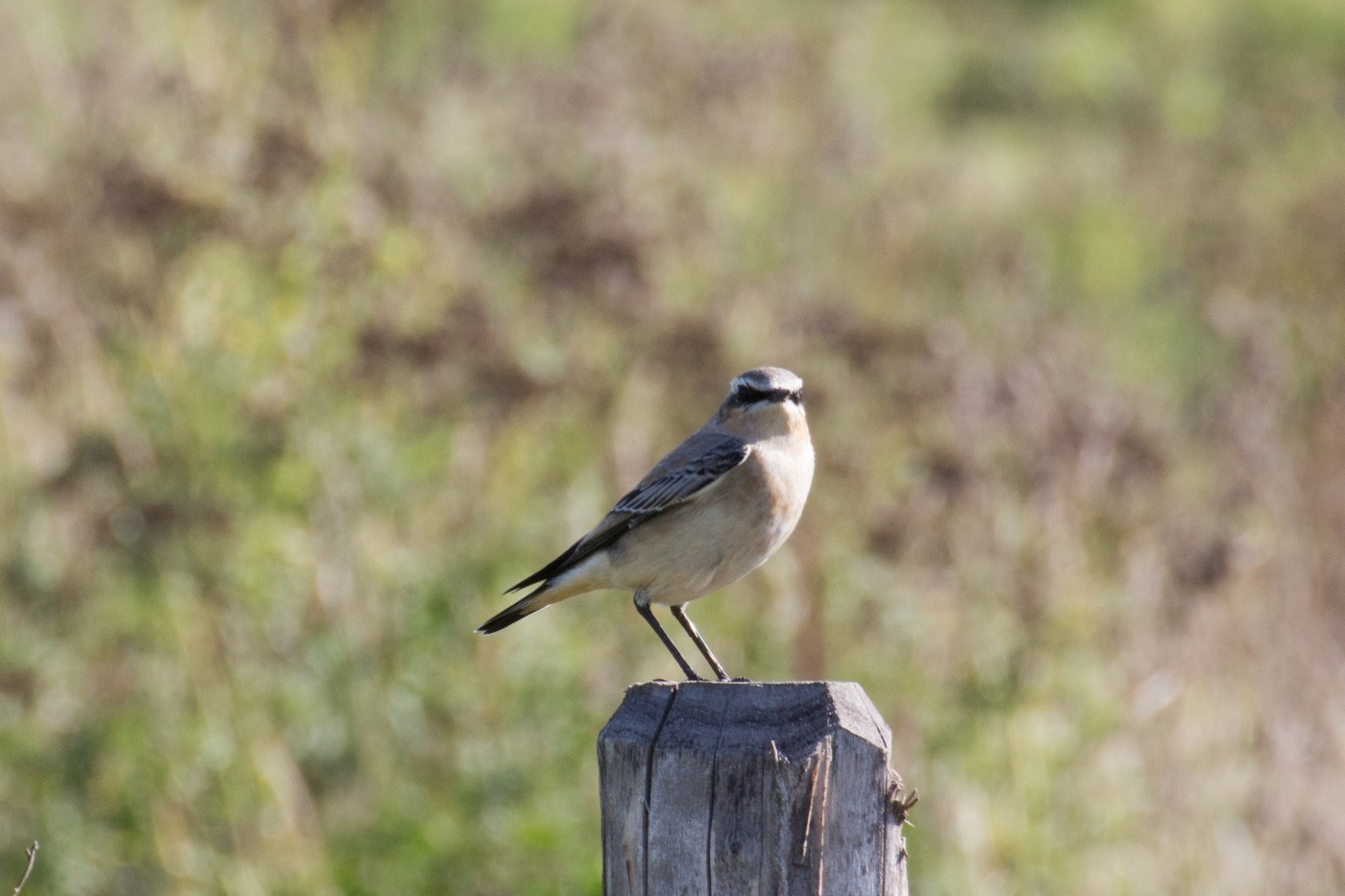
What Northern Wheatear Feathers Look Like
The Northern Wheatear is a small, ground-loving relative of the Old World flycatchers famous for one of the longest migrations of any songbird its size — and its tail feathers carry a pattern that is almost as distinctive as a fingerprint.
- Upperpart feathers: soft gray-buff to blue-gray (breeding males show the bluest tone), unmarked and smooth
- Facial feathers: a black mask through the eye, bordered above by a white supercilium (eyebrow stripe) — bold and crisp in breeding males, more muted and buffy in females and non-breeding birds
- Underparts: warm buffy-orange wash across the breast fading to whitish on the belly
- Rump feathers: bright white — one of the most conspicuous features in flight
- Tail feathers: white at the base with a bold black terminal band forming an inverted "T" or anchor shape when the tail is fanned — this pattern is the single best diagnostic feature; an individual outer tail feather will show white on the basal two-thirds and black only at the tip
- Wing feathers: blackish-brown, unmarked, contrasting against the paler body
Step-by-Step: Is This Feather From a Northern Wheatear?
- Check any tail feather first. White at the base transitioning to a solid black tip is close to diagnostic for this genus; if you can see the fanned "T" or anchor shape across multiple tail feathers together, that clinches it.
- Look for a white rump feather. Bright white rump feathers paired with the tail pattern strongly support Wheatear.
- Examine facial feathers for a mask. A black mask bordered by a white eyebrow stripe, especially crisp and contrasty, suggests a breeding male.
- Assess breast color. A warm buffy-orange wash fading to white belly is consistent with this species across sexes and seasons.
- Consider overall build. Small, upright-postured songbird feathers, similar in scale to a bluebird's smaller relatives.
Similar Species & How to Tell Them Apart
- Other wheatear species (e.g., Black-eared Wheatear, Pied Wheatear, found in parts of Eurasia/Africa where ranges may overlap): share the same basic white-rump, black-tipped-tail pattern common to the whole genus, but differ in how much black extends up the mask, throat, and back — Northern Wheatear's mask is more restricted, not extending onto the throat, and its back stays gray-buff rather than turning black.
- Bluebirds (Eastern/Western/Mountain): also show blue tones and buffy breasts in some plumages, but lack the black mask and the white-rump/black-tipped-tail pattern entirely.
- Shrikes: also show a black mask, but shrikes are larger with hooked bills and lack the wheatear's white rump and black-tipped tail combination.
Where & When You'll Find Them
Northern Wheatears breed across a vast circumpolar range including Arctic and subarctic tundra, rocky uplands, and open ground from the British Isles across Europe and Asia, and also breed in Arctic North America (Alaska, northern Canada, and Greenland) and even far northeastern Canada, all populations of which make one of the most extraordinary migrations of any small songbird — some individuals fly nonstop over open ocean for thousands of kilometers to reach wintering grounds in sub-Saharan Africa. Because of this, feathers found in North America are almost entirely restricted to Arctic and subarctic breeding areas during the short summer breeding season, while feathers found across Europe, the Middle East, and Africa may reflect breeding, migration stopover, or wintering activity depending on season. The complete molt occurs mostly before or during migration, so worn breeding feathers give way to fresher ones by the time birds reach African wintering grounds.
Frequently asked questions
What's the single best clue for identifying this species from a feather?
A tail feather that is white at the base with a solid black tip, forming an inverted T or anchor shape when several tail feathers are seen together, is close to diagnostic for the wheatear group.
How do I tell Northern Wheatear apart from other wheatear species?
Compare how far the black mask and throat coloring extend — Northern Wheatear keeps a relatively restricted mask that doesn't reach the throat or back, while several related species show more extensive black across the face, throat, or back.
Why is this species associated with such long migrations?
Northern Wheatear breeds across a huge circumpolar and even Arctic North American range, but nearly the entire global population winters in sub-Saharan Africa, forcing some populations to fly extraordinary nonstop distances over ocean and desert.
Does the white rump help confirm identification?
Yes — a bright white rump feather combined with the black-tipped tail pattern is a strong supporting pair of clues, since this rump flash is very conspicuous in the field as well.
When would I find this species' feathers in North America specifically?
Almost entirely during the brief Arctic and subarctic breeding season in summer, since North American breeding populations migrate all the way to Africa for winter rather than remaining in the Americas.