
How to Identify Oak Titmouse Feathers
A guide to identifying the plain gray, crested feathers of the Oak Titmouse and separating it from chickadees, Bushtit, and Juniper Titmouse.
Read the full Oak Titmouse encyclopedia entry →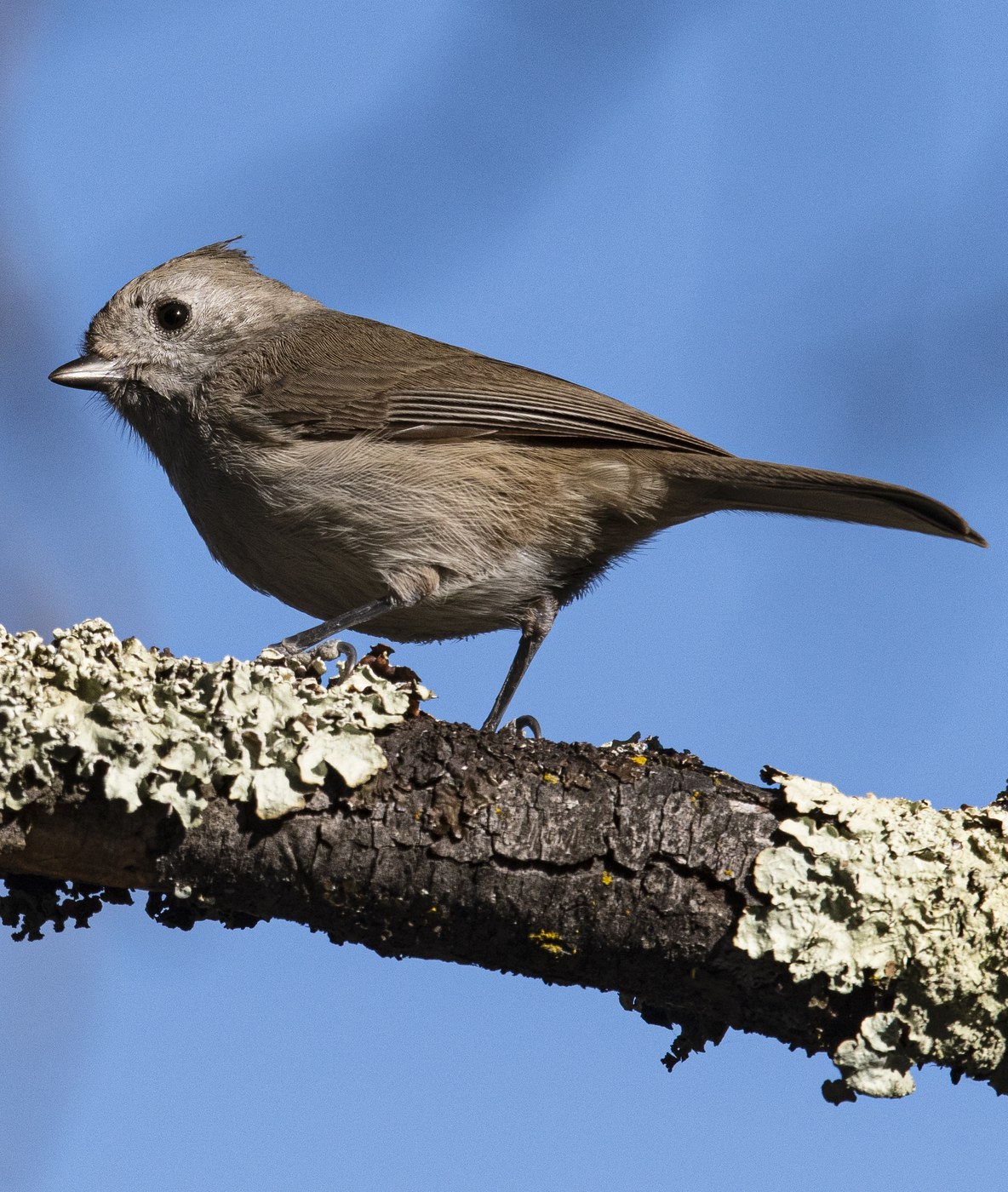
What Oak Titmouse Feathers Look Like
The Oak Titmouse is intentionally unremarkable — a small, soft gray-brown bird whose main claim to a distinctive feature is a small crest that immediately narrows down the identification possibilities.
- Body feathers: uniform grayish-brown above, paler buffy-gray below, with a warm buffy wash on the flanks — no streaking, spotting, or barring anywhere
- Crest feathers: small, pointed crown feathers capable of being raised into a short peak — the presence of any crest at all on a small, plain gray-brown bird narrows the field considerably among common backyard songbirds
- Wing and tail feathers: plain grayish-brown, unmarked, with no wing bars and no white edging
- Overall feather texture: soft and fluffy-looking, typical of a small non-migratory woodland songbird
- Bill-related feathers: short, stubby bill base bristles if a skin fragment is present, consistent with a seed-and-insect generalist
Step-by-Step: Is This Feather From an Oak Titmouse?
- Check for a crest. If you can find a crown feather with a pointed, slightly elongated shape suggesting a small peak, that's the most useful single clue — rules out chickadees and Bushtit immediately.
- Confirm plain, unmarked coloring. No streaks, spots, wing bars, or facial pattern on any body feather fits this deliberately plain species.
- Check for a buffy wash on the flanks. A warm, subtly buffy tone on the sides (rather than pure gray or white) supports Oak Titmouse.
- Assess size. Small, but slightly larger and less delicate than a Bushtit's tiny feathers.
- Consider habitat/location context. Found specifically in California or southern Oregon oak woodland strongly favors Oak Titmouse over its close relative Juniper Titmouse, whose range lies farther east and inland.
Similar Species & How to Tell Them Apart
- Juniper Titmouse: nearly identical in every feather feature — same plain gray-brown color, same small crest — and the two species are essentially indistinguishable by feather alone; range is the deciding factor, since Juniper Titmouse occupies pinyon-juniper woodland in the Great Basin and interior Southwest, while Oak Titmouse sticks to California and southern Oregon oak woodland, with very little range overlap.
- Black-capped and Mountain Chickadees: both show a bold black cap and bib contrasting with white cheeks, and neither has any crest at all — an easy distinction.
- Bushtit: much tinier overall with a notably long, thin tail and no crest whatsoever; also lacks any buffy flank wash.
- Verdin: has a yellow head/face in adults and a more grayish body without a crest, found more in desert scrub than oak woodland.
Where & When You'll Find Them
Oak Titmice are non-migratory residents of oak woodland and oak-chaparral habitat across California and a small part of southern Oregon, rarely straying from wooded areas dominated by oaks, where they forage on insects, acorns, and seeds year-round and often visit backyard feeders in suburban areas built within their woodland range. Because the species does not migrate, feathers can be found in any month, with the largest amount of feather turnover following the complete post-breeding molt in mid-to-late summer. Old nest cavities in oak snags and the ground beneath backyard feeders in oak-woodland neighborhoods are both good places to check for shed feathers.
Frequently asked questions
What's the single best clue for identifying this species?
The presence of any small crest on an otherwise plain gray-brown feather is the strongest clue, since it immediately rules out crestless species like chickadees and Bushtit.
Can I reliably tell this apart from Juniper Titmouse by feather alone?
Not really — the two species are nearly identical in plumage, so location is the most useful separator: Oak Titmouse occupies California/southern Oregon oak woodland, while Juniper Titmouse occupies pinyon-juniper habitat farther east and inland.
How do I rule out a chickadee quickly?
Check for a black cap and bib with white cheeks — chickadees have this bold facial pattern and no crest at all, while Oak Titmouse is uniformly plain gray-brown with a small crest.
Does this species migrate?
No, it's a non-migratory year-round resident of oak woodland, so feathers can be found in any season near suitable habitat.
Where's a good place to look for its feathers?
Near old nest cavities in oak snags and beneath backyard bird feeders located within oak-woodland neighborhoods, since this species readily visits feeders close to its home range.