
How to Identify Olive Sparrow Feathers
A guide to identifying the striped-crown feathers of the Olive Sparrow and separating it from towhees and other South Texas brushland sparrows.
Read the full Olive Sparrow encyclopedia entry →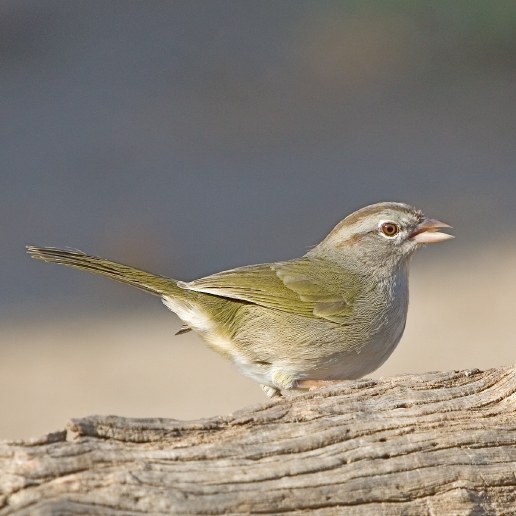
What Olive Sparrow Feathers Look Like
A skulking brushland specialist of South Texas and Mexico, the Olive Sparrow carries a subtle but distinctive head-stripe pattern that stands out once you know where to look.
- Upperpart feathers: plain olive-brown, unmarked and unstreaked across the back — deliberately drab for a bird that spends most of its time hidden in dense thorn-scrub
- Crown feathers: the most useful diagnostic feature — dark brown to chestnut lateral crown stripes flanking a paler grayish-olive central crown stripe, forming a clear three-part striped pattern on the top of the head
- Underpart feathers: plain grayish-white, unstreaked, with a faint olive wash on the sides
- Face feathers: fairly plain overall, without a bold eye-line, eye-ring, or malar stripe — the head pattern is essentially all about the crown stripes rather than the face
- Wing and tail feathers: olive-edged, unmarked, with no wing bars
- Bill-related feathers: a stout, conical seed-eating bill base, if a skin fragment is present, consistent with a sparrow
Step-by-Step: Is This Feather From an Olive Sparrow?
- Check any crown feather for striping. A dark brown/chestnut lateral stripe next to a paler grayish-olive central stripe is close to diagnostic for this species among South Texas brushland birds.
- Confirm plain, unstreaked upperparts and underparts. No streaking on the back or breast, just smooth olive-brown fading to grayish-white, supports Olive Sparrow.
- Look for a fairly plain face. Absence of a bold eye-line, eye-ring, or dark malar stripe helps separate this from several sparrow relatives with busier facial patterns.
- Assess overall size and bill shape. A stout, sparrow-type conical bill base with medium-small body feathers fits this species.
- Consider habitat context. Found in dense thorn-scrub of South Texas or northeastern Mexico strongly favors Olive Sparrow given its restricted range.
Similar Species & How to Tell Them Apart
- Green-backed Sparrow (and other Arremonops relatives farther south): very similar overall pattern; ranges mostly don't overlap with Olive Sparrow, which is more northerly (South Texas into eastern Mexico), so location is often the deciding factor.
- Canyon Towhee / California Towhee: both larger, plainer grayish-brown birds without the distinctive crown striping, and generally found in different habitat and range (Canyon Towhee overlaps somewhat in Texas but favors more open, rocky terrain than Olive Sparrow's dense brush).
- Rufous-crowned Sparrow: has a solid, unstriped rufous cap (rather than a striped crown) and a distinct dark malar stripe bordering a pale throat, quite different from Olive Sparrow's plain face and three-part crown stripe.
- Green Jay (loose color association only): much larger, brightly colored, and structurally entirely different — included only because it shares South Texas brushland habitat, not because of any real feather similarity.
Where & When You'll Find Them
Olive Sparrows are year-round residents of dense thorn-scrub and brushland in South Texas's Rio Grande Valley, extending south through eastern Mexico and into parts of Central America, where they forage on or near the ground under thick cover and are notoriously difficult to observe despite being fairly common within their narrow habitat. The species is non-migratory, remaining resident on territory throughout the year, so feathers can be found in any season within suitable brush habitat. The greatest feather turnover follows the post-breeding molt in mid-to-late summer, and the dense, low thorn-scrub understory this species favors for nesting and foraging is the most productive place to search, since Olive Sparrows rarely venture into open or more manicured habitat.
Frequently asked questions
What's the single best clue for identifying this species?
A crown feather showing a dark brown or chestnut lateral stripe bordering a paler grayish-olive central stripe is close to diagnostic for Olive Sparrow among South Texas brushland birds.
How do I rule out Rufous-crowned Sparrow?
Check whether the crown is striped (three distinct sections, as in Olive Sparrow) or a solid unstriped rufous cap paired with a dark malar stripe (as in Rufous-crowned Sparrow) — the two head patterns are quite different once compared.
Why is this species so hard to observe in the field?
Olive Sparrows are dense thorn-scrub skulkers that forage low to the ground under thick cover and rarely venture into open habitat, making both the bird and its feathers easy to overlook despite being fairly common locally.
Does this species migrate?
No, it's a non-migratory year-round resident within its limited South Texas and eastern Mexico range, so feathers can be found in any season within suitable brush habitat.
Where should I search for its feathers?
Within dense, low thorn-scrub understory used for nesting and foraging, since this species rarely strays into open or manicured habitat where feathers might be easier to spot.