
How to Identify Passerini's Tanager Feathers
A guide to identifying the black-and-red male and olive-toned female feathers of Passerini's Tanager, a common Central American songbird, and separating it from similar red-rumped tanagers.
Read the full Passerini's Tanager encyclopedia entry →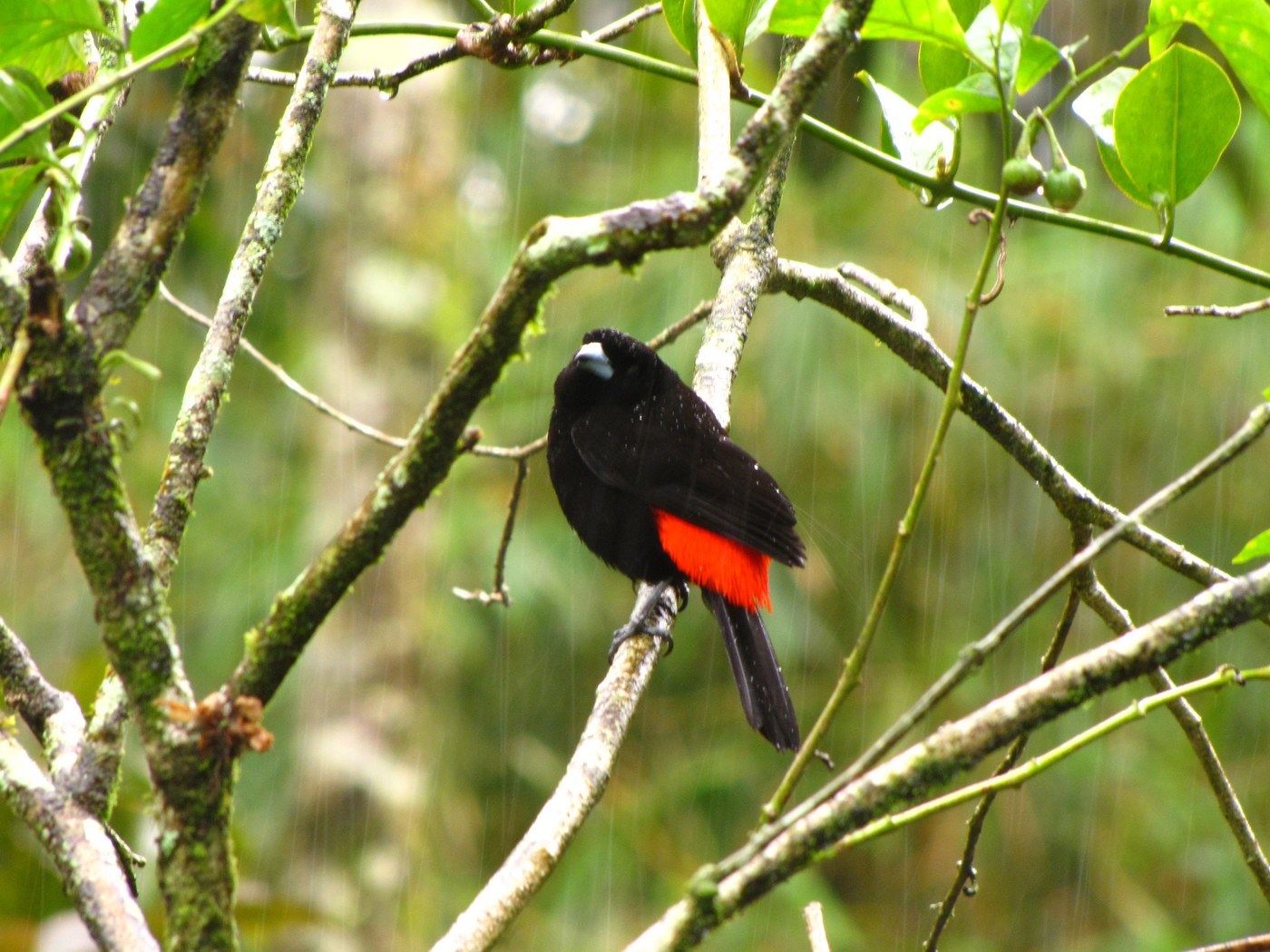
What Passerini's Tanager's Feathers Look Like
Passerini's Tanager feathers show a bold, two-tone pattern in adult males: body feathers are mostly deep glossy black, with a bright scarlet-red rump and lower back patch that stands out sharply against the black, plus red feathering that can extend onto the shoulder area in some individuals. This black-and-red combination is clean and high-contrast, without any blending or intermediate tones. Females are entirely different — a soft, warm olive-brown to yellowish-olive overall, darker above and slightly paler and more yellow-toned below, with no black or red at all. Flight feathers on males are black with little to no red, since the color is concentrated on the rump and back rather than the wings, while female flight feathers are a plain dusky olive-brown. Feathers are small to medium for a tanager, typically 6–8 cm for flight feathers, with a soft, smooth texture typical of a fruit-eating songbird.
Step-by-Step: Is This Feather From a Passerini's Tanager?
- Check for black-and-red rump contrast. A glossy black feather paired with a bright scarlet rump/lower-back feather is a strong male indicator.
- If plain olive, consider a female. Warm olive-brown to yellowish-olive feathers with no black or red fit a female or immature bird.
- Note where the red is concentrated. Red confined to the rump and back (not the throat, face, or wings) is typical of this species.
- Measure size. A 6–8 cm flight feather length fits a mid-sized tanager.
- Match habitat. A black-and-red or olive tanager feather found in Caribbean-slope lowland forest edge or second growth in Central America supports this identification.
Similar Species & How to Tell Them Apart
The closest look-alike is the Crimson-collared Tanager, found in overlapping parts of Central America, which also shows black-and-red plumage but with the red concentrated as a collar around the neck and upper breast rather than the rump — an important difference in red placement. Cherrie's Tanager, a close relative found on the Pacific slope where Passerini's occupies the Caribbean slope, is nearly identical in plumage (they were once considered the same species), so range is the most reliable separator between the two: Caribbean slope points to Passerini's, Pacific slope to Cherrie's. Female Passerini's Tanager feathers, being plain olive, can be confused with various female euphonias or other female tanagers, but the slightly larger size and more uniformly olive (rather than gray-olive) tone help narrow it down. If you have a black feather with red confined specifically to the rump/lower back, and it was found on the Caribbean slope of Central America, Passerini's Tanager is the strongest candidate.
Where & When You'll Find Them
Passerini's Tanagers are common residents of forest edges, second growth, plantations, and gardens on the Caribbean slope of Central America, from eastern Honduras through Costa Rica and into western Panama, favoring semi-open and disturbed habitats over deep forest interior. As a non-migratory resident species, feathers can be found year-round, with no seasonal migration to account for. The best time to search is during the breeding season, which generally runs through the wetter months, when pairs are actively nesting in low shrubby vegetation and more prone to losing feathers during nest-building and chick-rearing. Search along forest edges, roadside vegetation, banana and cacao plantations, and garden shrubbery on the Caribbean side of Central America, where this species is a familiar and conspicuous presence.
Frequently asked questions
What is the key clue for a male Passerini's Tanager feather?
Glossy black body feathers combined with a bright scarlet-red patch concentrated on the rump and lower back, a clean high-contrast pattern distinct from other black-and-red tanagers.
How does this differ from Crimson-collared Tanager?
Crimson-collared Tanager has its red concentrated as a collar around the neck and upper breast, while Passerini's Tanager's red is on the rump and lower back — the placement of red is the key difference.
How do I distinguish it from Cherrie's Tanager?
The two are nearly identical in plumage since they were once considered the same species, so geographic range is the most reliable clue: Caribbean slope favors Passerini's, Pacific slope favors Cherrie's.
What do female feathers look like?
Plain warm olive-brown to yellowish-olive overall, with no black or red patterning at all, quite different from the bold male plumage.
Where should I search for these feathers?
Along forest edges, second growth, plantations, and garden shrubbery on the Caribbean slope of Central America, from Honduras through Costa Rica into western Panama.