
How to Identify Peach-faced Lovebird Feathers
A guide to recognizing the grass-green body feathers, peach-pink face plumage, and cobalt-blue rump patch that mark a feather as coming from a Peach-faced Lovebird.
Read the full Peach-faced Lovebird encyclopedia entry →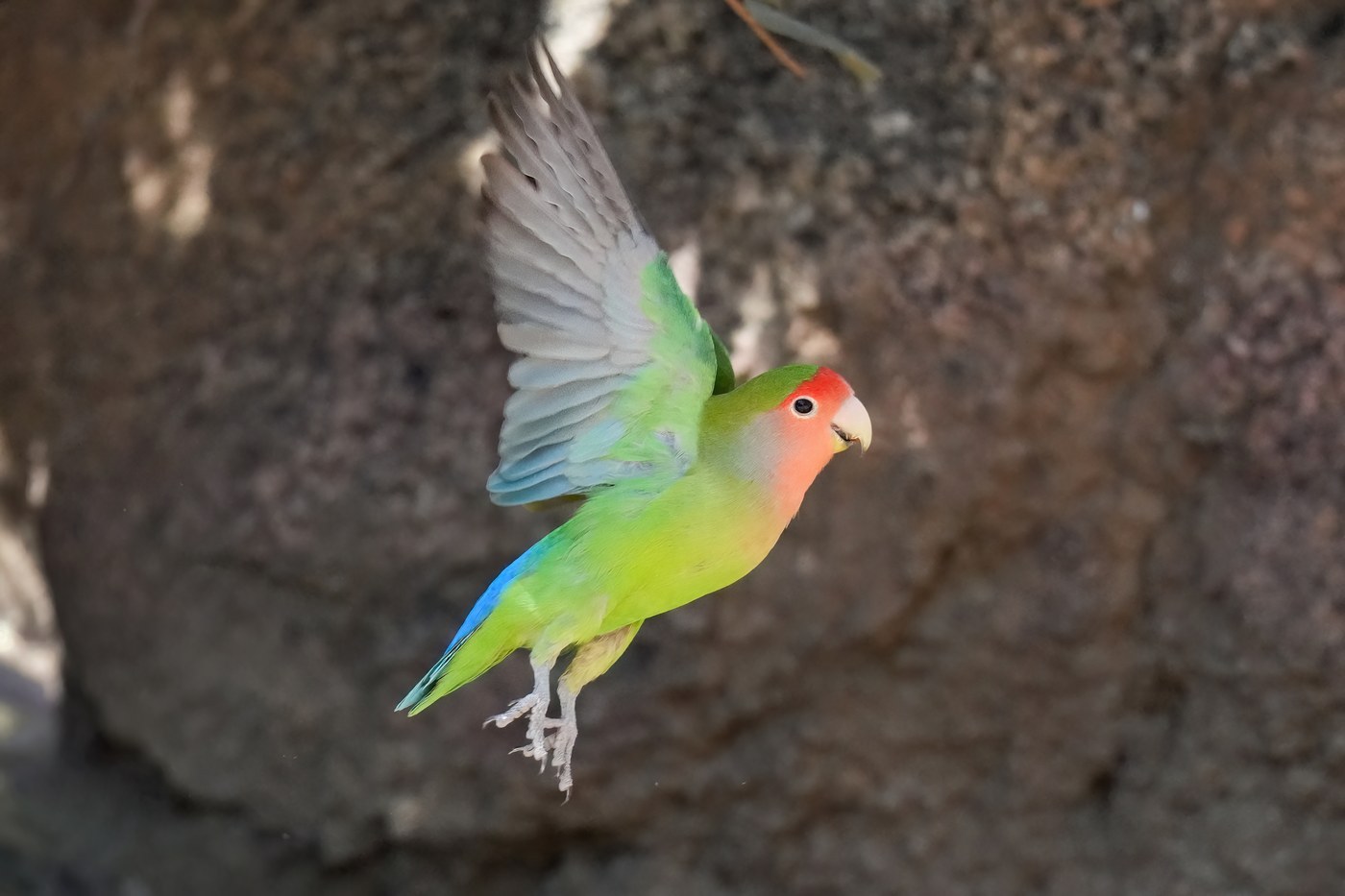
What Peach-faced Lovebird Feathers Look Like
Peach-faced Lovebirds are small, stocky parrots (about 15 cm long), and nearly every contour feather on the body is a bright grass-green with a slightly yellow cast on the underparts. The standout diagnostic feathers are on the face and rump:
- Face and throat feathers are a warm salmon-peach to rosy-pink, fading to green on the crown and nape
- Rump feathers are a bright, almost electric cobalt-blue — this patch is unique among common green parrots and is the single best clue
- Flight feathers (primaries/secondaries) are green with blackish tips, short and rounded rather than long and pointed
- Tail feathers are green with a black subterminal band and blue tips on the central pair Feathers are small overall — flight feathers run roughly 6-9 cm, body feathers 1-3 cm — with a soft, slightly waxy sheen typical of parrot plumage.
Step-by-Step: Is This Feather From a Peach-faced Lovebird?
- Check the color first. If the feather is bright grass-green with no gray or brown, you're in the right family.
- Look for peach or salmon-pink coloring on any part of the feather — this is present only on face/throat feathers and rules out most other green parrots if present.
- Look for a bright blue rump feather. A vivid cobalt-blue contour feather from the lower back is one of the most reliable single clues.
- Measure the feather. Anything under about 9 cm with rounded (not sharply pointed) tips fits this small parrot.
- Consider location. Lovebirds are cage birds; feathers found near homes, aviaries, or (in the US) feral colonies around Phoenix, Arizona are strong circumstantial evidence.
Similar Species & How to Tell Them Apart
- Fischer's Lovebird: also green-bodied with a blue rump, but the face is orange-red fading to a distinct yellow collar rather than peach — Fischer's lacks the soft peach wash blending gradually into green.
- Masked Lovebird: has a solid dark brown-black face/head, never peach or pink, with a yellow collar and green body.
- Budgerigar: similarly small and green in wild-type color, but budgies show fine black scalloping on the nape/back and lack any blue rump or peach face.
- Rose-ringed (Ring-necked) Parakeet: much larger with long pointed central tail feathers (25+ cm) and no peach face, easily ruled out on size and tail shape alone.
Where & When You'll Find Them
In the wild, Peach-faced Lovebirds are native to the arid scrub and rocky canyons of southwestern Africa (Namibia, Angola, and adjacent South Africa), where they nest in weaver nests and cliff crevices. As a popular cage bird, they are also found worldwide near aviaries, pet stores, and in established feral populations such as the well-known colony in the Phoenix, Arizona metro area. Feathers turn up year-round near cages and feeders since captive and feral birds molt on an irregular schedule rather than a strict seasonal one, with body feather replacement happening gradually throughout the year and flight feathers molted in sequence roughly annually.
Frequently asked questions
What is the single best clue that a feather is from a Peach-faced Lovebird?
A bright cobalt-blue rump feather combined with grass-green body color and any peach-pink coloring on the face or throat.
Could a green feather with no peach coloring still be from this species?
Yes — most of the body is plain green, so a green feather alone isn't diagnostic; look for the blue rump patch or any peach-toned feathers nearby to confirm.
How can I rule out a Budgerigar?
Budgerigar feathers show fine black scalloped barring on the back and nape and never show a blue rump or peach face color.
Are Peach-faced Lovebird feathers found in the wild in the US?
Yes, in and around Phoenix, Arizona, where an established feral population lives year-round.
Do male and female feathers look different?
No, the sexes are nearly identical in plumage, so feather color alone cannot reliably indicate sex.
Peach-faced Lovebird identified by the community
Recent Peach-faced Lovebird feathers identified with Feather Identifier.


