
How to Identify Plumbeous Vireo Feathers
A guide to the all-gray upperparts and bold white spectacles that separate Plumbeous Vireo feathers from Blue-headed and Cassin's Vireos.
Read the full Plumbeous Vireo encyclopedia entry →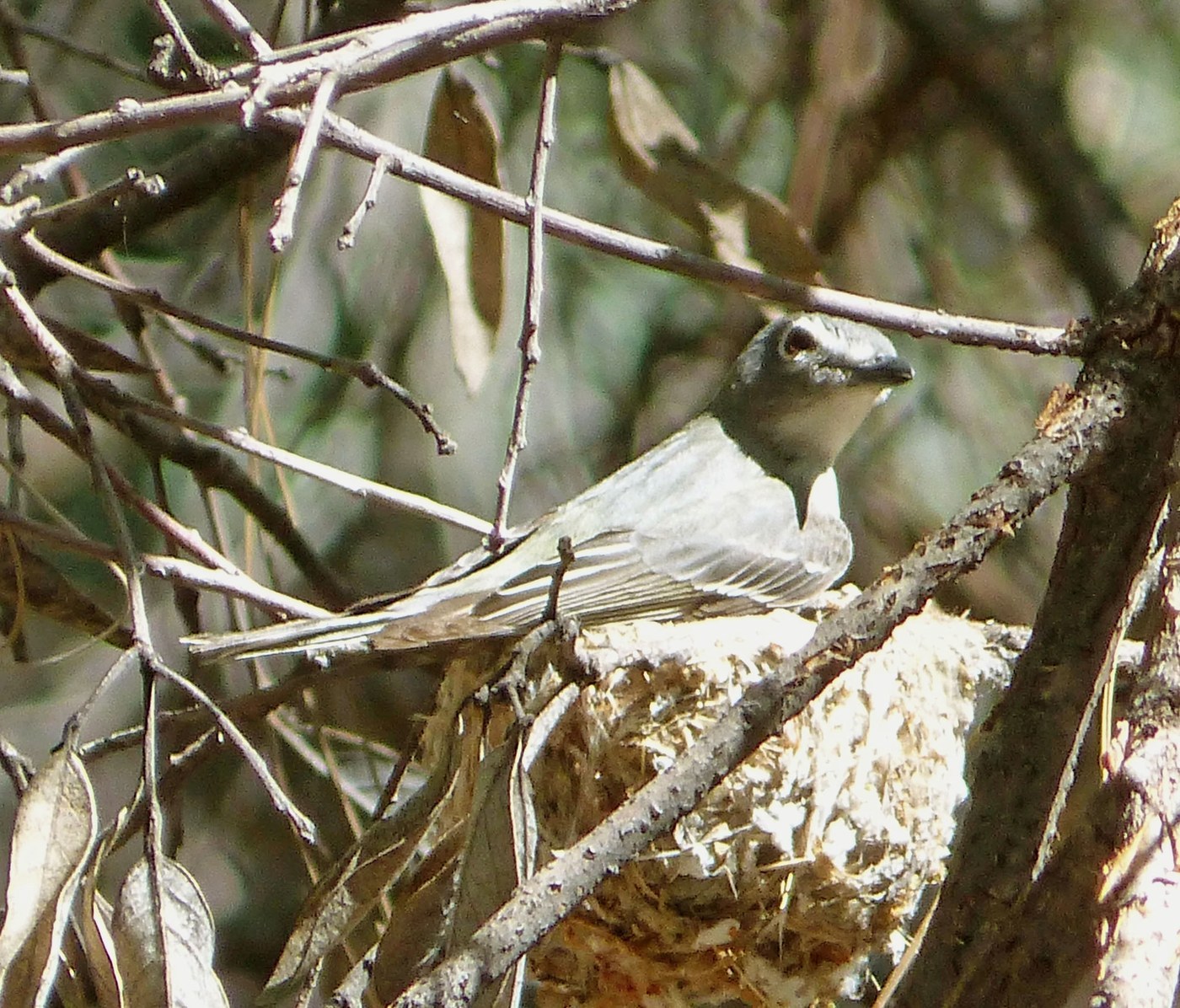
What Plumbeous Vireo Feathers Look Like
Plumbeous Vireo is a medium songbird whose upperpart feathers are a uniform gray with no olive or green wash at all — "plumbeous" again meaning lead-gray — a key point that separates it from its eastern relative, Blue-headed Vireo, and other vireos in its range. Head feathers are gray with bold white spectacles (a broken white eye-ring plus a short white line to the bill), visible if facial feathers are found together. Wing covert feathers show two crisp white wing bars against the gray wing. Underparts feathers are white to pale gray, clean and essentially unmarked, sometimes with a faint gray wash on the flanks. Tail feathers are gray with narrow white edges on the outer feathers. Overall feather texture is fairly stout and heavy for a small songbird, typical of vireos, with flight feathers around 2.5-2.75 inches.
Step-by-Step: Is This Feather From a Plumbeous Vireo?
- Check color saturation. Entirely gray upperparts with no green or yellow tint anywhere — this single check eliminates most other vireos, which show at least some olive or yellow.
- Check facial pattern. Bold white spectacles (eye-ring plus a short supraloral line) on head feathers, if present.
- Check wing bars. Two clean white bars on an otherwise plain gray wing.
- Check underparts. Clean white to pale gray, essentially unstreaked.
- Compare feather stoutness. Noticeably thicker and heavier than a warbler feather of similar length, consistent with vireo build.
Similar Species & How to Tell Them Apart
Blue-headed Vireo has a very similar spectacled pattern and wing bars, but shows an olive-green wash on the back and flanks and a blue-gray (not plain gray) head with more contrast — any hint of green anywhere on the body feathers should point toward Blue-headed instead. Cassin's Vireo is intermediate in appearance, and its range overlaps with Plumbeous in parts of the interior West; Cassin's shows a faint olive tinge on the back that Plumbeous entirely lacks, making the "any green at all" test the most useful field mark, even on isolated feathers. Gray Vireo is also plain gray but smaller, with a much fainter or single indistinct wing bar rather than two crisp bars, and a thinner white eye-ring without the full spectacled look.
Where & When You'll Find Them
Plumbeous Vireo breeds in dry montane pine-oak and pinyon-juniper woodlands of the interior western U.S. and Mexico's highlands, migrating to Mexico and Central America for winter. Feathers are most likely found in these coniferous or pine-oak woodlands during the breeding season, late spring through summer, when birds are molting after nesting, and along migration stopover woodlands in fall as birds move south.
Frequently asked questions
What's the fastest way to rule out other similar vireos?
Check for any olive or green tint on the body feathers — Plumbeous Vireo is purely gray, while Blue-headed and Cassin's Vireos both show at least a hint of olive.
How many wing bars should I see?
Two crisp white wing bars on an otherwise plain gray wing.
How is this different from Gray Vireo?
Gray Vireo is smaller with a much fainter single wing bar and a less complete eye-ring, while Plumbeous shows two bold bars and a full spectacled face pattern.
When is molt likely to produce loose feathers?
During and just after the breeding season, late spring into summer, in pine-oak and pinyon-juniper woodlands of the interior West.