
How to Identify Prairie Warbler Feathers
A guide to the yellow underparts with flank streaking and bold facial crescent that identify Prairie Warbler feathers among scrubland warblers.
Read the full Prairie Warbler encyclopedia entry →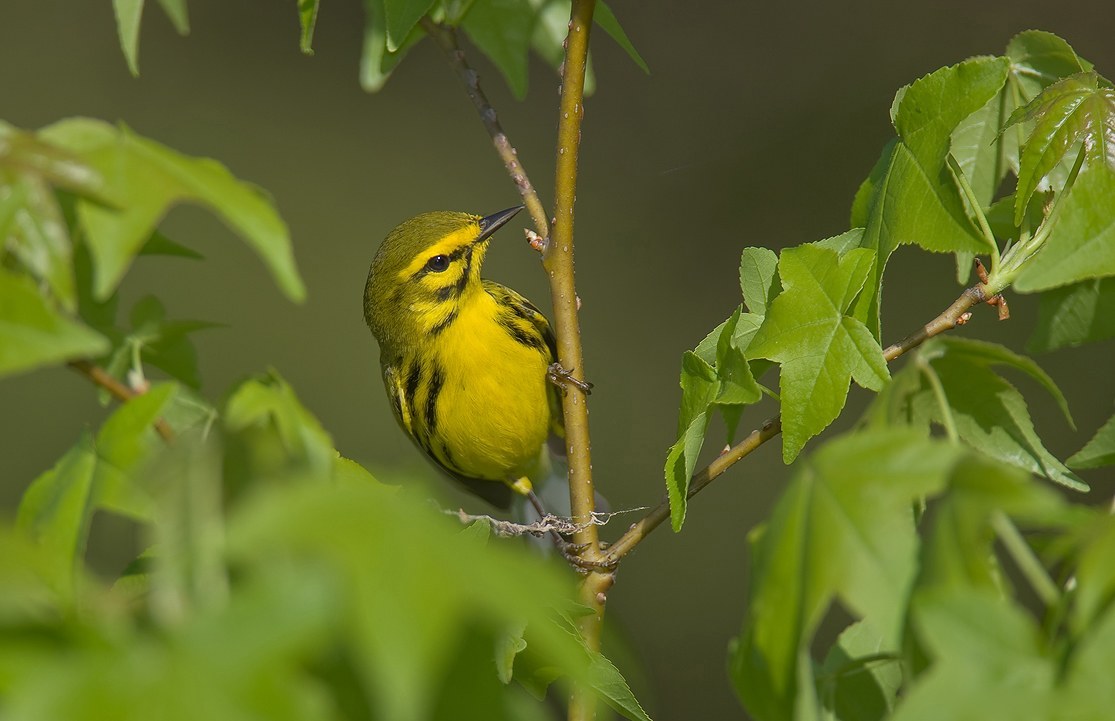
What Prairie Warbler Feathers Look Like
Prairie Warbler is a small warbler whose underpart feathers are bright yellow with bold black streaking confined mainly to the sides and flanks, forming a somewhat necklace-like pattern of streaks framing the yellow breast. Face feathers are yellow with a black eyeline extending back from the eye and a black crescent-shaped mark below the eye — together these create a distinctive facial pattern on isolated face feathers. Upperpart and back feathers are olive-green, usually with faint reddish-chestnut streaking visible at close range, often only apparent in good light or fresh plumage — a genus-level rarity among warblers with otherwise unstreaked backs, making this a useful secondary check. Wing feathers are dark, edged olive, with two faint yellowish-white wing bars, notably fainter and less crisp than in many other warblers. Tail feathers are dark olive-brown with white patches near the tips of the outer feathers, and flight feathers run about 1.9-2.2 inches.
Step-by-Step: Is This Feather From a Prairie Warbler?
- Check underparts. Bright yellow with black streaking concentrated on the sides and flanks rather than spread evenly across the breast.
- Check face feathers for a black eyeline plus a distinct crescent mark below the eye, a fairly bold, contrasty facial pattern for such a small bird.
- Check back feathers closely for faint chestnut streaking on an olive ground, subtle but present in good-condition feathers.
- Check wing bars. Present but faint and indistinct, unlike bolder-barred warblers.
- Measure. Small warbler flight feathers, under about 2.2 inches.
Similar Species & How to Tell Them Apart
Kentucky Warbler is also yellow below, but has a solid black facial "sideburn" pattern and a plain, unstreaked olive back and unstreaked yellow underparts, quite different from Prairie's streaked flanks and back. Palm Warbler has yellow underparts with fine streaking too, but shows a rufous cap, constantly bobs its tail, and has a warmer brown back tone rather than olive-green. Yellow Warbler has an essentially unstreaked back, with reddish streaking (in males) confined to the breast and underparts rather than the flanks-only pattern of Prairie Warbler, and lacks the black facial crescent mark.
Where & When You'll Find Them
Prairie Warbler breeds in scrubby, early-successional habitat across the eastern U.S. — old fields, forest clearcuts, pine barrens, and mangrove edges in Florida — then winters mainly in the Caribbean and Central America. Feathers are most likely found in scrubby breeding habitat from late spring through summer, during and after the nesting molt, and along the Atlantic and Gulf coasts during migration stopovers in spring (April-May) and fall (August-September) as birds move to and from wintering grounds.
Frequently asked questions
What's the most distinctive facial feature to check?
A black eyeline combined with a separate black crescent mark below the eye, together forming a fairly bold facial pattern for such a small warbler.
Is the back streaked or plain?
Faintly streaked with chestnut on an olive ground - subtle, but a genuine feature to check in good-condition feathers, unlike most yellow-breasted warblers with plain backs.
How do I tell this apart from Yellow Warbler?
Prairie Warbler's black streaking is confined to the flanks and sides (not spread across the breast) and it shows a distinct facial crescent mark that Yellow Warbler lacks.
What habitat should I search for feathers in?
Scrubby early-successional habitat like old fields, clearcuts, and pine barrens during the breeding season, or coastal habitats during spring and fall migration.