
How to Identify Purple-rumped Sunbird Feathers
A close look at the tiny, iridescent feathers of the Purple-rumped Sunbird, including its namesake rump patch, and how to separate it from other South Asian sunbirds.
Read the full Purple-rumped Sunbird encyclopedia entry →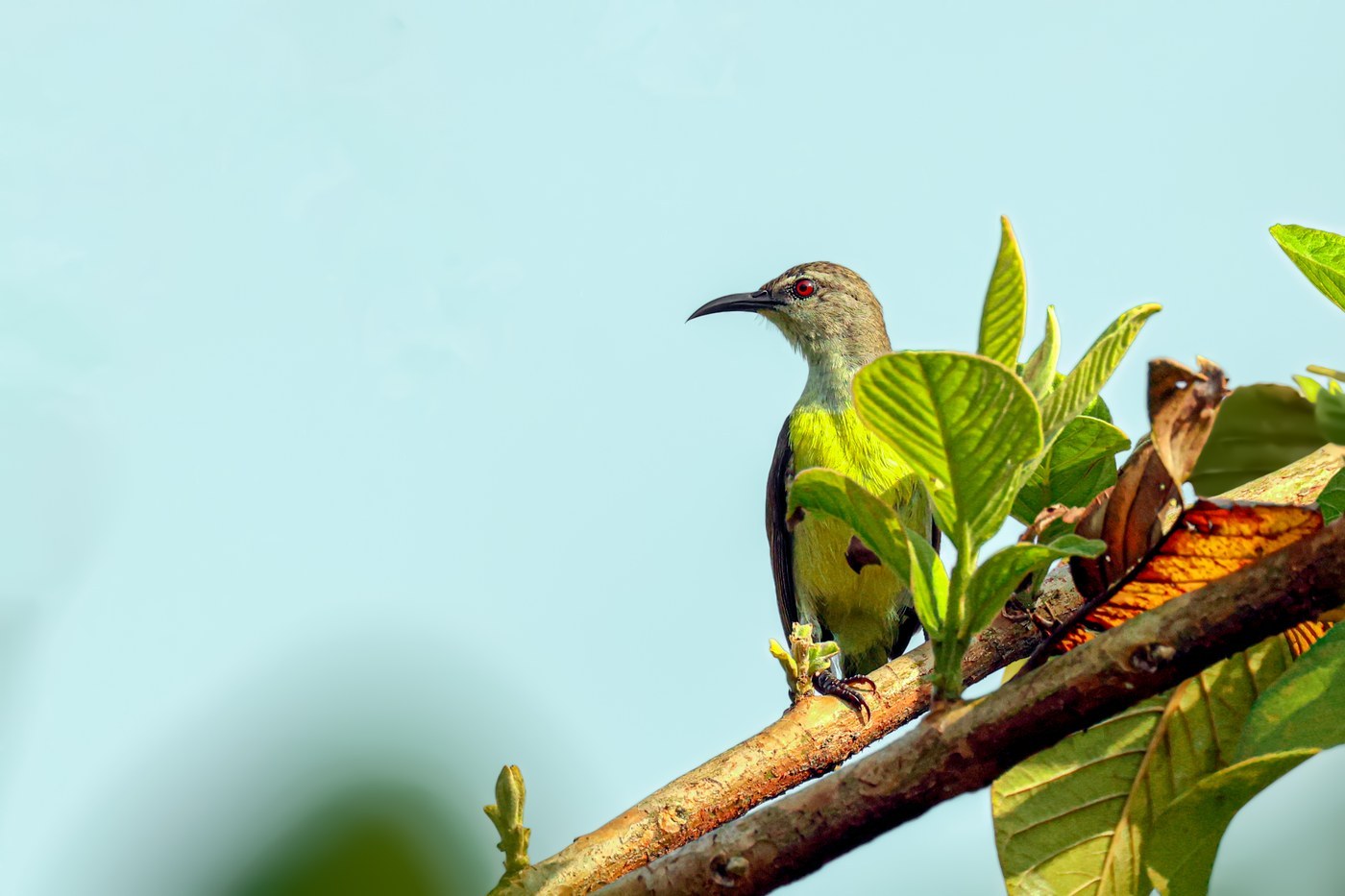
What Purple-rumped Sunbird's Feathers Look Like
This is one of the smallest birds you're likely to find a feather from, and every feather is correspondingly tiny:
- Rump feathers: the diagnostic feature — a small, brilliant, iridescent violet-purple patch just above the tail base on adult males, visible even as a single loose feather in good light.
- Back and crown feathers (male): deep maroon to purplish-brown with a metallic sheen, especially on the crown and mantle.
- Throat feathers (male): dark maroon-red, iridescent, bordered below by a narrow iridescent blue-green band across the upper breast.
- Underparts feathers: bright yellow on the belly, contrasting sharply with the darker throat.
- Female feathers: much plainer — olive-brown above, pale yellowish below, with no iridescence and no purple rump patch, making female feathers much harder to pin to species.
- Size: even the largest contour feathers rarely exceed 2 cm; flight feathers are minute, under 4 cm, and delicate.
Step-by-Step: Is This Feather From a Purple-rumped Sunbird?
- Check the scale first. If the feather is smaller than a fingernail, you're in the right size range for any sunbird — this immediately rules out most other perching birds.
- Look for a violet iridescent patch. A tiny feather that flashes purple-violet in the light, rather than plain brown, strongly suggests the rump of a male Purple-rumped Sunbird.
- Check for a maroon throat with a blue-green band beneath it. This two-tone throat pattern is distinctive among sunbirds in its range.
- Note the yellow belly. Bright lemon-yellow underparts paired with a dark, glossy throat is a strong combination pointing to this species.
- Consider female/juvenile options. A plain olive-and-yellow feather with no shine could be a female or juvenile of this or a related sunbird species, and cannot be confirmed to species by color alone.
Similar Species & How to Tell Them Apart
- Purple Sunbird: Males are almost entirely iridescent blue-black to purple-black over the whole body (in breeding plumage), lacking the Purple-rumped's contrasting maroon-and-yellow combination.
- Loten's Sunbird: Similar maroon throat but with a longer, more curved bill (not a feather trait) and a duller, less contrasting rump; overall the purple rump patch of this species is smaller and less flashy.
- Olive-backed Sunbird: Shows an olive-green back rather than maroon, and its throat is metallic blue-black rather than maroon-red.
- Purple-throated Sunbird: Throat iridescence extends further down the breast, without the sharp yellow-belly contrast seen in Purple-rumped.
Where & When You'll Find Them
Purple-rumped Sunbirds are common garden and scrubland birds across peninsular India and Sri Lanka, often visiting flowering trees and hedges, so feathers are most often found in gardens, temple grounds, and forest edges rather than deep wilderness. Because the species breeds nearly year-round in much of its range with a fairly continuous molt, tiny feathers can turn up under favored feeding perches at almost any time of year, though slightly more often after the main breeding peaks.
Frequently asked questions
Can a single tiny feather really be identified to species?
For males, yes in many cases — the specific combination of maroon throat, blue-green band, and violet rump patch is distinctive enough that even one contour feather can point strongly to this species. Female feathers are much less diagnostic.
Why is the rump patch called 'purple' when it can look blue or pink?
Like most iridescent bird feathers, the color comes from microscopic structural layers rather than pigment, so the same feather can shift between violet, blue, and pink depending on the viewing angle and light source.
Do juveniles have any purple feathers at all?
Juveniles resemble females and lack iridescent purple feathers until they mature and molt into adult male plumage, so a young bird's feather will look plain and dull.
How is this different from an Olive-backed Sunbird feather?
Look at the back: Purple-rumped Sunbird shows maroon on the mantle while Olive-backed Sunbird shows greenish-olive, and the throat colors differ in the same way (maroon-red vs. blue-black).