
How to Identify Purple Sunbird Feathers
How to identify the deep iridescent black-purple feathers of a male Purple Sunbird versus the plain olive feathers of females, plus tips for spotting the male's eclipse-plumage clue.
Read the full Purple Sunbird encyclopedia entry →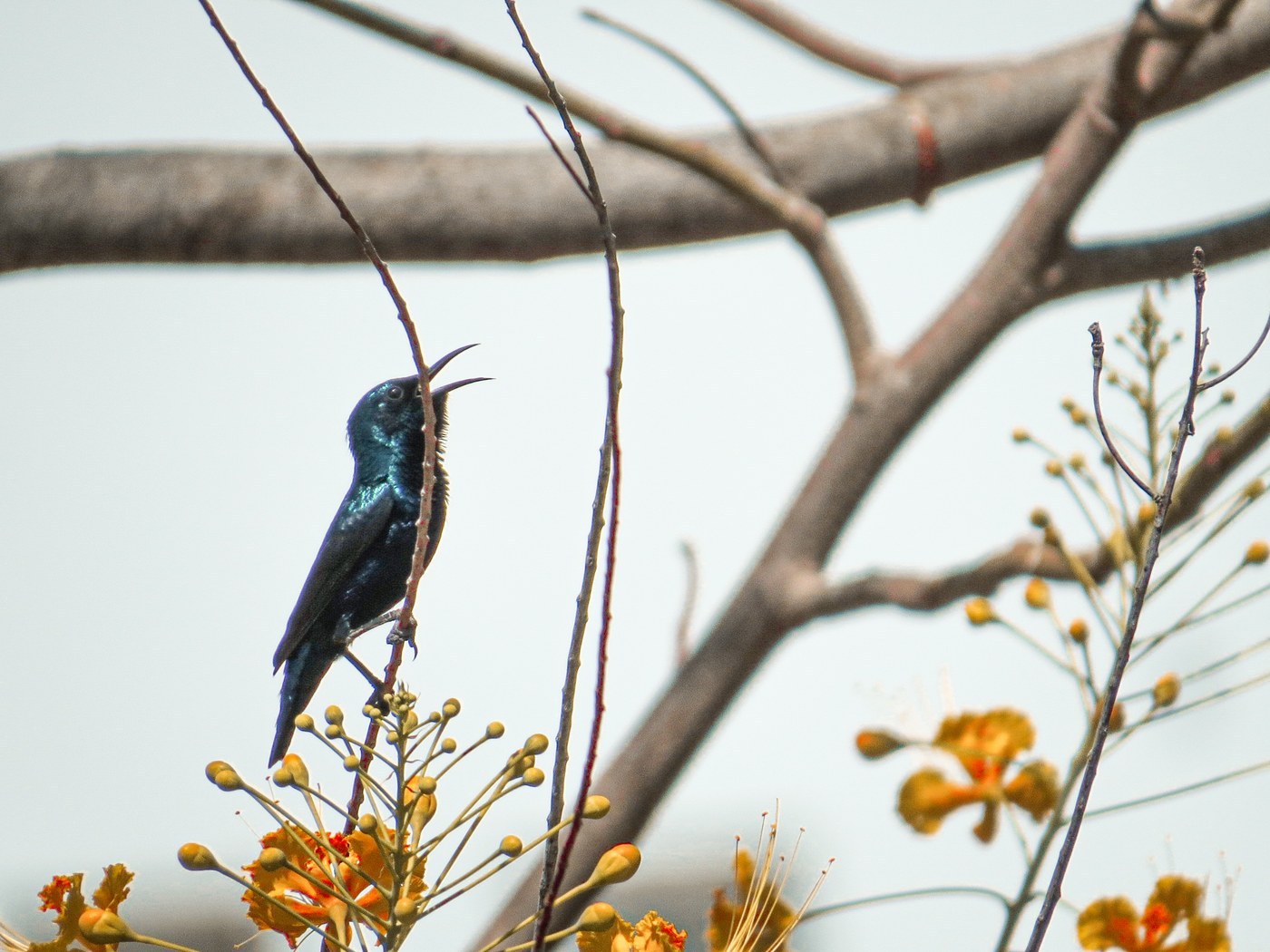
What Purple Sunbird's Feathers Look Like
Purple Sunbird males undergo one of the most dramatic plumage transformations among small songbirds, so feather identification depends heavily on which plumage stage you've found:
- Breeding male feathers: nearly the entire body iridescent blue-black to deep metallic purple, with a coppery-purple sheen strongest on the throat, crown, and back. There are no bright yellow or maroon patches like related sunbirds.
- Eclipse (non-breeding) male feathers: mostly dull olive-brown like a female, but with a narrow dark blue-black stripe running down the center of the throat and belly — a very distinctive mixed-plumage clue if you find such a feather still attached to skin or in a molt cluster.
- Female feathers: plain olive-brown above, dull yellowish-white below, with no iridescence at all — easily mistaken for many other small brown birds.
- Wing/tail feathers: small, slightly curved, dark brownish-black, consistent with an active nectar-feeding bird that needs agile, quick flight.
- Size: tiny, generally under 5 cm even for the longest flight feathers.
Step-by-Step: Is This Feather From a Purple Sunbird?
- Check for full-body iridescence. A tiny feather that is glossy blue-black to purple-black with no other bright colors mixed in strongly suggests a breeding male Purple Sunbird.
- Look for the dark central stripe. If you find an otherwise olive-brown feather with a blackish stripe or patch, this may be from an eclipse-plumage male mid-molt.
- Rule out yellow. Unlike Purple-rumped or Olive-backed Sunbirds, breeding male Purple Sunbird feathers show no yellow belly patch — solid dark iridescence instead.
- Consider size and curvature. Very small, slightly curved feathers fit the sunbird family generally; use plumage color to narrow to species.
- Set expectations for female feathers. A plain olive-brown, unglossy feather cannot be confidently assigned to Purple Sunbird over several similar female sunbirds without more context.
Similar Species & How to Tell Them Apart
- Purple-rumped Sunbird: Even breeding males retain a bright yellow belly and maroon throat rather than being uniformly iridescent black-purple.
- Loten's Sunbird: Shows a longer bill (not feather-relevant) and a maroon breast band breaking up the iridescence, unlike Purple Sunbird's more uniform dark plumage.
- Olive-backed Sunbird: Male shows an olive back and yellow underparts contrasting with a blue-black throat, rather than an all-dark body.
- Asian Glossy Starling: Larger, with coarser, broader feathers and red eyes; overall feather size alone should rule this out for anything sunbird-sized.
Where & When You'll Find Them
Purple Sunbirds are widespread across gardens, scrub, and open woodland from the Middle East through South and Southeast Asia, frequently visiting flowering shrubs and hibiscus. Because males molt into and out of breeding plumage seasonally (often tied to the local breeding season and flowering peaks), it's common to find part-molt feathers — mixed olive-and-black — around gardens during the transition months between breeding and non-breeding periods.
Frequently asked questions
Why does the male sometimes look olive-brown like the female?
Purple Sunbird males molt into a duller 'eclipse' plumage outside the breeding season, closely resembling females except for a telltale dark stripe down the throat and belly, which is a useful mid-molt identification clue.
Is the purple color from pigment or something else?
Like most iridescent sunbird plumage, the color comes from microscopic feather structures that scatter light rather than true pigment, which is why the feather can look black, blue, or purple depending on the angle it's viewed from.
Can female Purple Sunbird feathers be told apart from other female sunbirds?
Generally not with confidence from color alone, since most female sunbirds share a similar plain olive-and-yellowish pattern; habitat and region provide better clues than an isolated feather.
Do juveniles look like breeding males or females?
Juveniles resemble females with plain olive-brown plumage and only develop the iridescent black-purple feathers after reaching maturity and completing their first full molt into breeding condition.