
How to Identify Razorbill Feathers
A guide to the crisp black-and-white feathers of the Razorbill, a North Atlantic auk, and how to separate them from murres and other seabirds.
Read the full Razorbill encyclopedia entry →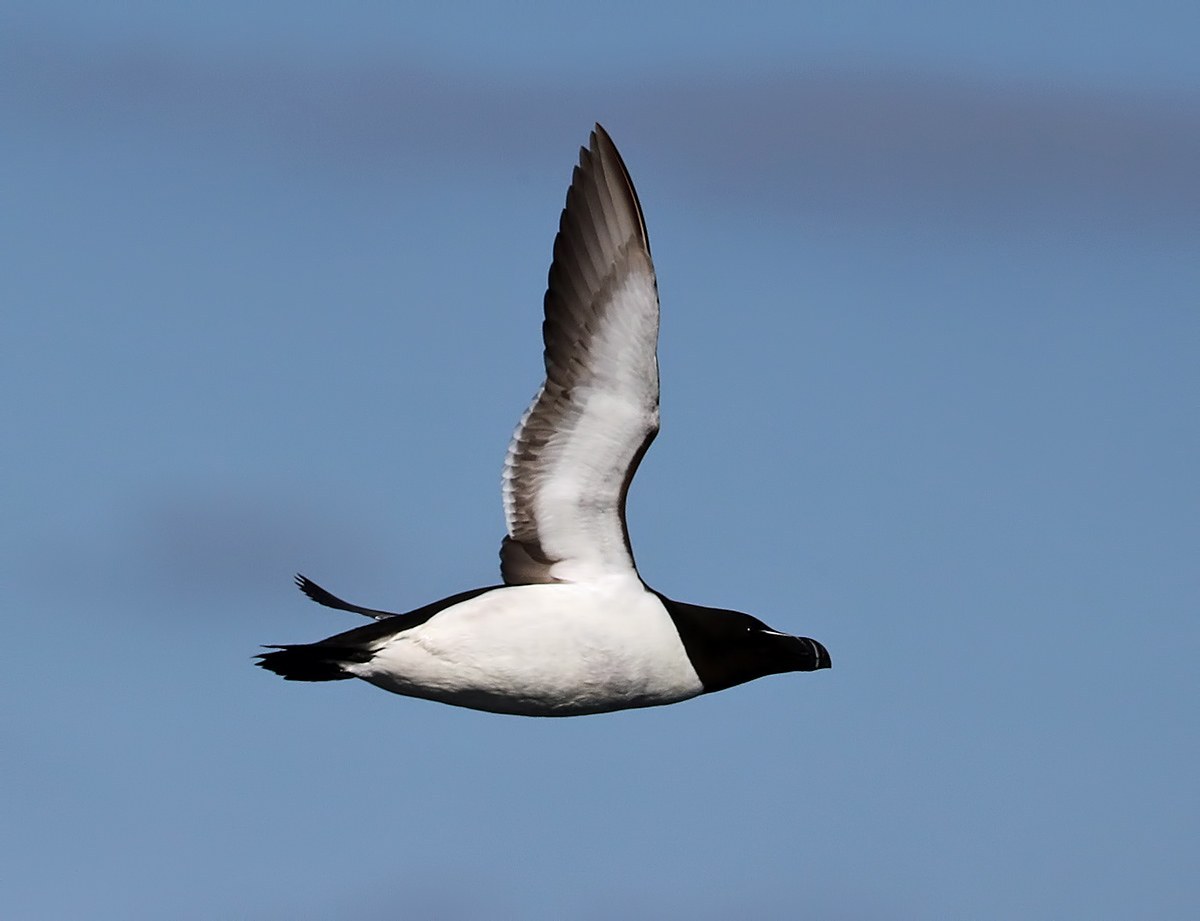
What Razorbill's Feathers Look Like
Razorbill is a heavy-bodied North Atlantic auk with simple but sharply contrasting plumage:
- Upperparts feathers (back, crown, nape): solid, glossy black, dense and smooth, built to shed water.
- Underparts feathers: crisp, pure white, sharply demarcated from the black upperparts with almost no blending or mottling.
- Wing feathers: black overall, but with a narrow white trailing edge stripe across the secondaries — a single secondary feather will show black with a clean white tip/edge, which is a key diagnostic.
- Face feathers (breeding adults): a thin white line running from the eye toward the bill, visible as a small white streak on an otherwise black face feather.
- Winter (non-breeding) feathers: throat and face feathers turn partly white, replacing the solid black throat of breeding birds.
- Feather texture: dense, stiff, and tightly packed — typical of a diving seabird that needs excellent waterproofing and insulation.
- Size: primaries relatively short and broad for the bird's size (auks have short, stiff wings adapted for underwater "flying"), roughly 12–15 cm.
Step-by-Step: Is This Feather From a Razorbill?
- Check for stark black-and-white contrast with almost no gray or brown. This clean two-tone pattern is a strong starting clue for an auk.
- Look for a white stripe on a black wing feather. A secondary feather with a crisp white trailing edge is one of the most distinctive Razorbill feather traits.
- Check face feathers for a thin white eye-to-bill line. If present, this points specifically to Razorbill rather than a similar auk.
- Feel the texture. Dense, stiff, slightly oily-feeling feathers fit a diving seabird rather than a softer terrestrial species.
- Consider winter versus breeding. A mostly white throat/face feather could still be Razorbill in non-breeding plumage, not necessarily a different species.
Similar Species & How to Tell Them Apart
- Common Murre (Guillemot): Also black-and-white but has thinner, more slender overall proportions and typically lacks the crisp white wing-edge stripe as prominently, plus no white eye-line.
- Thick-billed Murre: Shows a thin white line along the gape (mouth) rather than an eye-to-bill stripe, and generally lacks the Razorbill's bold wing stripe.
- Black Guillemot: Shows large white wing patches rather than a thin trailing-edge stripe, making its wing feathers look quite different at a glance.
- Atlantic Puffin: Similar black-and-white body but puffin wing feathers lack the white trailing stripe, and puffin body feathers are paired with a very different, colorful bill (not a feather trait, but a strong contextual clue if bill fragments are present).
Where & When You'll Find Them
Razorbills breed on rocky cliffs and offshore islands around the North Atlantic, nesting in crevices and boulder piles, then spend winters at sea, sometimes turning up along beaches after storms. Feathers are most commonly found at or near breeding colonies during the spring-to-summer nesting season, though winter storms can also wash beach-found feathers ashore from birds wintering offshore, especially after the main post-breeding molt in late summer and fall.
Frequently asked questions
What's the clearest single feather clue for Razorbill versus a murre?
A black wing (secondary) feather with a crisp white trailing-edge stripe is one of the most reliable single-feather clues, since murres typically don't show this stripe as prominently.
Why is there a white line on the face in breeding season but not always?
The thin white eye-to-bill line is part of Razorbill's breeding plumage and can be less pronounced or absent outside the breeding season, so its absence doesn't rule out the species, especially on a winter bird.
How can I tell this apart from an Atlantic Puffin feather?
Body feather color is very similar, but Razorbill wing feathers show the diagnostic white trailing-edge stripe that puffin wing feathers lack, making wing feathers more useful than body feathers for this comparison.
Are Razorbill feathers noticeably oily or waterproof-feeling?
Yes, like most diving seabirds, Razorbill feathers are densely packed and coated with preen oil for waterproofing, giving them a slightly slick or stiff feel compared to feathers from land birds.