
How to Identify Red-breasted Nuthatch Feathers
A guide to identifying Red-breasted Nuthatch feathers by their blue-gray back, rusty-orange underparts, and bold black-and-white head stripes, distinguishing them from White-breasted and Pygmy Nuthatch.
Read the full Red-breasted Nuthatch encyclopedia entry →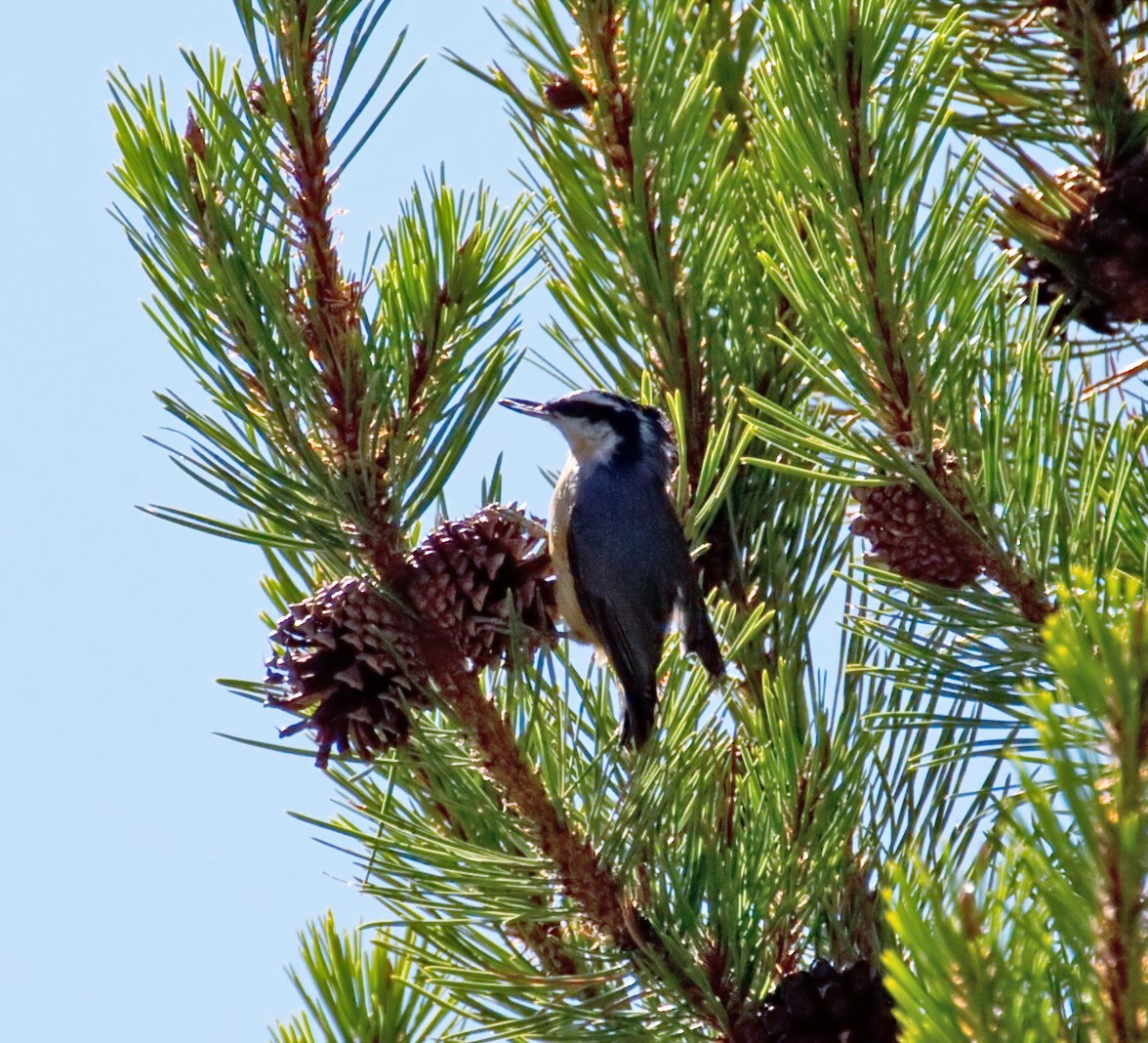
What Red-breasted Nuthatch's Feathers Look Like
Red-breasted Nuthatch is a compact, energetic songbird of conifer forests, and its feathers are small but boldly patterned. Back and wing covert feathers are a clean slate blue-gray, while breast and belly feathers carry a warm rusty-orange to cinnamon wash — genuinely distinctive among North American nuthatches, since most others show plain white or gray underparts. Flight feathers (primaries and secondaries) are blue-gray on the outer webs with darker centers, generally 5-7 cm long, reflecting the bird's small size.
Head feathers show the species' signature pattern: a black cap, a bold white stripe over the eye, and a black stripe through the eye, creating a striped face unlike the plainer head of related species. Tail feathers are short and blue-gray, with the outer pair or two showing small white spots near the tip, visible as a faint flash when the tail is fanned in flight.
Step-by-Step: Is This Feather From a Red-breasted Nuthatch?
- Check underparts color. A rusty-orange or cinnamon breast feather is one of the most reliable single clues, since few small songbirds combine this tone with blue-gray upperparts.
- Look at the head pattern. A black-and-white striped feather (cap, eyebrow, and eye-stripe) supports this species when found alongside rusty body feathers.
- Measure the feather. Flight feathers around 5-7 cm fit this small, compact nuthatch.
- Examine tail feathers for white tip spots. Small pale spots near the tip of an otherwise blue-gray tail feather are consistent with Red-breasted Nuthatch.
- Consider habitat. Feathers found in coniferous or mixed forest support this species over more open-country nuthatches.
Similar Species & How to Tell Them Apart
- White-breasted Nuthatch — larger, with clean white (not rusty) underparts and a plainer face lacking the bold black eye-stripe, the clearest feather-level distinction.
- Pygmy Nuthatch — smaller still, with a grayish-brown cap (not black) and pale grayish-buff underparts rather than rusty-orange, and no strong facial eye-stripe.
- Brown-headed Nuthatch — southeastern range, with a plain brown cap instead of black and pale buffy-white underparts, lacking the rusty wash entirely.
Where & When You'll Find Them
Red-breasted Nuthatches favor coniferous and mixed forests across Canada, the northern and western United States, and higher elevations further south, foraging along trunks and branches for insects and conifer seeds, and are prone to irruptive southward movements in years of poor cone crops. Feathers are most often found on the ground beneath favored foraging trees and around nest cavities in spring through summer during the breeding molt, and irruptive winters can bring feathers (and birds) well outside the species' usual range when food supplies fail up north.
Frequently asked questions
What's the most distinctive feather feature for Red-breasted Nuthatch?
A rusty-orange or cinnamon-washed underparts feather paired with blue-gray upperparts is the clearest single clue, since this color combination is unusual among North American nuthatches.
How do I tell this apart from a White-breasted Nuthatch feather?
Check the underparts color — White-breasted Nuthatch has clean white breast and belly feathers with no rusty wash, and its face lacks the bold black eye-stripe seen in Red-breasted Nuthatch.
Does the head pattern help with identification?
Yes, a black cap combined with a white eyebrow stripe and black eye-stripe is a strong supporting clue, especially when found with rusty-toned body feathers.
How small are Red-breasted Nuthatch feathers?
Flight feathers measure roughly 5-7 cm, consistent with this species' compact, small-bodied build.
Why would I find this species' feathers far outside its usual range?
Red-breasted Nuthatches undergo irruptive movements in years when conifer seed crops fail, pushing birds (and their feathers) well south of their typical range during fall and winter.