
How to Identify Red Crossbill Feathers
A guide to identifying Red Crossbill feathers by their brick-red to orange body color, unmarked dark wings with no wing bars, and deeply notched tail, distinguishing them from White-winged Crossbill.
Read the full Red Crossbill encyclopedia entry →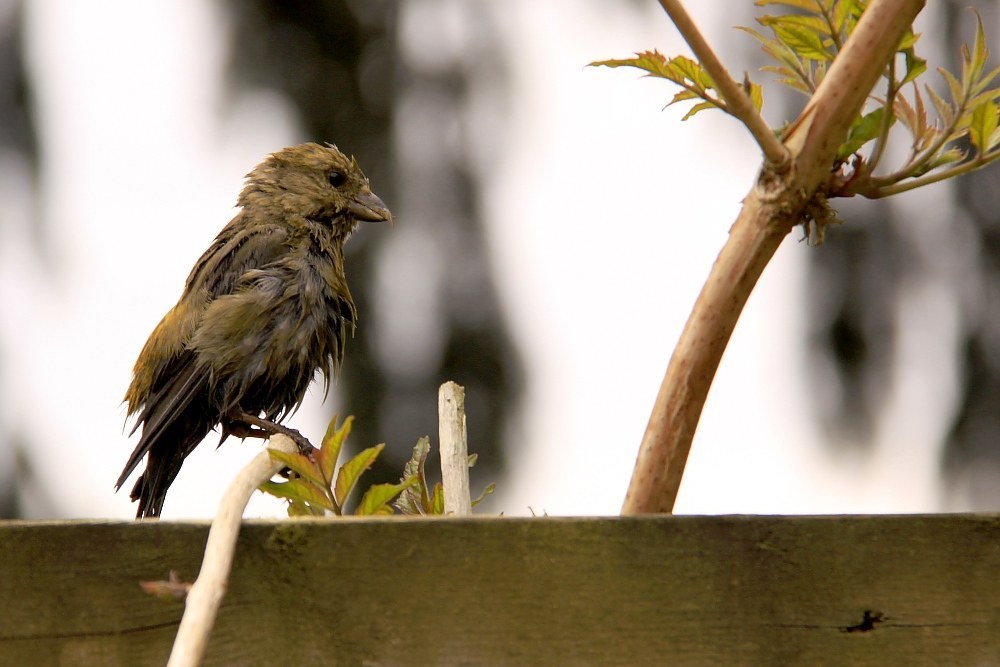
What Red Crossbill's Feathers Look Like
Red Crossbill is a conifer-seed specialist finch, and its plumage is built around a bold, unbroken body color rather than any complex pattern. Adult male body (contour) feathers are a warm brick-red to orange-red, sometimes with a duskier, more brownish tone on older or worn feathers, while females and immatures show olive-yellow to gray-green body feathers instead of red. In both sexes, the crucial detail is what's missing: flight feathers are plain blackish-brown with no white wing bars or markings whatsoever — a genuinely important negative clue, since the look-alike White-winged Crossbill shows the opposite.
Flight feathers are moderately long and pointed, typical of an active, flocking finch, and the tail feathers are noticeably short and deeply notched at the tip, distinct from the squarer tail of many finches. The bill, unique among songbirds for its crossed mandible tips, is not a feather but is a useful confirming detail if any bill fragment is found alongside candidate feathers, since no other bird shares this structure.
Step-by-Step: Is This Feather From a Red Crossbill?
- Check for solid, unbarred color. A plain brick-red, orange, or (in females) olive-yellow to gray body feather with no wing bars anywhere on the bird supports Red Crossbill.
- Confirm the wings are unmarked. Plain blackish-brown flight feathers, entirely lacking pale wing bars, are the single best distinguishing feature from White-winged Crossbill.
- Examine the tail. A short, deeply notched (forked) tail feather fits this species' distinctive tail shape.
- Consider color by likely sex/age. Reddish feathers suggest an adult male, while olive-yellow to grayish-green feathers suggest a female or immature.
- Factor in habitat. Feathers found under conifers, especially pines or spruces with cone debris nearby, support this species' specialized feeding habits.
Similar Species & How to Tell Them Apart
- White-winged Crossbill — the key look-alike, distinguished by two bold white wing bars across the black flight feathers, completely absent in Red Crossbill; body color (pink-red males, yellow-green females) is otherwise similar.
- Pine Grosbeak — much larger overall, with white or pinkish wing bars and a stouter, uncrossed bill, easily separated by size and wing pattern.
- House Finch — smaller, with streaked underparts and a plain (uncrossed) conical bill, plus streaking that Red Crossbill entirely lacks.
Where & When You'll Find Them
Red Crossbills are nomadic conifer specialists found across boreal, montane, and temperate coniferous forests of North America, Europe, and Asia, following irregular cone crops rather than keeping to fixed territories or a predictable annual schedule. Because breeding can occur at almost any time of year when cone crops are abundant, feathers can turn up year-round beneath productive conifer stands, though flocks and molt activity are often most concentrated in late summer and fall, when large cone crops draw feeding flocks together for extended periods.
Frequently asked questions
What's the single most important clue for Red Crossbill feathers?
Plain, unmarked flight feathers with no white wing bars at all — this absence is the key difference from the very similar White-winged Crossbill, which shows two bold white bars.
Why do some Red Crossbill feathers look reddish and others greenish-yellow?
Adult males show brick-red to orange body feathers, while females and immatures show olive-yellow to gray-green feathers instead; both share the same unmarked wing pattern.
Does tail shape help confirm this species?
Yes, a short, deeply notched or forked tail feather is consistent with Red Crossbill's distinctive tail structure among finches.
Could a reddish feather with wing bars still be a Red Crossbill?
No — genuine Red Crossbill flight feathers are entirely unmarked; a reddish bird's feather showing white wing bars points instead to White-winged Crossbill.
When and where are Red Crossbill feathers most likely to be found?
Beneath productive conifer stands such as pines or spruces, especially in late summer and fall when large, nomadic feeding flocks gather to exploit heavy cone crops.