
How to Identify Red-faced Warbler Feathers
A guide to identifying Red-faced Warbler feathers by their bright red face and throat, black crown and cheek patch, and contrasting gray body, distinguishing them from other high-elevation warblers.
Read the full Red-faced Warbler encyclopedia entry →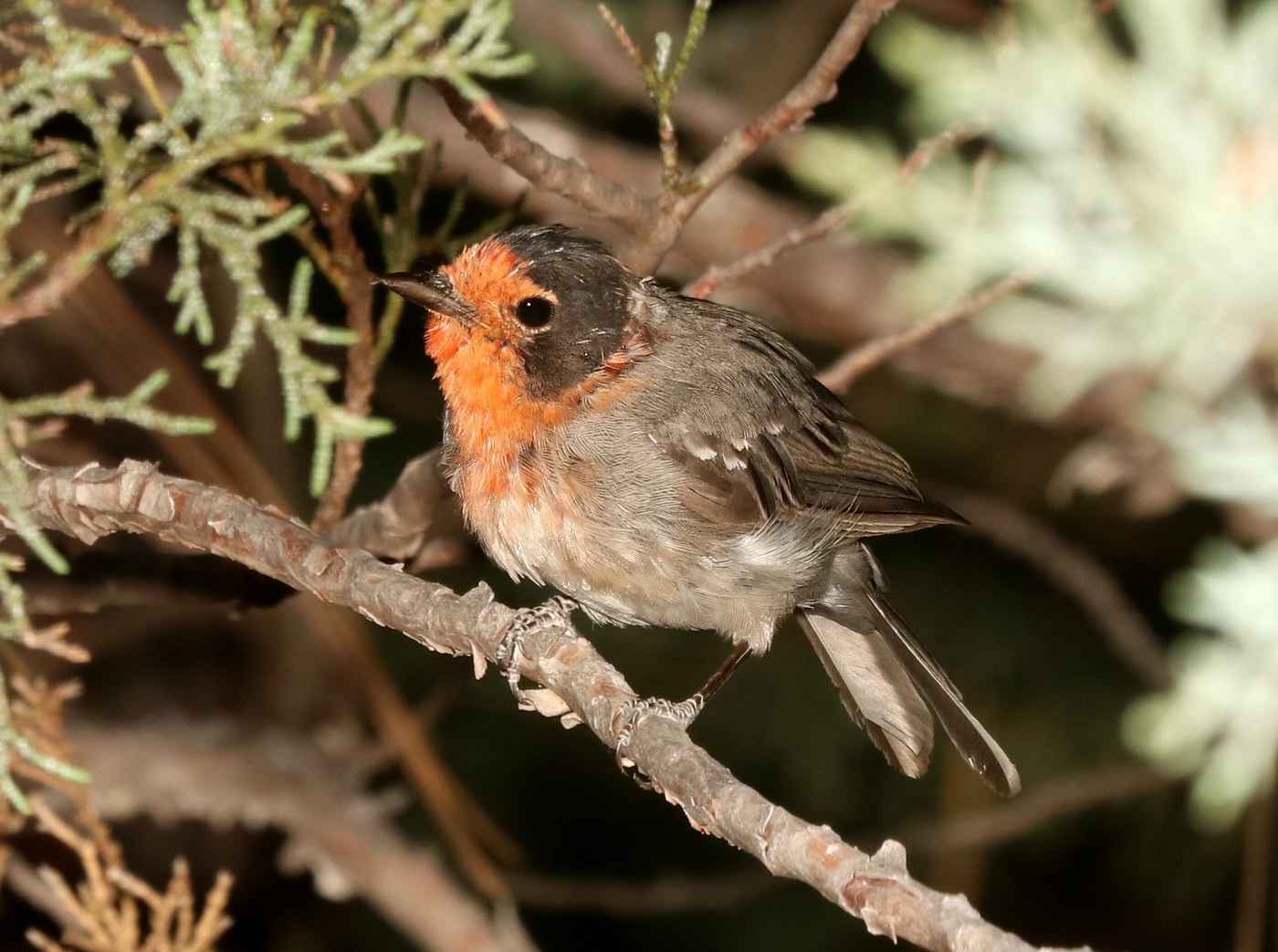
What Red-faced Warbler's Feathers Look Like
Red-faced Warbler is a distinctive high-elevation songbird whose feathers combine an unusual, vivid facial color with an otherwise plain gray body. Face and throat feathers are a bright red to reddish-pink, bordered by a solid black crown and black cheek/ear patch — a striking, high-contrast combination not shared by any similar warbler in its range. Just behind the black crown, a small patch of white feathers forms a pale nape spot, another useful, easily overlooked detail.
Back, wing, and most of the body feathers are a plain, clean gray, with no wing bars, streaking, or spotting anywhere — genuinely unusual restraint for a warbler, most of which show at least some patterning on the wings or flanks. The rump is white, contrasting against the gray back and tail, and is often visible as a pale flash even on a folded-wing bird. Flight feathers are small, gray, and unmarked, around 5-6 cm, consistent with this warbler's compact size.
Step-by-Step: Is This Feather From a Red-faced Warbler?
- Check for bright red face/throat feathers bordered by black. This vivid combination is essentially unique among warblers sharing its montane habitat.
- Look for a white nape spot. A small patch of white feathers just behind the black crown is a distinctive, often-overlooked supporting clue.
- Confirm the body is plain gray. No wing bars or streaking on back and wing feathers fits this species specifically.
- Examine the rump. A white rump feather contrasting with gray back and tail feathers is characteristic.
- Measure the feather. Small, unmarked gray flight feathers around 5-6 cm are consistent with this compact warbler.
Similar Species & How to Tell Them Apart
- Painted Redstart — shows black-and-white body plumage with a red belly patch and bold white wing patches, an entirely different pattern from Red-faced Warbler's gray body and red face.
- Slate-throated Redstart — has a red belly (not face) and a plain slaty-gray throat, the opposite arrangement of red placement from Red-faced Warbler.
- Grace's Warbler — shows yellow (not red) on the face and throat along with streaked flanks, easily separated by both color and pattern.
Where & When You'll Find Them
Red-faced Warblers breed in high-elevation conifer and mixed conifer-oak forests of the southwestern United States and Mexico's Sierra Madre, often foraging actively in dense foliage at mid-to-upper levels. Feathers are most likely found on the forest floor beneath breeding habitat during spring and summer, when adults are nesting and undergoing their post-breeding molt, with the species withdrawing to Mexico and Central America for the winter, after which feathers become far less likely to be found within its U.S. breeding range until birds return the following spring.
Frequently asked questions
What's the standout feather feature for Red-faced Warbler?
A bright red face and throat feather bordered by solid black on the crown and cheek — this red-and-black facial combination is essentially unique among warblers in its montane range.
Does this species have any wing bars?
No, its wing and back feathers are plain gray with no bars, streaking, or spotting, which is unusual for a warbler and helps confirm the identification.
What's the significance of a small white feather patch behind the black crown?
That's the white nape spot characteristic of this species, an easy-to-miss but useful supporting clue alongside the red face and gray body.
How do I tell this apart from Painted Redstart?
Painted Redstart has black-and-white body plumage with a red belly and bold white wing patches, a completely different pattern from Red-faced Warbler's plain gray body and red face.
When are Red-faced Warbler feathers most likely to be found?
During spring and summer in high-elevation conifer and conifer-oak forests of the southwestern U.S. and Mexico, before the species withdraws south for winter.