
How to Identify Red Wattlebird Feathers
A guide to identifying Red Wattlebird feathers by their gray-brown streaked body, contrasting pale yellow belly patch, and note on the bare (non-feather) red wattle.
Read the full Red Wattlebird encyclopedia entry →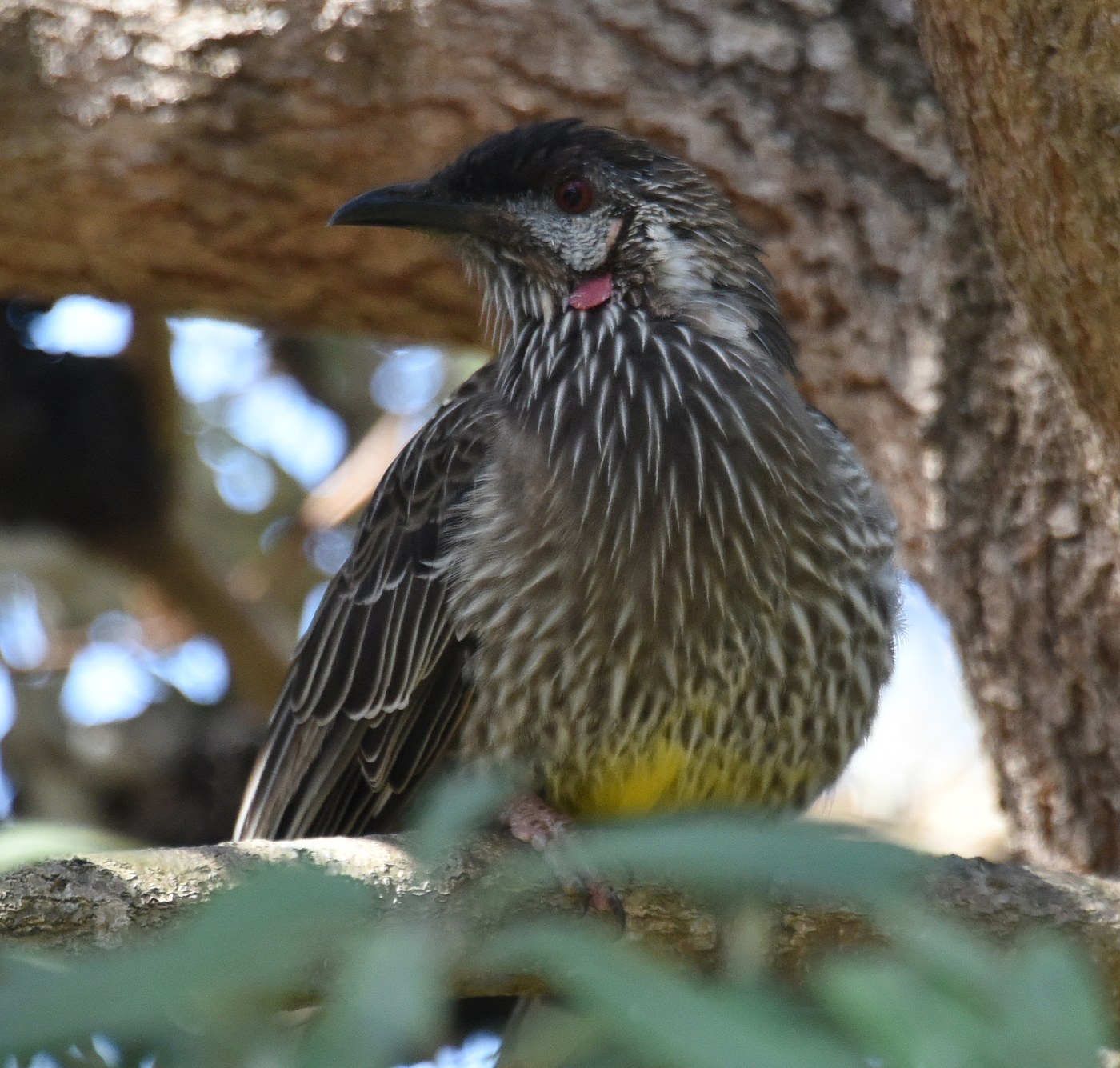
What Red Wattlebird's Feathers Look Like
The Red Wattlebird is a large Australian honeyeater, and its feathers reflect a somewhat plain-looking but distinctively marked bird once you know what to check. Body contour feathers are grayish-brown overall, with fine white streaking or shaft-streaks running through the plumage — this streaky texture across the back, breast, and head is a good general first clue for the honeyeater family and for this species specifically given its large size. The chin and throat feathers are whitish, providing some contrast against the streaked gray-brown of the rest of the head and body.
The most useful diagnostic feather feature is on the belly: a patch of pale yellow feathers marks the lower belly, standing out clearly against the streaky gray-brown of the rest of the underparts — this yellow belly patch is one of the fastest ways to confirm this species among similarly sized brownish honeyeaters. Tail feathers are long and dark brown with white tips, and flight feathers are brownish with pale edging. It's important to note that the red "wattle" this species is named for — the fleshy patch hanging below and behind the eye — is bare skin, not feathers, so it will never appear on a shed feather itself.
Step-by-Step: Is This Feather From a Red Wattlebird?
- Look for a yellow belly feather. A pale yellow feather from the lower belly, found alongside grayish-brown streaked feathers, is the strongest single clue for this species.
- Check for fine streaking. Gray-brown body feathers with white shaft-streaks running through them support honeyeater identification generally and this species specifically at its larger size.
- Measure it. As a large honeyeater, feathers should be sizable — tail feathers notably long, reflecting the bird's substantial overall size compared to smaller honeyeaters.
- Examine tail feather tips. Dark brown tail feathers with white tips are consistent with this species.
- Don't expect red in the feathers themselves. Remember the red wattle is bare skin; its absence from a feather sample doesn't rule out this species.
Similar Species & How to Tell Them Apart
The Little Wattlebird is a useful comparison since it lacks both the yellow belly patch and the red facial wattle, being more uniformly streaked gray-brown without that lower-belly color contrast — the presence of a yellow belly feather is therefore a good way to favor Red Wattlebird over Little Wattlebird. The Yellow Wattlebird, found in Tasmania, is larger still, with longer bare wattles (again, not a feather feature) and can show a somewhat similar body pattern, so range is often the more practical separator since Yellow Wattlebird is restricted to Tasmania while Red Wattlebird has a broader mainland Australian distribution. General honeyeaters sharing streaky brown plumage are usually ruled out by the combination of large size and the distinct pale yellow belly patch, which isn't as pronounced in most smaller relatives.
Where & When You'll Find Them
Red Wattlebirds inhabit open forests, woodlands, heathland, and increasingly gardens and urban parks across southern Australia, often seen aggressively defending flowering trees and shrubs from other nectar-feeding birds. As a largely resident species with some local nomadic movement following flowering plants, feathers can be found year-round in suitable habitat, particularly near flowering eucalypts, banksias, and grevilleas that provide their primary food source. Breeding season (spring in the Southern Hemisphere) increases feather turnover near nest sites in dense shrubs or low trees, and because these birds are bold and vocal around food sources, feathers often accumulate near well-visited flowering plants and garden feeders.
Frequently asked questions
What is the best single clue for identifying a Red Wattlebird feather?
A pale yellow feather from the lower belly, paired with gray-brown streaked body feathers, is the most reliable diagnostic marker for this species.
Why won't a Red Wattlebird feather show any red color?
The red wattle for which the species is named is bare fleshy skin below the eye, not a feather structure, so no shed feather will ever display that red coloring.
How do I tell this apart from a Little Wattlebird feather?
Little Wattlebird lacks the pale yellow belly patch entirely, showing more uniform gray-brown streaking without that lower-belly color contrast.
Does range help distinguish Red Wattlebird from Yellow Wattlebird?
Yes, Yellow Wattlebird is restricted to Tasmania, while Red Wattlebird has a much broader mainland Australian distribution, making location a useful practical clue.
Where should I look for Red Wattlebird feathers?
Near flowering eucalypts, banksias, and grevilleas in open forests, woodlands, and gardens across southern Australia, especially during the spring breeding season.