
How to Identify Rufous-crowned Sparrow Feathers
How to use the solid rufous cap, gray face, and bold black whisker mark to confirm a feather came from a Rufous-crowned Sparrow.
Read the full Rufous-crowned Sparrow encyclopedia entry →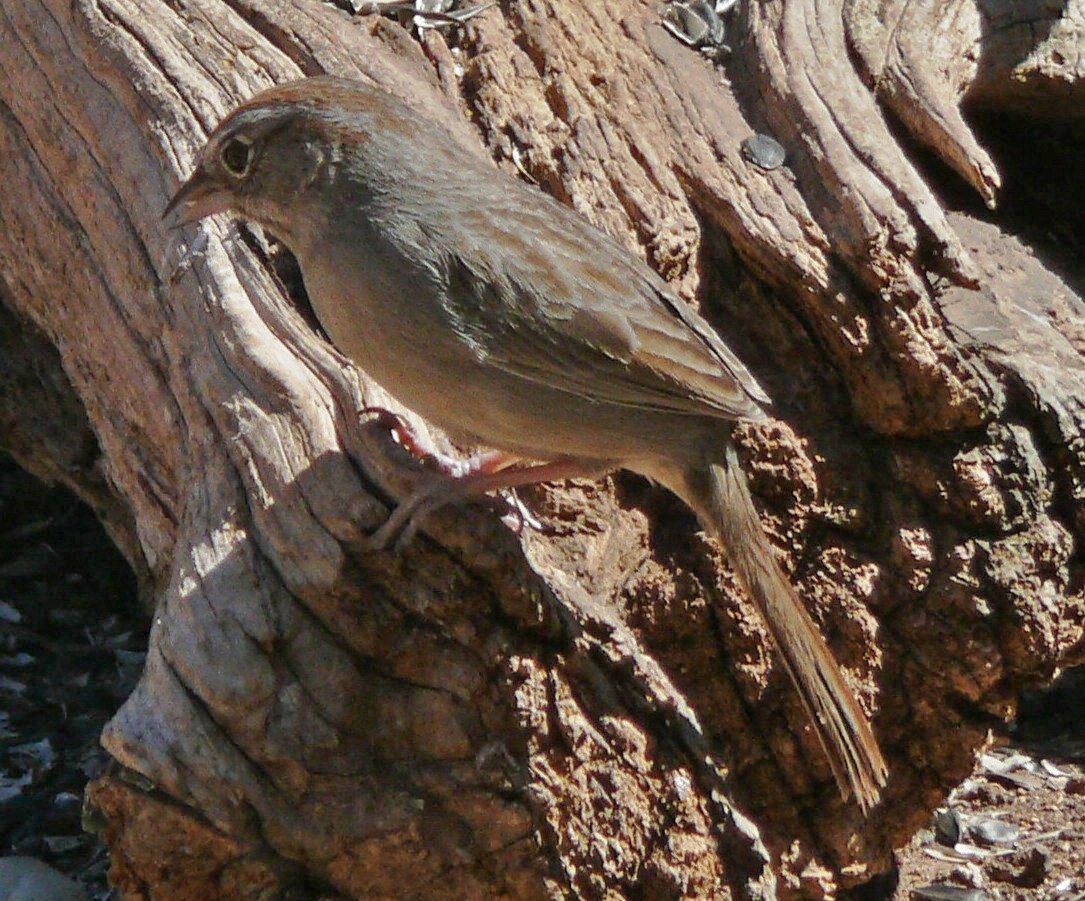
What Rufous-crowned Sparrow Feathers Look Like
Rufous-crowned Sparrows are chunky, long-tailed sparrows of dry, rocky hillsides in the southwestern United States and Mexico, and their feathers show a subdued but distinctive palette. Crown feathers are a solid, unstreaked rufous-brown cap, split by a thin gray central stripe, contrasting with a plain gray face. A key diagnostic feature is the black whisker (malar) mark bordered by white, giving isolated cheek feathers a crisp black-and-white edge. Back feathers are grayish-brown with rufous-brown streaking that is duller and less contrasty than in many streak-backed sparrows. Underparts feathers are plain unstreaked gray, lacking any breast spot or streaking. The tail is notably long and rounded for a sparrow, and individual tail feathers are grayish-brown, broad, and rounded at the tip rather than notched. Flight feathers are dull brown with rufous-tinged edges, generally 5–6 cm long.
Step-by-Step: Is This Feather From a Rufous-crowned Sparrow?
- Check feather size. Body feathers 2–4 cm, tail feathers up to 6–7 cm and notably broad and rounded — a proportionally long, full tail for the bird's size.
- Look for solid rufous coloring confined to a crown feather, not a neck band.
- Search for the black-and-white cheek mark — an isolated malar feather with black bordered by white is a strong clue.
- Examine the back streaking. It should look muted brownish-rufous on gray, not bold black-and-white.
- Confirm plain, unstreaked underparts — no spotting or streaking on breast/belly feathers.
- Factor in habitat. Feathers found on dry, brushy, rocky slopes support this species over grassland or wetland sparrows.
Similar Species & How to Tell Them Apart
Rufous-collared Sparrow (range barely overlaps in Mexico) has its rufous limited to a neck collar rather than the crown, and a bolder gray-and-black striped crown pattern. Chipping Sparrow in nonbreeding plumage shows a duller, streakier crown, a distinct pale eyebrow, and a shorter, notched (not rounded) tail. Rufous-winged Sparrow, a range-mate in the Sonoran Desert, has rufous confined mostly to the wing coverts rather than a full crown cap, and a paler, sandier back. Botteri's and Cassin's Sparrows lack rufous crowns altogether and show plainer, buffier overall tones.
Where & When You'll Find Them
This species is a non-migratory resident of dry, rocky, brush-covered hillsides and chaparral from California and the desert Southwest south through much of Mexico, rarely straying far from its home territory. Because it doesn't migrate, feathers can be found near suitable habitat throughout the year, but the heaviest feather drop follows the post-breeding molt in mid-to-late summer after nesting wraps up. Look for feathers caught in low shrubs, grass tussocks, and rock crevices on sun-exposed slopes rather than in dense forest or wetlands.
Frequently asked questions
What's the single best clue this feather came from a Rufous-crowned Sparrow?
A solid rufous-brown crown feather split by a thin gray stripe, paired with a black malar mark bordered in white on the cheek.
Are the underparts feathers streaked?
No — breast and belly feathers are plain unstreaked gray, which helps rule out heavily streaked sparrows.
How does the tail differ from other sparrows?
It's notably long with broad, rounded tail feather tips rather than the notched tail typical of many sparrows like Chipping Sparrow.
Could a Rufous-winged Sparrow feather be confused with this species?
Only wing-covert feathers might confuse; Rufous-winged Sparrow's rufous is concentrated on the wing, not spread across the whole crown.
When is feather drop heaviest?
Mid-to-late summer, right after the post-breeding molt, though since the species doesn't migrate feathers can appear year-round near its habitat.