
How to Identify Sabine's Gull Feathers
How the tricolor wing pattern — black, white, and gray in a bold triangle — helps identify a Sabine's Gull feather at any age.
Read the full Sabine's Gull encyclopedia entry →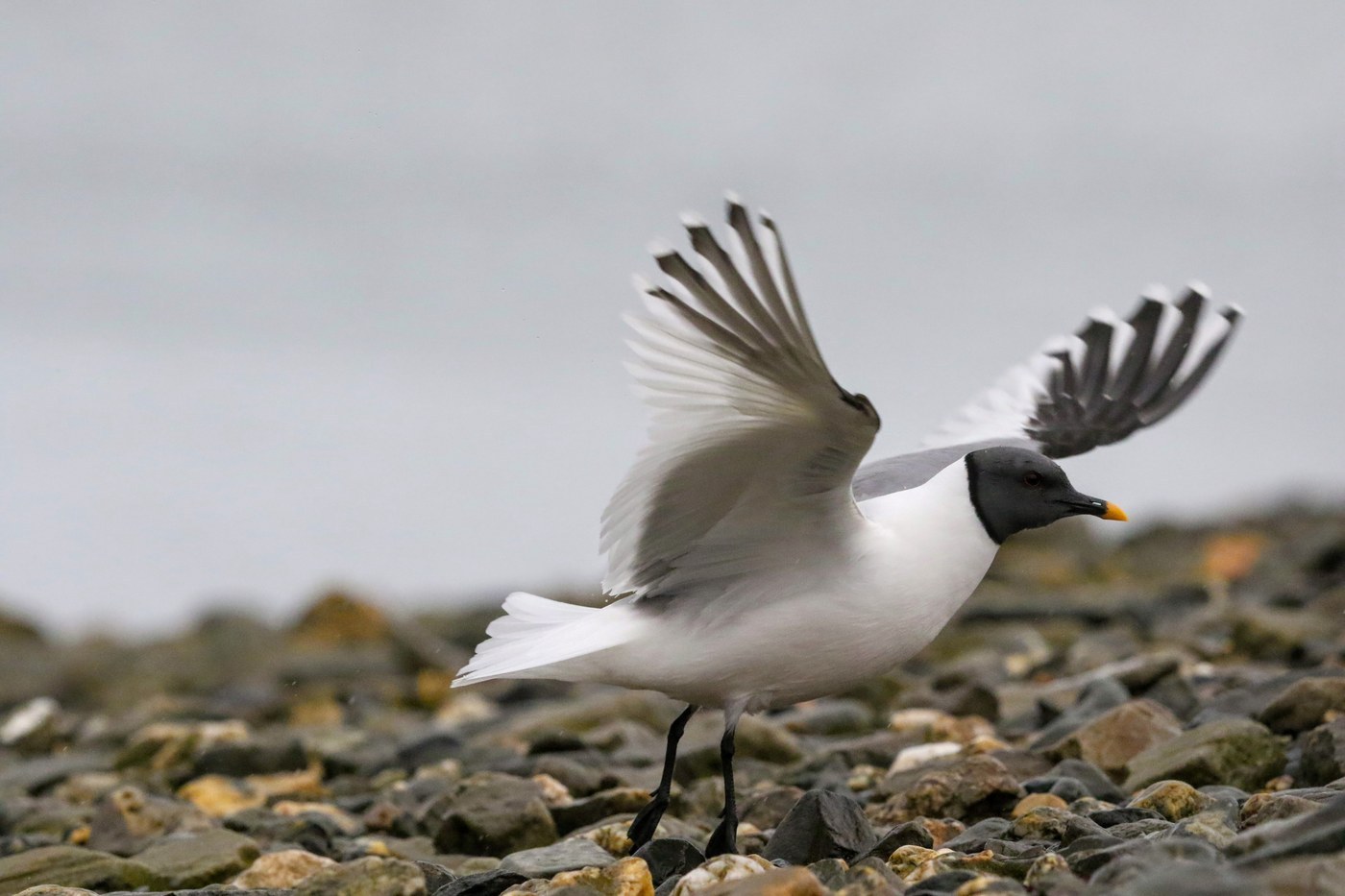
What Sabine's Gull Feathers Look Like
Sabine's Gull is a small, elegant Arctic-breeding gull best known for a striking wing pattern that remains diagnostic across all ages, a rare and useful trait for feather identification. In flight, the upperwing shows three distinct blocks of color: jet-black outer primaries, a bright white triangular wedge across the secondaries and inner primaries, and gray upperwing coverts and mantle — a tricolor pattern unlike almost any other gull. This means an isolated primary feather will typically be solidly black, while a secondary feather will be crisp white, and mantle/covert feathers will be plain gray. The head of a breeding adult is covered in a dark slate-gray hood with a thin black border, while nonbreeding and immature birds show a duskier, partial hood or dark head markings instead of solid gray. The tail is white and distinctly forked, a shape retained even in the feathers of young birds, and the bill is dark with a yellow tip (not reflected in a single feather but useful context).
Step-by-Step: Is This Feather From a Sabine's Gull?
- Check for a solid black primary or a crisp white secondary, either of which fits this species' tricolor wing pattern.
- Look at a covert or mantle feather. Plain gray, unmarked, supports the ID when found alongside black and white wing feathers.
- Examine any tail feather for a forked shape and pure white color.
- Consider that the tricolor wing pattern holds at every age, so even a duller immature-type feather with this same three-block arrangement still points to this species.
- Assess size. This is a small gull, so flight feathers in the 10–15 cm range fit better than a larger gull's longer feathers.
- Weigh location. Feathers found on Arctic tundra in summer or on offshore Pacific waters during migration/winter support this species.
Similar Species & How to Tell Them Apart
The Black-legged Kittiwake, sharing some range, shows solid black wingtips without a bordering white triangle, and its coverts and mantle blend more smoothly gray without the sharp three-block contrast of Sabine's Gull. Other small gulls, such as Bonaparte's Gull, show a different wing pattern with a white leading-edge wedge on the outer wing rather than the trailing white triangle across secondaries seen in Sabine's Gull, plus a different, more solidly capped head pattern rather than a full slate hood.
Where & When You'll Find Them
Sabine's Gulls breed on low Arctic tundra near coasts and wetlands across the high Arctic of North America, Greenland, and Siberia, then undertake a long migration to spend the nonbreeding season far out at sea, mainly in productive upwelling zones off the Pacific coasts of South America and southwestern Africa. Feathers are most likely to be found on Arctic tundra breeding grounds in summer during the post-breeding molt, or washed up along Pacific coastlines during migration periods in spring and fall, when birds pass offshore in numbers.
Frequently asked questions
What makes this species' feathers identifiable at any age?
The tricolor wing pattern — black outer primaries, a white triangular wedge on the secondaries, and gray coverts/mantle — holds true even in young/immature birds.
What does an isolated primary feather look like?
Solidly jet-black, part of the outer wing block in this species' tricolor pattern.
What does the tail feather look like?
Pure white and distinctly forked, a shape retained even in young birds.
How is this different from a Black-legged Kittiwake feather?
Kittiwake shows solid black wingtips without a bordering white triangle, and its coverts blend more smoothly gray without sharp three-block contrast.
Where would I find these feathers?
On Arctic tundra breeding grounds in summer, or along Pacific coastlines during spring/fall migration when the species passes offshore.