
How to Identify Saddle-billed Stork Feathers
How the glossy black-and-white body feathers of this giant African stork help confirm an identification, alongside its unmistakable bill.
Read the full Saddle-billed Stork encyclopedia entry →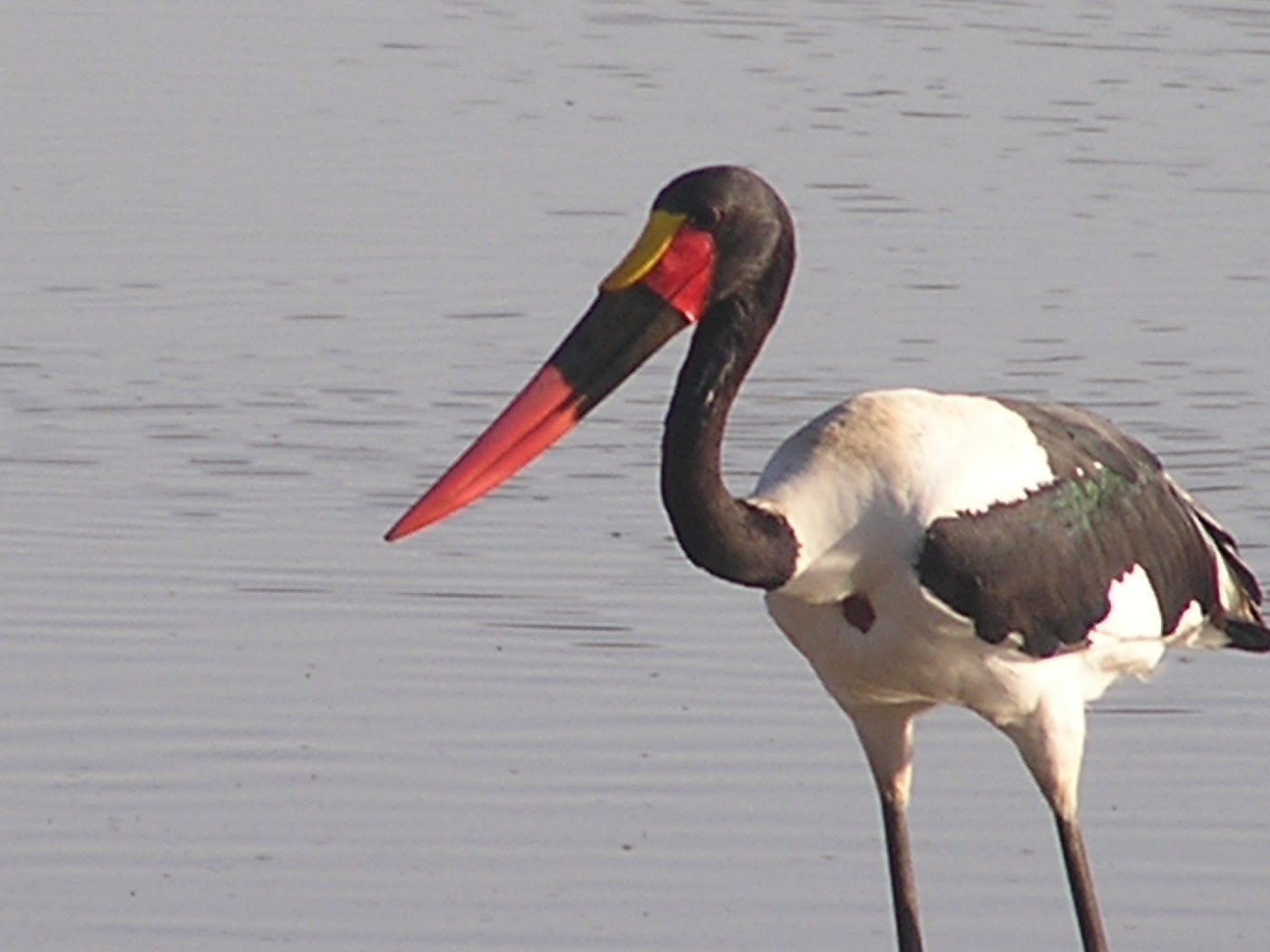
What Saddle-billed Stork Feathers Look Like
The Saddle-billed Stork is one of Africa's largest wading birds, and its feathers show a bold, high-contrast black-and-white pattern befitting such an imposing bird. Head, neck, and most wing covert and flight feathers are glossy black, often showing a subtle green-purple iridescent sheen in good light — a genuinely metallic quality that helps separate this species from duller black waterbirds. A broad white band across the breast and belly, along with a white patch on the secondaries visible as a bright panel in the closed wing, provides strong contrast against the black. The tail is black. Feathers are notably large given the bird's size — flight feathers can exceed 30–40 cm, and even body contour feathers commonly reach 8–10 cm. The bill itself is a striking red, black, and yellow (not a feather, but a helpful field mark if the whole bird or head is seen).
Step-by-Step: Is This Feather From a Saddle-billed Stork?
- Check for genuine gloss. Black feathers with a subtle green-purple iridescent sheen (rather than flat matte black) support this species.
- Look for a broad white band among contour feathers, consistent with the white breast/belly patch.
- Search for a white secondary feather, matching the bright wing panel visible in the closed wing.
- Assess size. Very large feathers — flight feathers over 30 cm — fit one of Africa's largest storks.
- Confirm solid black tail feathers without any barring or streaking.
- Match habitat. Feathers found near African wetlands, floodplains, or riverbanks, often away from dense colonies since this species nests solitarily, support the ID.
Similar Species & How to Tell Them Apart
The Black-necked Stork, found in Australia and parts of Asia, shares a broadly similar black-and-white pattern but occurs on a different continent, so range alone often resolves the two; its black areas also tend to show a slightly different iridescent quality. The Woolly-necked Stork, smaller and more widespread across Africa and Asia, shows a fluffy white neck ruff rather than a solid black neck, and lacks the bold white breast band arrangement of Saddle-billed Stork. The Marabou Stork, sharing range, is much larger still with a bare pink head/neck and grayish (not glossy black) body feathers, easily distinguished by the lack of gloss and the different color balance.
Where & When You'll Find Them
Saddle-billed Storks are found across sub-Saharan Africa's wetlands, floodplains, and riverbanks, typically as solitary pairs defending large territories rather than nesting in dense colonies like many other storks. Because pairs are sedentary and territorial, feathers can be found near suitable wetland habitat throughout the year, with a modest increase in feather drop following the breeding season, which varies regionally but often aligns with the dry season when food becomes concentrated in shrinking water bodies.
Frequently asked questions
What's the key texture clue for this species' black feathers?
A subtle green-purple iridescent sheen — genuinely glossy rather than flat matte black — distinguishing it from duller black waterbirds.
How large are the feathers?
Very large: flight feathers can exceed 30–40 cm, and even body contour feathers commonly reach 8–10 cm, reflecting the bird's massive size.
How is this different from a Marabou Stork feather?
Marabou Stork body feathers are grayish and lack gloss, quite different from Saddle-billed Stork's glossy black plumage.
Does this species nest in colonies like other storks?
No, it typically nests as solitary territorial pairs, so feathers are more likely scattered near individual territories than concentrated at a colony.
When is feather drop heaviest?
Modestly increased after the breeding season, which often aligns with the dry season across much of its African range.