
How to Identify Saddleback Feathers
How the black body plumage and sharply contrasting chestnut saddle patch identify a feather from New Zealand's Saddleback.
Read the full Saddleback encyclopedia entry →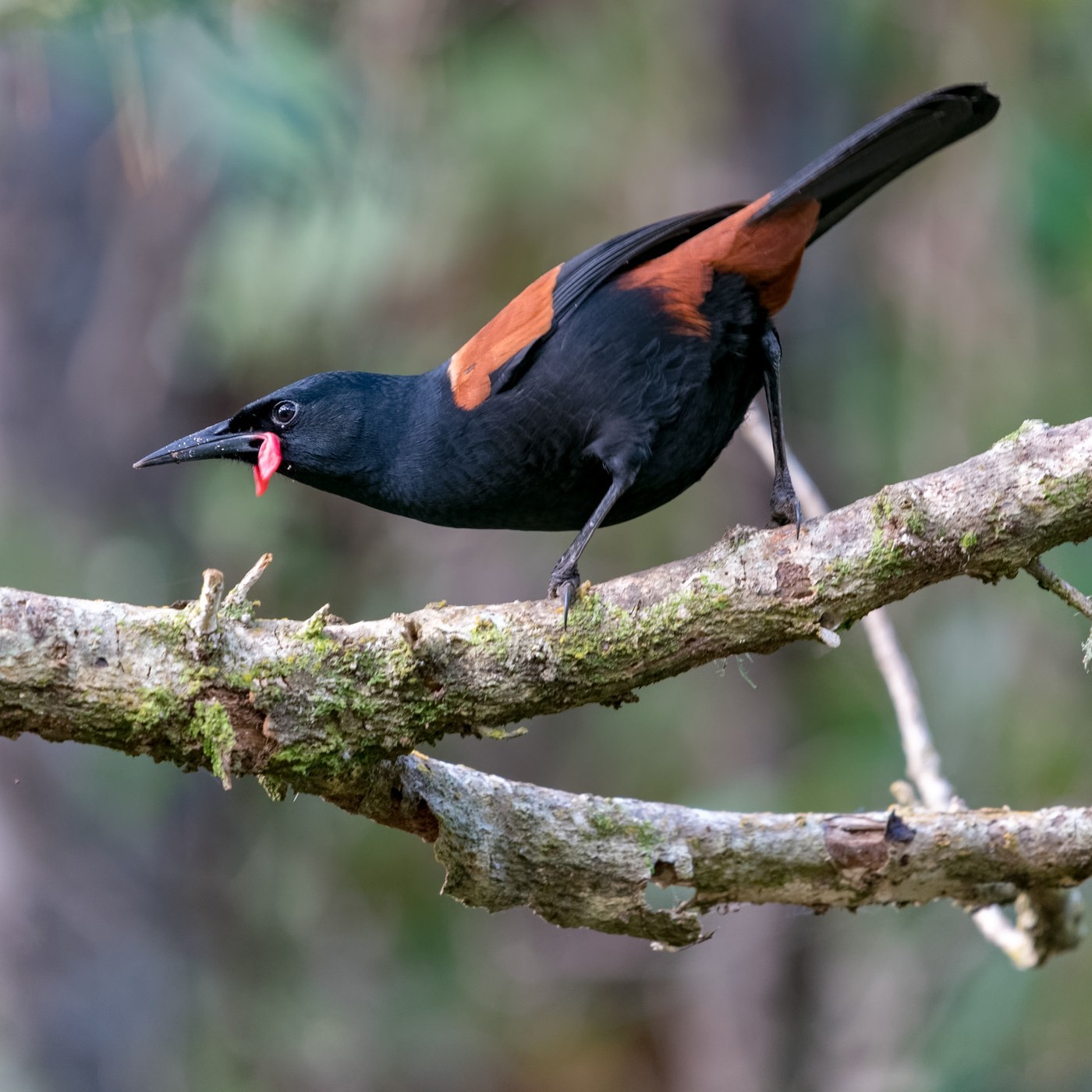
What Saddleback Feathers Look Like
The Saddleback, or tieke, is a New Zealand wattlebird found only on predator-free islands and mainland sanctuaries, and its feathers show one of the most striking patterns of any New Zealand bird. Head, throat, breast, wings, and tail feathers are glossy black. Across the back and rump sits a broad, sharply demarcated chestnut-rufous "saddle" patch, contrasting boldly against the black — the single most diagnostic feather for this species. In the North Island subspecies, saddle feathers along the front edge often show a thin yellowish-buff border stripe separating the saddle from the black shoulder area, a detail absent in the South Island subspecies, where the saddle meets the black more abruptly. Wing feathers are black and notably short and rounded, reflecting this species' very limited flying ability. Orange-red fleshy wattles hang at the base of the bill (not a feather feature, but a strong confirming trait if the head is seen).
Step-by-Step: Is This Feather From a Saddleback?
- Check for a sharply bordered chestnut-rufous patch on an otherwise black feather — this is the defining clue for the species.
- Look for a thin yellow-buff border along the front of the saddle patch, which if present indicates the North Island subspecies rather than the South Island one.
- Confirm glossy black elsewhere on the body, including head, throat, wings, and tail.
- Assess wing feather shape. Short and rounded, reflecting weak flight ability, rather than long and pointed.
- Consider location carefully. Because this species survives only on predator-free islands and fenced sanctuaries in New Zealand, feathers found elsewhere are extremely unlikely to be genuine.
- Rule out confusion with unrelated black-and-rufous birds outside New Zealand, since this species has no natural range beyond it.
Similar Species & How to Tell Them Apart
The Kokako, another New Zealand wattlebird sharing some habitat, has entirely different coloring — an overall blue-gray body with blue (not orange-red) wattles and no rufous saddle patch at all, so the two are not easily confused once color is checked. No other bird within the Saddleback's restricted range shares its sharply contrasting black-and-chestnut saddle pattern, making this one of the more straightforward species to confirm once a feather with this pattern is found, provided the North Island/South Island subspecies detail (the yellow-buff border) is also checked for extra confidence.
Where & When You'll Find Them
Saddlebacks survive only on a number of predator-free offshore islands and fenced mainland sanctuaries in New Zealand, following near-extinction caused by introduced predators, and are the focus of ongoing conservation translocation programs. Because the species is non-migratory and confined to small, closely managed populations, feathers are only findable within these specific reserve sites, with feather drop following the breeding season, typically spring through summer in the Southern Hemisphere (roughly October through February).
Frequently asked questions
What is the defining feather feature of this species?
A sharply bordered chestnut-rufous saddle patch across the back and rump, contrasting boldly with otherwise glossy black plumage.
How can I tell if a feather is from the North Island or South Island subspecies?
Check the front edge of the saddle patch — a thin yellow-buff border stripe indicates the North Island subspecies, while its absence points to the South Island subspecies.
Could this be confused with a Kokako feather?
No, Kokako is blue-gray overall with blue wattles and no rufous saddle, quite different in color from Saddleback.
Why are the wing feathers short and rounded?
Saddlebacks have very limited flying ability, and their short, rounded wing feathers reflect that adaptation.
Where would I realistically find one of these feathers?
Only within New Zealand's predator-free island or fenced mainland sanctuaries where the species survives, most likely during the spring-to-summer breeding season.