
How to Identify Scaled Dove Feathers
A guide to the finely scalloped neck and breast feathers of the Scaled Dove, a small Neotropical ground dove, and how to distinguish them from Ruddy Ground Dove and Common Ground Dove.
Read the full Scaled Dove encyclopedia entry →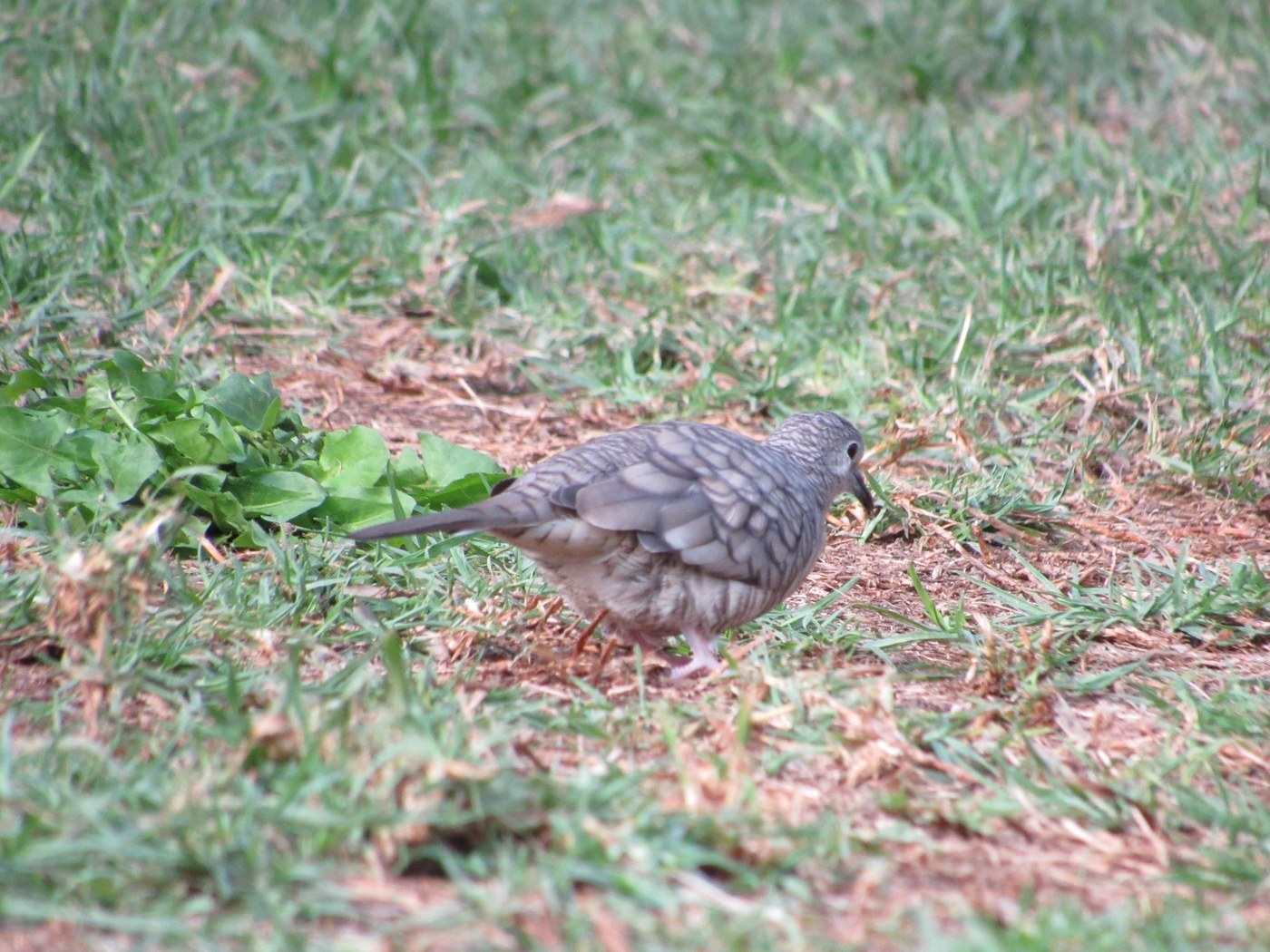
What Scaled Dove's Feathers Look Like
Scaled Dove (also called Scaly Dove) is a small, slender ground dove named for the distinctive pattern on its neck and breast feathers. Each feather on the neck, breast, and upper back carries a dark, crescent-shaped border around a paler center, so when several are seen together they create a neat, overlapping scaled or fish-scale pattern — this is the single most useful diagnostic feature and gives the species its common name. The overall base color of these scaled feathers is a soft grayish to pale brown, contrasting with the crisp dark edging. Wing feathers show a warm rufous-chestnut patch on the flight feathers, visible as a rusty wash on the primaries and wing coverts, which flashes noticeably in flight. The tail is relatively long and graduated for such a small dove, with the outer tail feathers blackish and tipped or edged in white or pale gray, creating a two-toned look when the tail is fanned. Feathers overall are small, mostly 3-8 cm, consistent with a bird only slightly larger than a sparrow.
Step-by-Step: Is This Feather From a Scaled Dove?
- Look for scalloped/scaled patterning: a small feather with a dark crescent border framing a pale center is highly diagnostic.
- Check for a rufous wing patch: rusty-chestnut coloring in the flight feathers supports the ID.
- Examine tail feathers: blackish outer tail feathers with white or pale tips/edges suggest this species.
- Assess size: small, generally under 8 cm, consistent with a compact ground dove.
- Confirm rounded dove shape: broad, rounded feather tips typical of pigeons/doves rather than pointed songbird feathers.
- Consider habitat: open, dry scrubby country, forest edge, or human-altered land in the Neotropics.
Similar Species & How to Tell Them Apart
Common Ground Dove, which overlaps in parts of its range, is smaller and shows scaling concentrated more on the head/breast with less contrast, plus a shorter tail and a more uniformly grayish-brown back without as sharp a scale pattern — Scaled Dove's scaling tends to be crisper and more extensive down onto the upper back. Ruddy Ground Dove lacks true scaling altogether, showing plain rufous-brown body feathers with dark wing spotting instead of a scaled neck/breast, so any feather with genuine crescent scaling rules out Ruddy Ground Dove. Picui Ground Dove, another regional look-alike, has a more grayish overall tone with a distinct blackish stripe on the closed wing rather than the fine head-to-breast scaling that defines Scaled Dove.
Where & When You'll Find Them
Scaled Dove is found across much of South America east of the Andes, favoring open and semi-open country, savanna, scrubland, agricultural areas, and increasingly urban parks and gardens where it has adapted well to human presence. Because it's a ground forager, feathers are commonly found on bare soil, gravel paths, or short grass where the bird walks and feeds, often near human settlements. This species breeds over an extended period across much of its warm range with relatively little strict seasonality, so feathers can be found throughout the year, though local breeding peaks tied to regional wet seasons may produce brief upticks in fresh contour and juvenile down feathers.
Frequently asked questions
What is the defining feature of Scaled Dove feathers?
A dark crescent-shaped border framing a paler center on the neck and breast feathers, creating a scaled or fish-scale look.
Does Scaled Dove have any rufous coloring?
Yes, a rufous-chestnut patch appears on the wing feathers, visible as a rusty flash in flight.
How do I rule out Ruddy Ground Dove?
Ruddy Ground Dove lacks true scaling and instead shows plain rufous-brown body feathers with dark wing spots, so any crescent-scaled feather points to Scaled Dove instead.
Is there a specific season to find these feathers?
Not strongly — breeding is extended with little strict seasonality across its range, so feathers can be found year-round with local upticks during regional wet seasons.
Where geographically would I find this species?
Open and semi-open country across much of South America east of the Andes, including savanna, scrubland, and urban parks.