
How to Identify Scarlet Macaw Feathers
A guide to the huge scarlet body feathers and yellow-and-blue wing feathers of the Scarlet Macaw, a giant Neotropical parrot, and how to tell it apart from other large macaws.
Read the full Scarlet Macaw encyclopedia entry →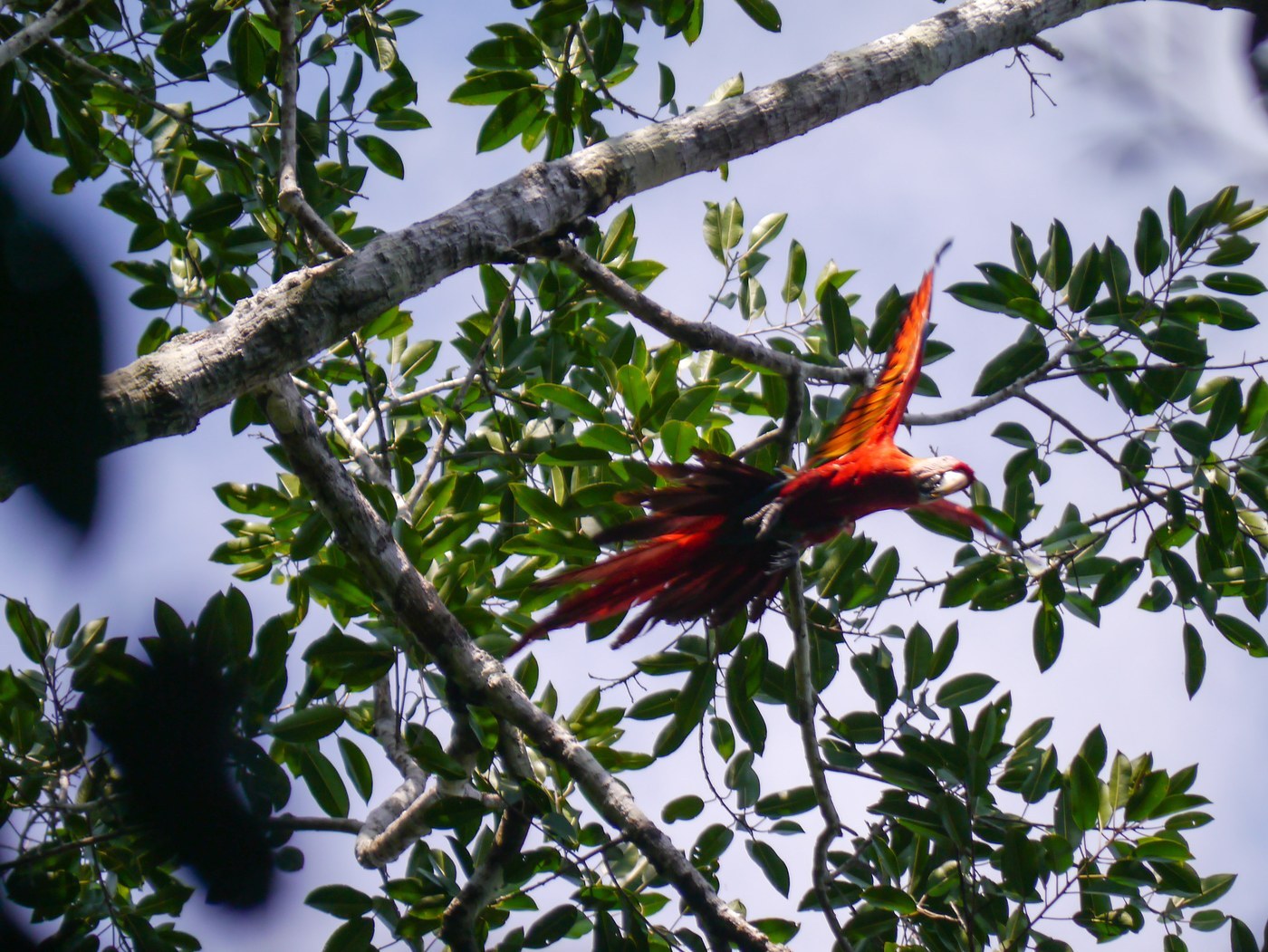
What Scarlet Macaw's Feathers Look Like
Scarlet Macaw is one of the largest and most vividly patterned parrots in the world, and its feathers are correspondingly enormous and boldly zoned by color. Body feathers covering the head, neck, breast, and back are a bright, saturated scarlet-red, generally large and rounded, often 8-15 cm even for contour feathers. The wing tells a clear three-color story useful for identification: lesser wing coverts continue the red, but the greater coverts and secondaries shift to bright yellow, and the outer primary feathers turn a rich cobalt blue — so a genuine Scarlet Macaw wing feather set, viewed together, shows a red-yellow-blue progression across the wing rather than a single color. Tail feathers are extremely long (often 35-50 cm in a full adult), mostly red with blue tips, tapering to a point. Feather shafts are thick and strong, reflecting the bird's large size and powerful flight, and the overall texture is glossy rather than matte.
Step-by-Step: Is This Feather From a Scarlet Macaw?
- Check for large size: contour feathers well over 8 cm and tail feathers potentially 35+ cm point to a macaw-sized bird.
- Look for the red-yellow-blue wing progression: red coverts transitioning to yellow then blue across the wing is highly diagnostic.
- Examine tail feathers: long, red feathers with blue tips are a strong confirming sign.
- Assess overall red saturation: body feathers should be a vivid, warm scarlet, not orange-red or brick-red.
- Rule out green tones: this species has no green feathers anywhere, unlike some other large macaws.
- Consider range/context: found (wild or escaped) in Neotropical lowland forest, or as a common aviary/pet bird virtually anywhere.
Similar Species & How to Tell Them Apart
Green-winged Macaw (Red-and-green Macaw) is similarly large and red-bodied but shows green (not yellow) greater coverts in the wing, with the red-to-green-to-blue progression replacing Scarlet Macaw's red-to-yellow-blue pattern — a feather showing green rather than yellow in the mid-wing rules out Scarlet Macaw. Military Macaw is predominantly green-bodied with only a red forehead patch, easily ruled out since its body feathers are green rather than red. Because macaws are widely kept in captivity, an unusually perfect or clipped feather found far outside Central/South American forest habitat may well be from an aviary bird rather than a wild one, though the color pattern itself is identical either way.
Where & When You'll Find Them
Scarlet Macaw ranges through lowland tropical forest, forest edge, and gallery forest from southern Mexico through Central America and into the Amazon basin of South America, typically favoring areas with tall trees for nesting cavities and clay licks where flocks gather to eat mineral-rich soil. Feathers are most likely to be found near these clay licks, fruiting trees, or nest cavities in emergent forest trees, where birds spend long periods and naturally shed feathers during preening and molt. Molt in macaws tends to be gradual and continuous rather than sharply seasonal, so feathers can be found through much of the year in appropriate habitat, though breeding season activity (which varies by region, often tied to the dry season in much of its range) can increase feather turnover around active nest sites.
Frequently asked questions
What's the best way to confirm a Scarlet Macaw feather versus another big red macaw?
Check the wing coverts: Scarlet Macaw shows a yellow band between the red and blue sections, while Green-winged Macaw shows green in that same position instead of yellow.
How long can Scarlet Macaw tail feathers get?
Full adult tail feathers can reach 35-50 cm, among the longest of any common parrot species.
Does this species have any green feathers?
No, true Scarlet Macaw has no green feathers anywhere on the body or wings, unlike Green-winged and Military Macaw.
Could a feather like this come from a captive bird rather than a wild one?
Yes, since Scarlet Macaws are widely kept in captivity, a feather found outside its natural Central/South American range is more likely from an aviary bird, though the color pattern is identical.
Is there a specific molt season?
Not sharply — molt is gradual and continuous, though breeding-season activity near nest cavities can increase local feather turnover.
Scarlet Macaw identified by the community
Recent Scarlet Macaw feathers identified with Feather Identifier.


