
How to Identify Seaside Sparrow Feathers
A field guide to recognizing the dull olive-gray, salt-marsh-camouflaged feathers of the Seaside Sparrow and telling them apart from other marsh sparrows.
Read the full Seaside Sparrow encyclopedia entry →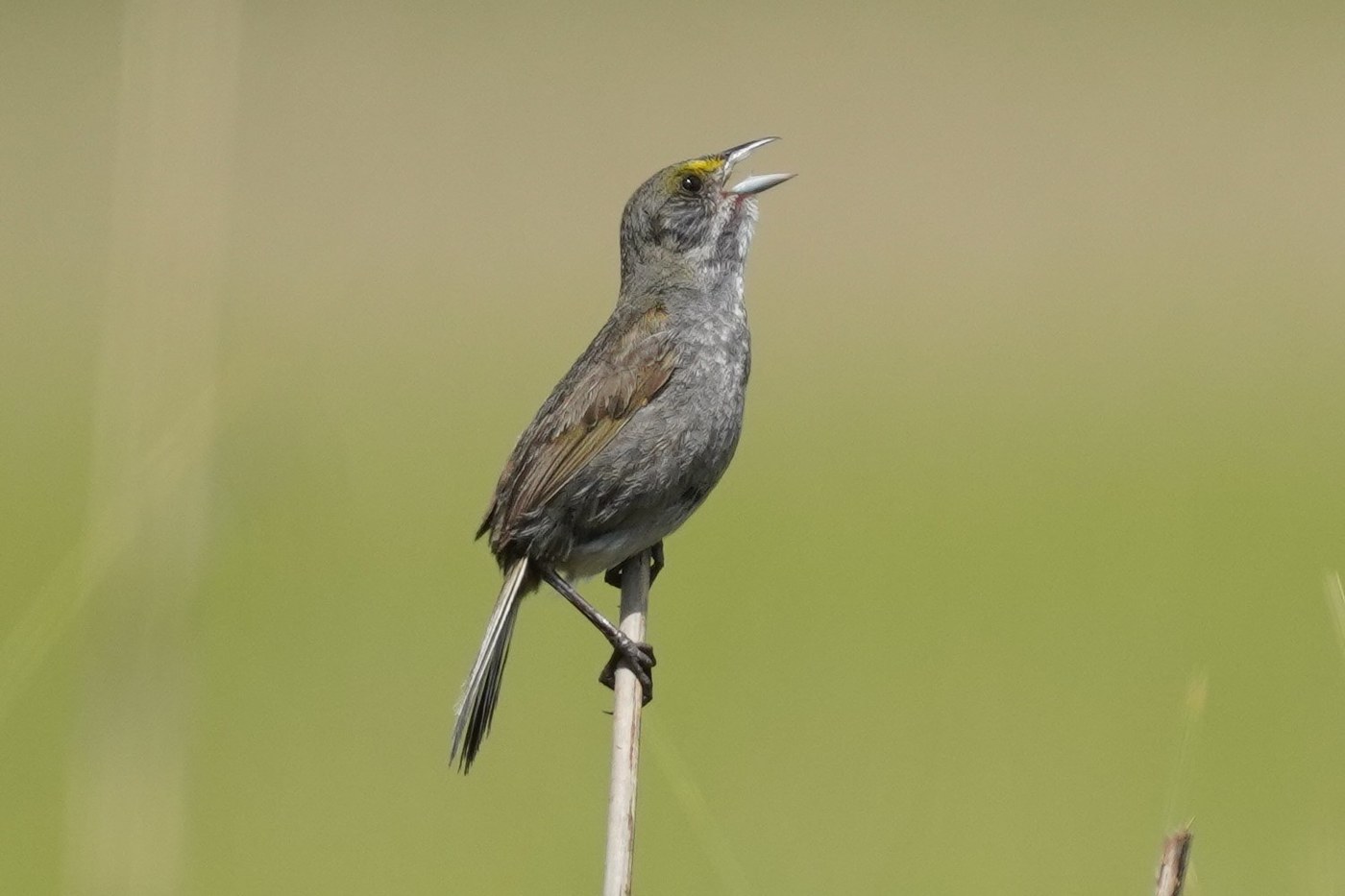
What Seaside Sparrow Feathers Look Like
Seaside Sparrow feathers reflect a bird built to disappear into cordgrass, not to show off. Contour feathers from the back and crown are dull olive-gray to grayish-brown, lacking the warm rufous tones seen in many sparrows. Breast and flank feathers are dingy grayish-white with blurry, diffuse gray streaking rather than crisp, sharp streaks. A distinctive clue on facial feathers is a small patch of dull yellow-orange at the base of the feathers around the lores (the area between the eye and bill) — even a single loose feather from this spot, if it shows a yellow wash at the base, is a strong hint. Flight feathers (primaries and secondaries) are plain grayish-brown with no bars or wing bars to speak of, and the tail feathers are short, narrow, and pointed with rounded tips, typical of the genus Ammospiza. Overall feather size is modest for a sparrow — primaries usually run 5–6 cm, tail feathers 5–6.5 cm.
Step-by-Step: Is This Feather From a Seaside Sparrow?
- Measure it. Body contour feathers should be small (2–4 cm); flight feathers 5–7 cm. Anything larger points to a different bird entirely.
- Check the color base. Look for an overall grayish-olive cast with no bright rufous or chestnut tones — Seaside Sparrows are among the drabbest of the marsh sparrows.
- Look for diffuse streaking. Breast/flank feathers show soft, smudgy gray streaks on a whitish-gray ground, not bold blackish streaks on a bright buffy ground.
- Search for a yellow tinge. A tiny yellow-orange wash at the feather base (from the lores) is one of the most reliable single clues.
- Note the habitat context. If the feather was found anywhere but a tidal salt marsh, reconsider — this species almost never strays from cordgrass and needlerush habitat.
- Rule out barring. No barring on wings or tail; feathers are essentially plain.
Similar Species & How to Tell Them Apart
The two most likely confusion species share the same marsh: Saltmarsh Sparrow and Nelson's Sparrow. Both are noticeably brighter and warmer than Seaside Sparrow, with rich orange-buff faces and chests and crisp, dark streaking — Seaside Sparrow feathers look washed-out and gray by comparison. Song Sparrow (a common marsh edge visitor) has bolder, blacker streaking on a whiter background and a longer, more rounded tail with a central breast spot pattern rather than diffuse streaks. Song Sparrow feathers are also usually a bit larger and browner, lacking any yellow lore tinge.
Where & When You'll Find Them
Seaside Sparrows are year-round residents of Atlantic and Gulf Coast tidal salt marshes from New England south through Texas, rarely moving more than a short distance inland even during migration since most populations are non-migratory or only partially migratory. Because of this fidelity to marsh habitat, a found feather is almost always going to be within a stone's throw of tidal cordgrass or black needlerush. Molt happens in late summer through early fall (roughly August–October) after breeding, which is when most loose contour and flight feathers turn up on marsh mud, wrack lines, and around dense grass tussocks where birds forage and roost.
Frequently asked questions
Why do Seaside Sparrow feathers look so plain compared to other sparrows?
Their coloring is an adaptation for camouflage in dense salt marsh grass, favoring dull olive-gray tones over the brighter rufous patterns many sparrows use in open or wooded habitats.
Is the yellow lore patch visible on a single loose feather?
Yes, if the feather comes from the area just above the bill, a faint yellow-orange wash at its base is often retained and is one of the most reliable clues for this species.
Could a marsh feather actually be from a Saltmarsh Sparrow instead?
It's possible where ranges overlap; look for brighter orange-buff tones and crisper black streaking, both of which point away from Seaside Sparrow.
What time of year are Seaside Sparrow feathers most common?
Late summer into early fall, during the post-breeding molt, is when the most feathers accumulate in marsh vegetation and wrack lines.
Do Seaside Sparrows have any wing bars or barring?
No, their wing and tail feathers are essentially plain and unbarred, which helps rule out several other marsh and grassland sparrows.