
How to Identify Snowy Plover Feathers
A guide to the pale sandy-gray feathers and partial breast patches of the Snowy Plover, a small shorebird camouflaged against open sand and salt flats.
Read the full Snowy Plover encyclopedia entry →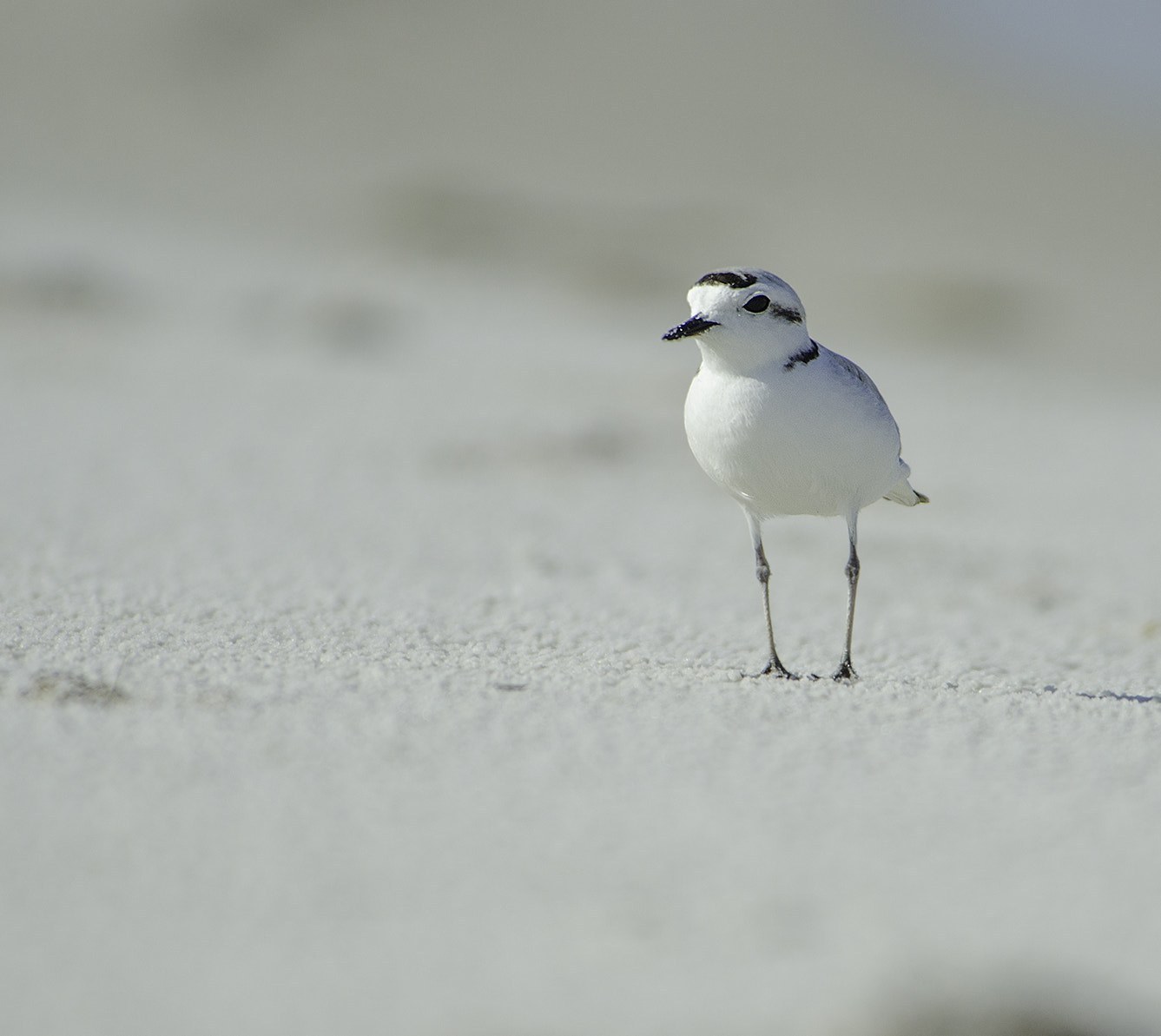
What Snowy Plover Feathers Look Like
Snowy Plover is a small, pale shorebird whose feathers are noticeably lighter than most other plovers, an adaptation for blending into open sand and salt-flat habitat. Back and crown feathers are a pale sandy brown to grayish tone — much paler than the darker browns seen in many other small plovers. Underparts are white, and the only dark markings are small, incomplete patches at the sides of the breast, never joining into a full band across the chest — a key structural difference from several similar species. A small dark patch also occurs behind the eye. In flight, wing feathers show a crisp white stripe, and tail feathers are pale brown-gray with white edges, especially on the outer feathers. Overall feather size is small, matching this diminutive shorebird, with primaries typically 8–10 cm.
Step-by-Step: Is This Feather From a Snowy Plover?
- Check overall paleness. A back or crown feather that reads notably pale sandy brown or gray, rather than dark brown, fits this species' camouflage strategy.
- Look at the breast pattern. Dark feathers should be confined to small patches at the sides of the breast — a feather suggesting a full, unbroken dark band across the chest points to a different species.
- Examine the wing stripe. A crisp white stripe on the wing feathers, visible in flight, supports this identification.
- Check tail edges. Pale brown-gray tail feathers with white edging, especially on the outer pair, are consistent with Snowy Plover.
- Confirm sandy or salt-flat habitat. A feather found on open beach sand or alkali flats fits this species' strong habitat preference.
Similar Species & How to Tell Them Apart
Piping Plover is even paler still and shows a single breast band that can be either broken or complete depending on the individual, plus its legs and bill base carry an orange tone (though this won't show on a feather itself) — range is a helpful extra clue since Piping Plover favors the Atlantic coast, Great Lakes, and northern prairies rather than the more western and Gulf coast range of Snowy Plover. Wilson's Plover is notably larger with a heavier bill and shows a complete, solid dark breast band, unlike Snowy Plover's broken side patches. Kentish Plover, the Old World counterpart, looks nearly identical in feather but occupies a separate range in Europe, Asia, and Africa, so location is the main distinguishing factor when feather features alone are inconclusive.
Where & When You'll Find Them
Snowy Plovers nest directly on the ground on sandy beaches, alkali flats, and salt pans across the western United States, the Gulf Coast, and parts of South America, which means feathers are often found scattered across open sand rather than near trees or dense vegetation. Because nests sit exposed on bare ground, feathers can be found near nesting areas throughout the breeding season, with the heaviest feather turnover coming during the post-breeding molt in late summer, timing that varies somewhat by local population since breeding season length differs across this species' broad range.
Frequently asked questions
What's the key feather feature separating Snowy Plover from most other plovers?
An unusually pale sandy-brown or grayish back and crown color, paired with small, incomplete dark patches at the sides of the breast rather than a full chest band.
How is this different from Wilson's Plover?
Wilson's Plover is larger and shows a complete, solid dark breast band, while Snowy Plover has only small broken patches at the sides of the breast.
How do I separate Snowy Plover from Piping Plover by feather alone?
Both are pale, but Piping Plover is even paler and its breast band pattern varies from broken to complete; range is often the most reliable extra clue since the two species favor different regions.
Where would I find a Snowy Plover feather?
On open sandy beaches, alkali flats, or salt pans, since this species nests directly on bare ground in these open habitats.
When is feather turnover highest?
During the post-breeding molt in late summer, though exact timing shifts somewhat depending on the local population's breeding schedule.