
How to Identify Solitary Sandpiper Feathers
A guide to the dark, finely spotted feathers and dark underwing of the Solitary Sandpiper, and how to separate it from Spotted Sandpiper and yellowlegs.
Read the full Solitary Sandpiper encyclopedia entry →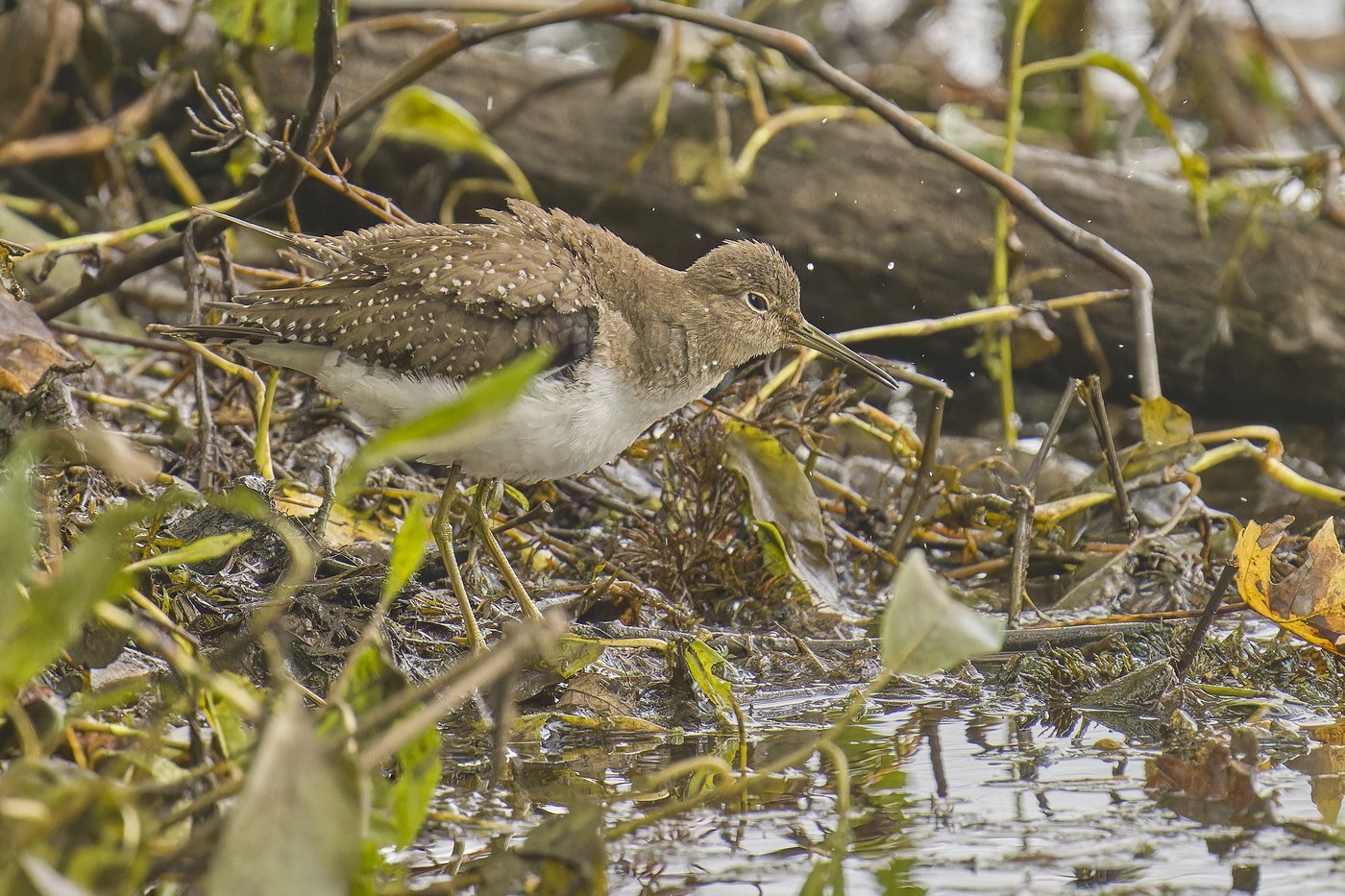
What Solitary Sandpiper Feathers Look Like
Solitary Sandpiper is a dark, understated shorebird of freshwater edges, and its feathers show more contrast between plumage areas than its plain name might suggest. Back and wing covert feathers are a dark olive-brown to blackish with small, neat white spots dotted evenly along the edges — finer and more uniform than the coarser spotting seen in some larger relatives. A bold white eyering is visible on facial feathers. The single most diagnostic feather is from the underwing: covert feathers there are dark gray to blackish, contrasting sharply with the otherwise pale white belly — a feature that immediately narrows down the possibilities among similar shorebirds. Tail feathers, especially the outer pair, are barred black and white, more strongly patterned than the plain central tail feathers. Overall feather size is modest, with primaries around 10–12 cm.
Step-by-Step: Is This Feather From a Solitary Sandpiper?
- Check underwing color first. A dark gray to blackish underwing covert feather is the single strongest clue for this species among similarly-sized shorebirds.
- Look for fine, even white spotting. Small, neatly spaced white dots along the edges of dark olive-brown back or covert feathers fit this species.
- Examine outer tail feathers. Bold black-and-white barring on the outer tail feathers, with plainer central feathers, supports this identification.
- Rule out coarse spotting. Larger, more irregular white spotting suggests a bigger relative like a yellowlegs rather than Solitary Sandpiper.
- Confirm freshwater edge habitat. A feather found at the margins of ponds, ditches, or forest pools (rather than open mudflats or coastline) fits this species' preferred foraging habitat.
Similar Species & How to Tell Them Apart
Spotted Sandpiper in juvenile or winter plumage lacks the fine white spotting on the back and shows a white, not dark, underwing — a quick and reliable way to separate the two when underwing feathers are available. Lesser and Greater Yellowlegs are notably larger, with correspondingly bigger feathers, coarser and less uniform white spotting, and a paler, less contrasty underwing than Solitary Sandpiper's dark one. The Old World Green Sandpiper is an extremely close counterpart, sharing the dark underwing and fine spotting almost feather-for-feather, but the two species' ranges don't meaningfully overlap, making location the deciding factor in that rare case of confusion.
Where & When You'll Find Them
Despite its name, Solitary Sandpiper isn't found in unusual habitat so much as it forages alone rather than in flocks, typically at the muddy edges of ponds, ditches, and shaded forest pools rather than open mudflats or beaches. Unusually among sandpipers, it breeds in boreal forest, using old songbird nests in trees rather than nesting on the ground — a behavior worth noting since it means breeding-ground feathers may occasionally be found well away from open water, near forest nest trees. It winters in Central and South America, and the complete molt largely occurs on the wintering grounds, so freshly molted feathers are more likely to be found there or along the migratory route rather than near the breeding grounds themselves.
Frequently asked questions
What's the clearest single feather feature for Solitary Sandpiper?
A dark gray to blackish underwing covert feather, which contrasts sharply with the pale belly and separates this species from most similarly sized shorebirds.
How is this different from Spotted Sandpiper?
Juvenile or winter Spotted Sandpiper lacks the fine white back spotting and shows a white underwing, while Solitary Sandpiper has neat white-spotted upperparts and a dark underwing.
How do I rule out a yellowlegs?
Yellowlegs feathers are larger overall, with coarser and less evenly spaced white spotting and a paler underwing than Solitary Sandpiper's dark one.
Where does this species nest?
Unusually for a sandpiper, it breeds in boreal forest and uses old songbird nests in trees rather than nesting on the ground.
When and where does molt mostly happen?
The complete molt largely occurs on the wintering grounds in Central and South America, so fresh feathers are more likely found there or along migration routes than near the breeding range.