
How to Identify Spotted Nutcracker Feathers
A guide to identifying Spotted Nutcracker feathers by their chocolate-brown body densely covered in white spots, glossy black wings, white undertail coverts, and stout bill, distinguishing them from Clark's Nutcracker and other corvids.
Read the full Spotted Nutcracker encyclopedia entry →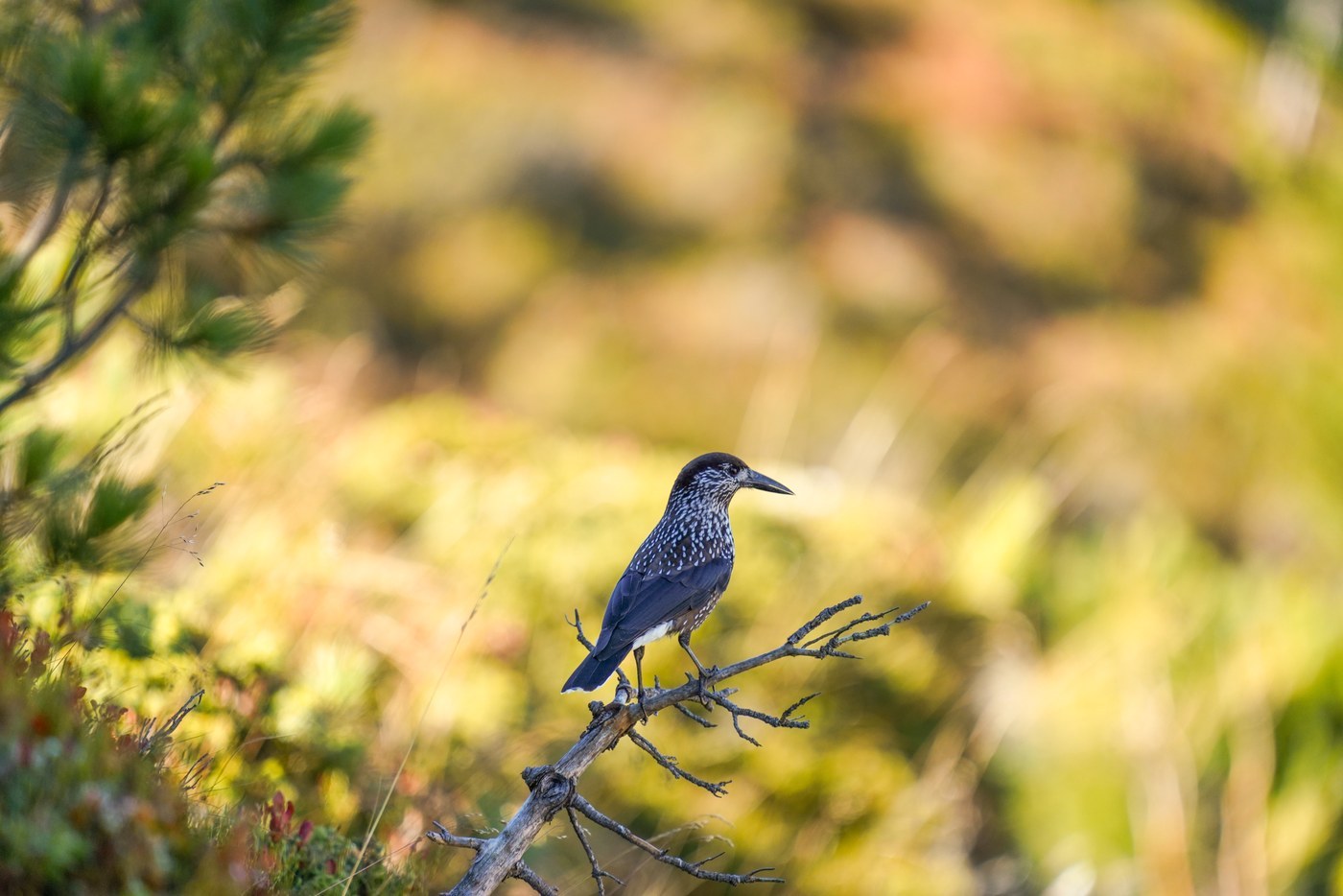
What Spotted Nutcracker's Feathers Look Like
Spotted Nutcracker is a Eurasian corvid closely tied to conifer and hazel forests, and its body feathers carry an unmistakable pattern that gives the species its name. Body feathers across the breast, back, and flanks are a rich chocolate-brown ground, each feather tipped with a crisp white spot, producing an evenly speckled appearance across nearly the entire body — quite different from the plain or streaked plumage of most other corvids. The crown is a slightly darker, less spotted brown cap by comparison.
Wing feathers are glossy black with a blue-green sheen, contrasting sharply against the spotted brown body, and the undertail covert feathers are a clean bright white, forming a conspicuous white patch under the black tail that flashes as the bird flies away. The tail itself is black with white corners/tips on the outer feathers, visible as a pale band when fanned. The bill-supporting facial feathers frame a notably long, straight, stout bill (built for prying open hazelnuts and conifer cones), giving the head a heavier, more elongated look than most similarly sized songbirds.
Step-by-Step: Is This Feather From a Spotted Nutcracker?
- Check body feathers for chocolate-brown ground with white spot tips. Dense, even white spotting across an otherwise brown feather is the single strongest clue to this species.
- Look at wing feather color. Glossy black with blue-green iridescence, contrasting against the spotted body, supports this identification.
- Confirm undertail covert color. Bright white undertail feathers set against black tail feathers is a hallmark of Spotted Nutcracker.
- Examine tail corners. White tips or corners on the outer tail feathers, visible when fanned, add further support.
- Consider habitat. Feathers found in conifer or hazel-rich forest across Eurasia strongly favor this species.
Similar Species & How to Tell Them Apart
- Clark's Nutcracker — restricted to western North America (no range overlap), with an overall pale gray body lacking any white spotting, black wings showing bold white secondary patches, and a black tail with white outer feathers — an entirely different pattern from Spotted Nutcracker's brown-and-spotted body.
- Eurasian Jay — shows pinkish-brown body plumage with a streaked black crown and a bright blue wing patch barred black and white, quite different from the evenly spotted brown body and unbarred black wings of Spotted Nutcracker.
- Common Starling (worn winter plumage) — can show scattered pale spotting, but has a much shorter, straighter, more slender bill and a smaller, more compact body shape than the heavy-billed nutcracker.
Where & When You'll Find Them
Spotted Nutcrackers are closely tied to coniferous and hazel forests across much of Eurasia, from Scandinavia and central Europe through Siberia to Japan, where they cache enormous numbers of hazelnuts and conifer seeds for winter. Feathers are most often found near favored caching and foraging areas in coniferous or hazel woodland, especially in late summer and fall during peak seed-caching activity and the post-breeding molt, and irruptive individuals occasionally wander well beyond the normal range in years of poor seed crops, potentially turning up feathers outside typical habitat.
Frequently asked questions
What is the single best clue for identifying a Spotted Nutcracker feather?
A chocolate-brown body feather tipped with a crisp white spot — dense, even white spotting across nearly the whole body is this species' defining and most reliable trait.
How do I tell this apart from Clark's Nutcracker?
Clark's Nutcracker occurs only in western North America with no range overlap, and shows a plain pale gray body with no white spotting at all, quite different from Spotted Nutcracker's brown-and-spotted plumage.
What color are the undertail feathers?
Bright white, forming a conspicuous patch set against the black tail — a useful confirming feature alongside the spotted body plumage.
Why does this species have such a stout bill?
It's adapted for prying open hazelnuts and conifer cones, which the species caches in huge numbers for winter, and this heavy bill goes along with a somewhat elongated, heavier head profile than similarly sized songbirds.
When are Spotted Nutcracker feathers most likely to be found?
Late summer and fall are most productive, coinciding with peak seed-caching activity and the post-breeding molt, especially near coniferous or hazel woodland foraging areas.