
How to Identify Swainson's Warbler Feathers
How the plain brown, unstreaked feathers and long bill of Swainson's Warbler set it apart from waterthrushes and other ground-dwelling warblers.
Read the full Swainson's Warbler encyclopedia entry →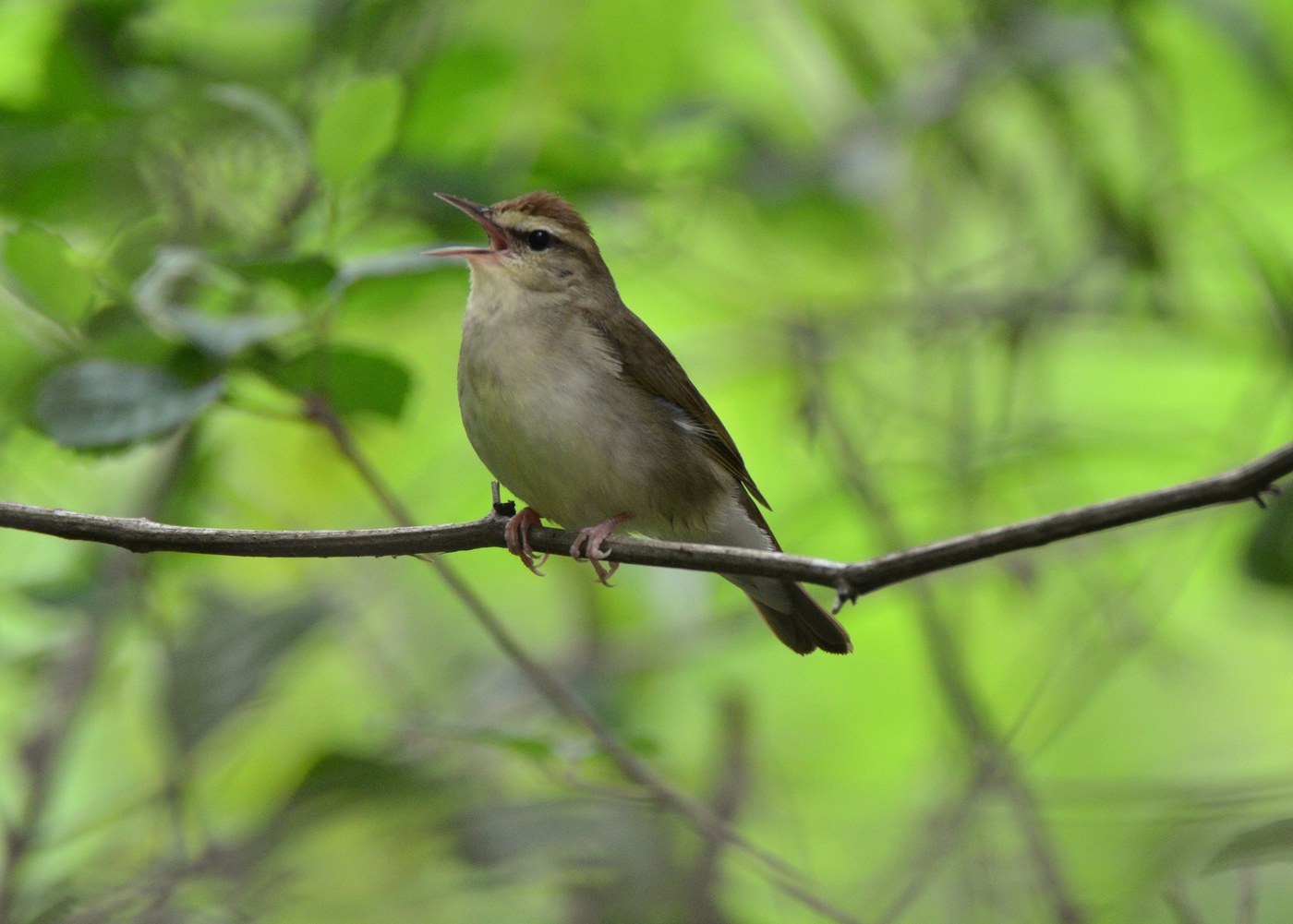
What Swainson's Warbler's Feathers Look Like
Swainson's Warbler is an unusually plain, large-bodied warbler adapted to skulking through dense canebrakes and swampy thickets, and its feathers reflect that camouflaged lifestyle. The crown feathers are a warm, slightly rufous-tinged brown, distinctly warmer than the back, giving the head a subtle capped appearance even on isolated crown feathers. Back, wing, and tail feathers are a plain olive-brown with no streaking, spotting, or wing bars whatsoever — a genuinely blank canvas compared to almost every other North American warbler, which makes the absence of pattern itself a useful clue. A pale, indistinct buffy-white eyebrow stripe is visible on face feathers, bordered below by a faint dusky eyeline. Underparts are a dingy off-white to pale buffy color, entirely unstreaked, sometimes with a faint yellowish or olive wash on the flanks. The bill-related feathering is unremarkable, but body proportions suggest a notably long, heavy bill relative to a typical warbler — useful contextual information if a bill fragment or head feathers are found together. Overall feather size is larger and the feathers themselves noticeably sturdier than the average wood-warbler, closer in bulk to a small thrush.
Step-by-Step: Is This Feather From a Swainson's Warbler?
- Check for any streaking at all. A truly plain, unstreaked brown-olive feather with no wing bars is the starting point — most other warblers show at least some streaking or wing pattern.
- Look at the crown color. A warmer, more rufous-brown tone on crown feathers compared to a cooler olive back supports this species.
- Assess size and sturdiness. Feathers that feel a bit large and stiff for a "typical" warbler, closer to thrush-like bulk, fit Swainson's.
- Rule out streaked underparts. Any streaking on breast/belly feathers points away from this species toward a waterthrush instead.
- Consider habitat. Found in dense cane, rhododendron thickets, or wet bottomland forest undergrowth strongly favors Swainson's Warbler.
Similar Species & How to Tell Them Apart
Louisiana Waterthrush and Northern Waterthrush, which share swampy, streamside habitat, both have heavily streaked underparts, immediately separating them from Swainson's plain, unstreaked breast and belly feathers. Worm-eating Warbler, another plain brown warbler of similar habitat, shows bold black stripes on the crown (a striped, not solid, crown pattern) that Swainson's lacks entirely. Female or nonbreeding Prothonotary Warbler can share a plain look but shows a much more golden-yellow head and underparts rather than Swainson's dingy buff-white tones.
Where & When You'll Find Them
Swainson's Warbler breeds in dense, wet thickets — canebrakes, rhododendron tangles, and swampy bottomland forest with a heavy understory — across the southeastern United States, foraging almost entirely on or near the ground where it flips leaf litter for insects. Feathers are most often found low in this tangled understory during the breeding season (late spring through summer), and only rarely encountered during migration since this is a secretive, seldom-seen species even where common; wintering feathers may turn up in similarly dense thicket habitat in the Caribbean and Central America during the northern winter.
Frequently asked questions
What's the easiest way to rule out a waterthrush when identifying this feather?
Check for streaking on the underparts. Both waterthrush species have heavily streaked breasts and bellies, while Swainson's Warbler is completely plain and unstreaked below.
Why is Swainson's Warbler's plumage so plain compared to other warblers?
It's adapted for camouflage in dense, shaded thicket and canebrake understory where bold patterns would be less useful than blending into brown leaf litter and stems.
How can I distinguish this species from Worm-eating Warbler by feather?
Worm-eating Warbler has bold black head stripes, while Swainson's Warbler's crown is a plain warm brown with no striping.
Where is a Swainson's Warbler feather most likely to be found?
Low in dense, wet thicket habitat such as canebrakes, rhododendron tangles, or swampy bottomland forest understory during the breeding season in the southeastern U.S.