
How to Identify Sword-billed Hummingbird Feathers
Identifying the iridescent green body feathers of this large Andean hummingbird known for having the longest bill relative to body size of any bird.
Read the full Sword-billed Hummingbird encyclopedia entry →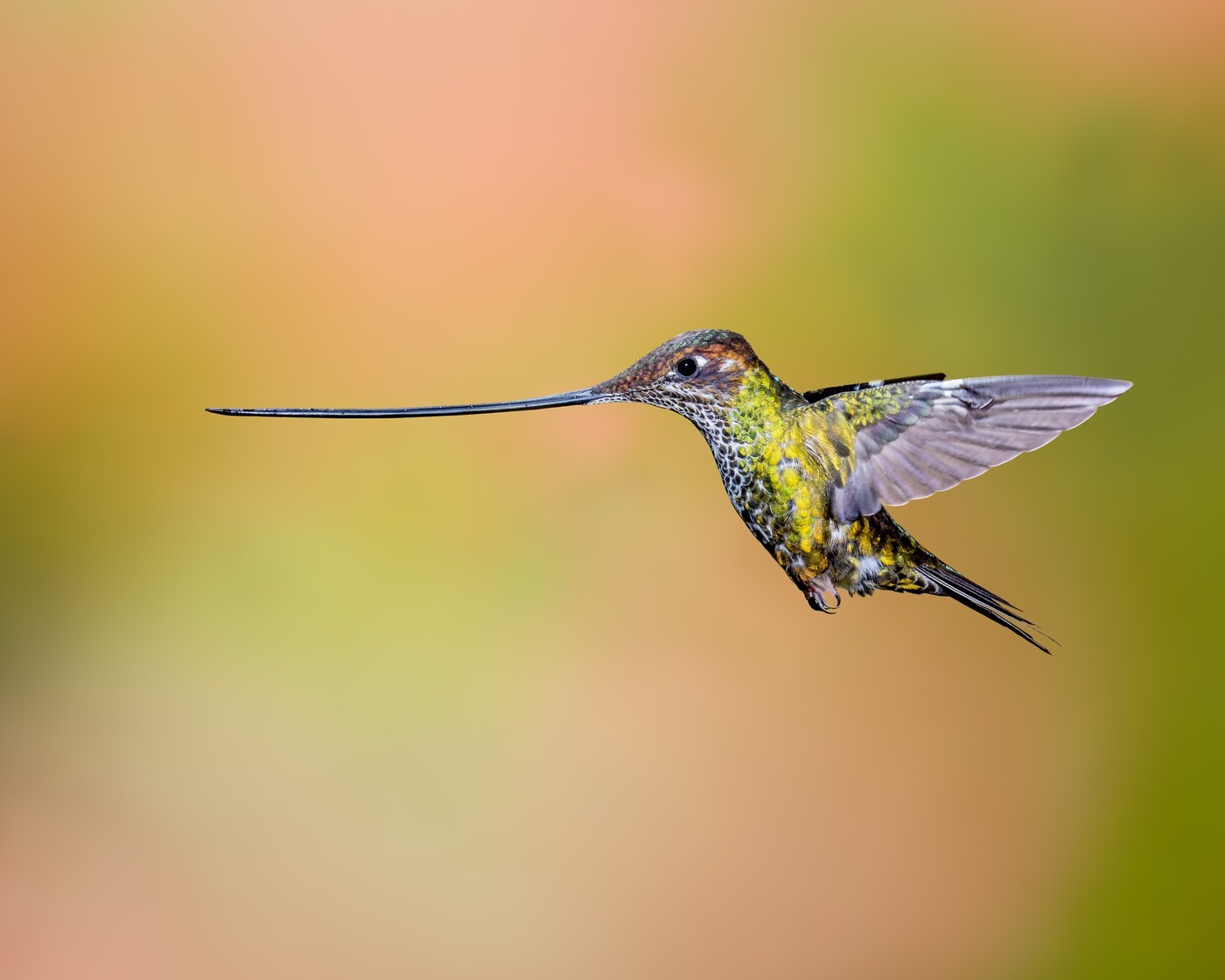
What Sword-billed Hummingbird's Feathers Look Like
Sword-billed Hummingbird is a large hummingbird from the high Andes, and while its famously enormous bill isn't feathered, the surrounding plumage carries typical hummingbird traits at an unusually large scale. Male body feathers show iridescent bronze-green to coppery-green across the crown, back, and upper breast, shifting between dull olive and bright metallic green depending on light angle, consistent with the structural iridescence typical of hummingbird feathers. The underparts are duller, a mix of grayish or sooty-green feathers with faint iridescent flecking, less brilliant than the back. Females are generally similar but slightly less iridescent overall, with a somewhat paler, grayer belly. Flight feathers (primaries) are narrow, stiff, and dark grayish-black, built for the rapid wingbeats and hovering flight typical of hummingbirds, but notably longer than those of most hummingbird species given this bird's larger overall size. Tail feathers are dark, slightly forked in shape, with a faint bronze-green gloss on the central feathers. Overall, feather size for this species is distinctly larger than typical hummingbirds — this is one of the largest hummingbird species in the world — so even without the bill, a green iridescent feather of unusually large hummingbird proportions is a good clue.
Step-by-Step: Is This Feather From a Sword-billed Hummingbird?
- Check for iridescence. A body feather that shifts between dull olive and bright metallic green/bronze in different light is characteristic of hummingbird structural color.
- Assess size relative to typical hummingbirds. Feathers noticeably larger than those of common garden hummingbirds (this species is unusually large-bodied) support this identification.
- Look at flight feather shape. Narrow, stiff, blackish primaries consistent with rapid hovering flight, but on the longer end of the hummingbird size range.
- Consider underpart tone. A duller, sooty-gray-green belly feather paired with brighter bronze-green back feathers matches this species' typical two-toned look.
- Factor in elevation and location. Found in high-elevation Andean cloud forest, especially near long-tubed flowers this species specializes on, strongly supports the identification.
Similar Species & How to Tell Them Apart
Many Andean hummingbirds share iridescent bronze-green plumage, making feather-only identification to species genuinely difficult without the bill present. The Great Sapphirewing and other large Andean hummingbirds can show comparable size and green iridescence, but tend toward more blue-green or violet-blue tones on the crown rather than Sword-billed's bronzier cast. Practically, without the distinctively oversized bill attached, an isolated body feather is often best identified only as "large Andean hummingbird" rather than pinned to this exact species with full confidence.
Where & When You'll Find Them
Sword-billed Hummingbird lives in humid montane and cloud forest along the Andes from Venezuela south to Bolivia, typically at high elevations (1,700–3,500 meters), where it specializes in feeding from unusually long, tubular flowers like Passiflora and Datura that few other pollinators can access. Feathers are most likely to be found near flowering shrubs and forest edge in this high-elevation habitat, with molt occurring at various times depending on the local population's breeding schedule, which is less strongly seasonal near the equator than in temperate hummingbirds.
Frequently asked questions
Why doesn't the famous long bill help with feather identification?
The bill isn't made of feathers, so a detached feather alone won't show this signature trait — identification has to rely on body plumage color and overall feather size instead.
How large are Sword-billed Hummingbird feathers compared to other hummingbirds?
Noticeably larger, since this is one of the biggest hummingbird species in the world; feather size alone can help rule out the many smaller Andean hummingbird species.
Can I be certain a green iridescent Andean hummingbird feather is from this species?
Not usually with full confidence — several large Andean hummingbirds share similar bronze-green iridescence, so an isolated feather is often best labeled as a large hummingbird species rather than this one specifically.
Where would I find Sword-billed Hummingbird feathers?
High-elevation cloud forest and forest edge in the Andes, particularly near long-tubed flowering plants like Passiflora that this species specializes in feeding from.