
How to Identify Verdin Feathers
How to identify the tiny gray body, yellow head, and rufous shoulder patch of a Verdin, a small desert songbird.
Read the full Verdin encyclopedia entry →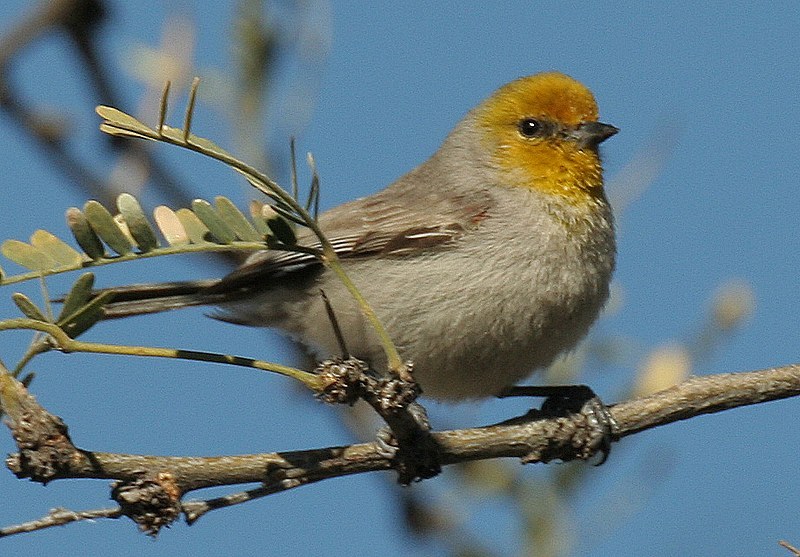
What Verdin's Feathers Look Like
Verdin is one of the smallest songbirds in North American deserts, and its feathers are correspondingly tiny but carry a couple of very useful color clues.
- Body/contour feathers: soft, plain gray overall, with no streaking or barring — a simple, unmarked gray that matches this bird's understated body plumage.
- Head feathers (adult): a patch of bright yellow feathers covers the head and throat in adults, a strong contrast against the gray body and one of the best single clues to this species.
- Shoulder/covert feathers: a small patch of rufous-chestnut feathers sits at the bend of the wing (lesser coverts) — another distinctive, localized color patch.
- Juvenile feathers: lack the yellow head and rufous shoulder entirely, appearing plain gray throughout, which can make young birds' feathers harder to pin down without other context.
- Wing and tail feathers: plain grayish-brown, unmarked, without wing bars.
- Size: extremely small — body contour feathers run 1-1.5 cm, flight feathers 3-4 cm — among the tiniest songbird feathers you'll find in desert habitat, reflecting this species' status as one of the smallest passerines in North America.
Step-by-Step: Is This Feather From a Verdin?
- Check for a yellow head feather. A small, bright yellow feather found in desert scrub, especially paired with plain gray body feathers, strongly suggests this species.
- Look for the rufous shoulder patch. A tiny rufous-chestnut feather from the wing-bend area is a second strong clue, often found alongside the gray and yellow feathers.
- Assess the size. Extremely small size (well under 4 cm even for flight feathers) fits Verdin better than most other desert songbirds.
- Consider plain gray feathers with no yellow. These could still be Verdin (juveniles lack the yellow head), so don't rule the species out solely on an absence of color if the feather is very small and found in the right habitat.
- Weigh the habitat. Feathers found in desert wash, mesquite, or thorny scrub in the southwestern U.S. or northern Mexico support this species strongly, since Verdin rarely strays from arid habitat.
Similar Species & How to Tell Them Apart
- Lucy's Warbler: shows a rufous crown patch and rufous rump, but its head is otherwise grayish, not bright yellow like adult Verdin.
- Bushtit: overall plain grayish-brown with no yellow or rufous patches at all, and a notably longer tail relative to body size.
- Lesser Goldfinch: has yellow underparts too, but shows a black cap and back (in males) or olive-green tones, quite different from Verdin's plain gray body with just a yellow head.
- Common Yellowthroat: has a bold black facial mask absent in Verdin, plus an overall more olive-green body tone.
Where & When You'll Find Them
Verdins are non-migratory residents of desert scrub, mesquite thickets, and arid washes across the southwestern United States and northern Mexico, often building distinctive globular thorn nests. Because they don't migrate, feathers can be found in their territory year-round, but the main molt follows the breeding season, roughly June through August, so late summer is the best time to find fresh feathers in desert scrub habitat.
Frequently asked questions
What's the single best clue for a Verdin feather?
A tiny bright yellow feather from the head, especially paired with plain gray body feathers and a small rufous shoulder-patch feather.
I found a plain gray feather with no yellow — could it be Verdin?
Yes, possibly a juvenile — young Verdins lack the yellow head and rufous shoulder patch entirely, showing plain gray plumage until they mature.
How do I tell this apart from Lucy's Warbler?
Lucy's Warbler has a rufous crown patch and rufous rump rather than a bright yellow head, and lacks Verdin's rufous wing-bend patch.
Would I find this feather outside desert habitat?
Unlikely — Verdins are strongly tied to desert scrub and arid washes, so feathers found in wetter or forested habitat are unlikely to be from this species.