
How to Identify Wedge-tailed Eagle Feathers
How the long graduated tail feathers forming a wedge shape and golden nape hackles identify Australia's largest raptor.
Read the full Wedge-tailed Eagle encyclopedia entry →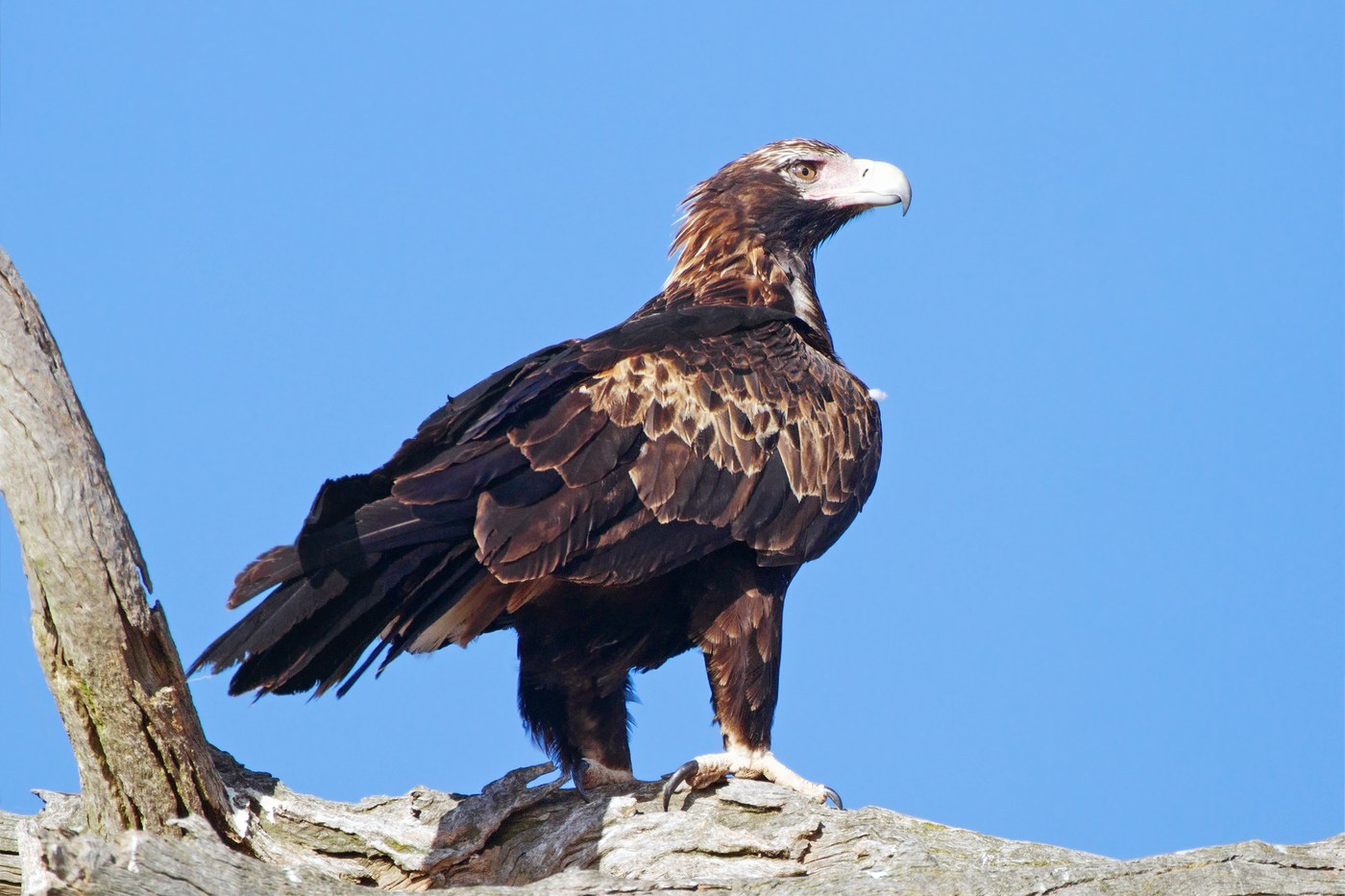
What Wedge-tailed Eagle Feathers Look Like
Wedge-tailed Eagle is Australia's largest bird of prey, and its tail feathers alone are often enough to confirm identification thanks to a shape found in no other Australian raptor.
- Tail feathers: long and strongly graduated, with the central pair distinctly longest — when the tail is fanned, this creates the diagnostic wedge or diamond shape that gives the species its name; even a single outer tail feather will show a clearly stepped, tapering length pattern relative to its neighbors.
- Body/contour feathers: overall blackish-brown, appearing almost black in adults, with younger birds showing more variable warm brown tones.
- Nape/neck feathers: elongated, pointed, golden-tawny hackle feathers that contrast with the darker body, giving the head and neck region a "maned" look.
- Flight feathers: very large, dark brown-black, reflecting the species' huge wingspan among the largest of any eagle worldwide.
- Leg feathers: fine feathering extends down the tarsus to the toes (a "booted eagle" trait), distinguishing it from raptors with bare legs.
- Size: among the largest eagle feathers you're likely to encounter in Australia or southern New Guinea, reflecting the species' status as the region's top raptor.
Step-by-Step: Is This Feather From a Wedge-tailed Eagle?
- Check for a wedge-shaped tail pattern. If you have several tail feathers or can judge graduation, a long central feather with progressively shorter outer feathers forming a wedge is essentially unique among Australian raptors.
- Look for golden nape feathers. Elongated, pointed, tawny-golden feathers from the neck/nape region contrasting against a dark body support this species.
- Assess overall darkness. Blackish-brown body feathers (rather than more mottled patterns) fit adult Wedge-tailed Eagle.
- Check leg feathering. Fine feathers extending down to the toes confirm a "booted eagle" rather than a bare-legged raptor.
- Consider size. Given the species' enormous wingspan, unusually large flight feathers found in Australian or southern New Guinean open woodland support this identification.
Similar Species & How to Tell Them Apart
- Little Eagle: much smaller overall, with a squared, banded tail rather than a graduated wedge shape, and lacks the golden nape hackles.
- Black Kite: has a distinctly forked tail rather than a wedge shape, and is considerably smaller with less bulky flight feathers.
- Whistling Kite: pale brown overall with a rounded tail, lacking both the wedge tail shape and golden nape feathering of Wedge-tailed Eagle.
- Immature Wedge-tailed Eagles: browner and more mottled than adults but still show the same diagnostic wedge-shaped tail graduation, making tail shape more reliable than body color across ages.
Where & When You'll Find Them
Wedge-tailed Eagles are found across nearly all of mainland Australia and southern New Guinea, favoring open woodland, arid country, and grassland where they hunt and scavenge over large territories. As a resident species with a large body size, its flight feather molt is protracted, often extending across a year or more per feather generation, so feathers can be found within its range at various times rather than concentrated in one short season.
Frequently asked questions
What's the single clearest way to confirm this species from feathers?
A tail feather showing strong graduation — the central feathers distinctly longer than the outer ones, forming a wedge shape when fanned — is essentially unique among Australian raptors.
How do the nape feathers help with identification?
Elongated, pointed, golden-tawny hackle feathers on the nape/neck contrasting against dark body feathers are a useful supporting clue for this species.
How is this different from Little Eagle?
Little Eagle is much smaller with a squared, banded tail rather than a graduated wedge shape, and lacks the golden nape hackles of Wedge-tailed Eagle.
Does body color change with age affect identification?
Yes, immatures are browner and more mottled than the blackish-brown adults, but the wedge-shaped tail graduation remains a reliable clue across all ages.
Is there a specific molt season for this species?
Not a sharply defined one — molt is protracted due to the bird's large size, so feathers can be found across a broad span of time within its Australian and southern New Guinea range.