
How to Identify Welcome Swallow Feathers
How rufous limited to the forehead and throat, plus grayish underparts, separate a Welcome Swallow feather from Barn Swallow.
Read the full Welcome Swallow encyclopedia entry →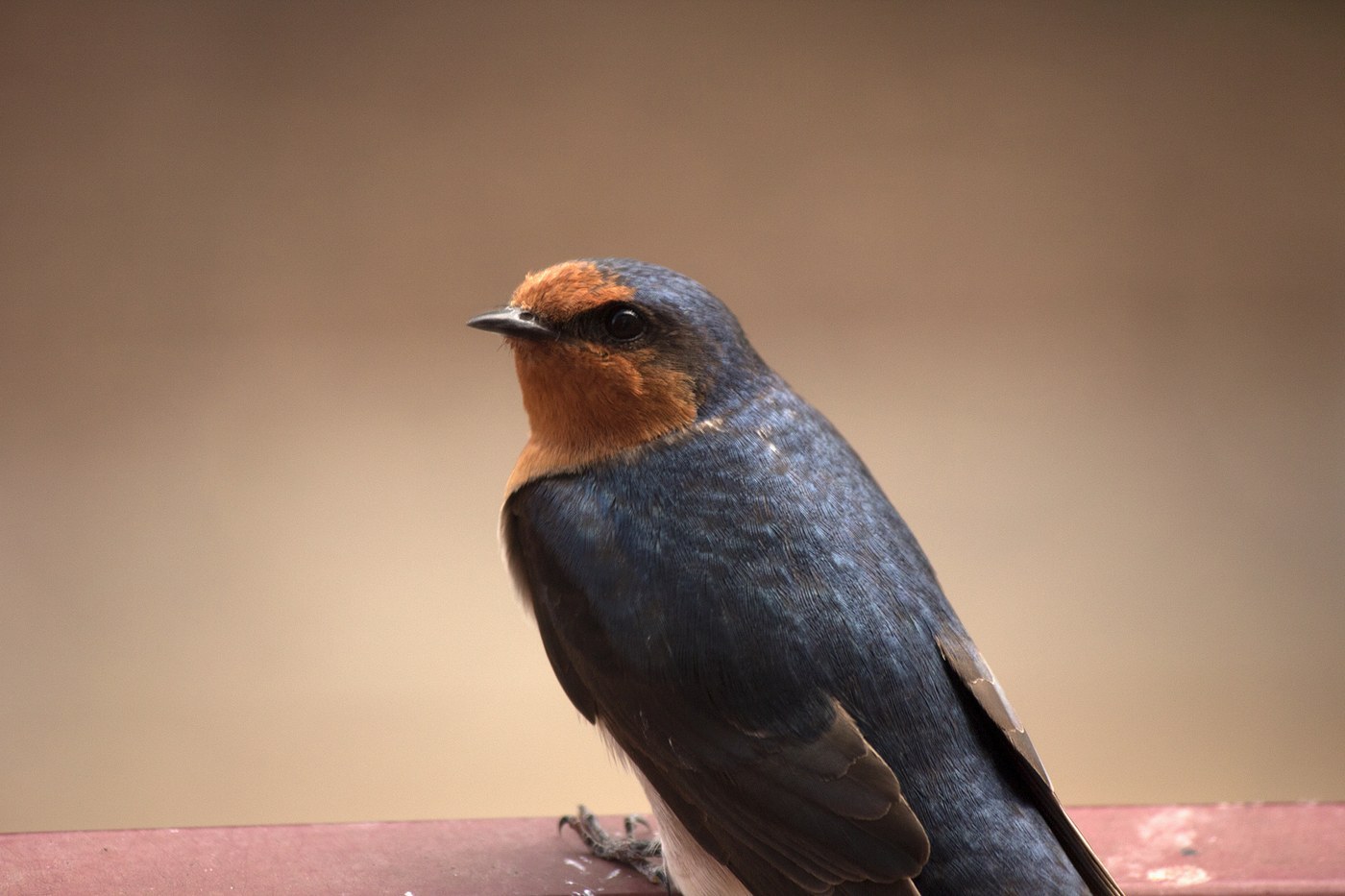
What Welcome Swallow Feathers Look Like
Welcome Swallow is the common swallow of Australia, New Zealand, and nearby Pacific areas, closely related to and easily confused with Barn Swallow, but with several consistent feather differences.
- Back/crown feathers: glossy blue-black, iridescent in good light, similar in tone to Barn Swallow.
- Forehead/throat feathers: rich rufous-chestnut, but notably confined to just the forehead and throat rather than spreading across the whole face.
- Breast band feathers: grayish, forming a subtle breast band below the rufous throat.
- Belly/underparts feathers: pale grayish-white, cooler in tone than the warmer buffy underparts typical of Barn Swallow.
- Tail feathers: moderately forked, with small white spots near the tips of the inner webs, visible as small pale spots when the tail is fanned; the outer tail streamers are notably shorter than Barn Swallow's.
- Size: small swallow feathers, body around 15 cm, generally slightly more compact than Barn Swallow.
Step-by-Step: Is This Feather From a Welcome Swallow?
- Check the extent of rufous coloring. If rufous is limited to the forehead and throat, without extending across the whole face, that favors Welcome Swallow over Barn Swallow.
- Assess underparts tone. Grayish-white (rather than warm buffy or orange) belly feathers support this species.
- Look at tail streamer length. Shorter outer tail feathers with a shallower fork suggest Welcome Swallow rather than the longer-streamered Barn Swallow.
- Check tail spot size. Small, modest white spots near the tail tip fit Welcome Swallow better than Barn Swallow's typically bolder white spots.
- Consider location. Feathers found in Australia, New Zealand, or nearby Pacific areas strongly favor Welcome Swallow as the default local swallow.
Similar Species & How to Tell Them Apart
- Barn Swallow: shows more extensive rufous across the face, warmer buffy underparts, longer tail streamers, and larger white tail spots; in Australia, Barn Swallow is typically a nonbreeding visitor rather than the common resident swallow.
- Pacific Swallow: found more in Asia and parts of the Pacific, with a shorter tail overall and darker, grayer underparts than Welcome Swallow.
- Tree Martin: has a shorter, less forked tail, a pale rump patch, and lacks the extensive rufous throat coloring of Welcome Swallow.
- Fairy Martin: shows a rufous crown and pale rump, with a square (not forked) tail, quite different from Welcome Swallow's forked tail and throat-only rufous.
Where & When You'll Find Them
Welcome Swallows are widespread across Australia, New Zealand, and nearby Pacific islands, nesting on buildings, bridges, and cliffs in open country, farmland, and towns. They are partial migrants, with some populations moving seasonally, so feathers are most commonly found near breeding sites during the austral spring and summer breeding season, with an additional wave of molted feathers appearing after breeding in the warmer months.
Frequently asked questions
What's the best clue for separating this from Barn Swallow?
Check how far the rufous coloring extends — Welcome Swallow's rufous is confined to the forehead and throat, while Barn Swallow shows more extensive rufous across the face along with warmer, buffier underparts.
Does tail length help identify this species?
Yes, Welcome Swallow has shorter outer tail streamers and a shallower fork compared to Barn Swallow's longer, more deeply forked tail.
How big are the white tail spots on this species?
They tend to be small and modest, smaller than the typically bolder white tail spots seen on Barn Swallow.
Is Barn Swallow common in Australia too?
Barn Swallow does occur in Australia but mainly as a nonbreeding visitor, so a feather found there during breeding season is more likely from the resident Welcome Swallow.
When are Welcome Swallow feathers most likely to be found?
During the austral spring and summer breeding season, and again after breeding when adults molt before any seasonal movement.