
How to Identify Western Marsh Harrier Feathers
How to tell Western Marsh Harrier feathers apart from other harriers using their long proportions, the male's silvery-gray flight feathers, and the female's cream throat patch.
Read the full Western Marsh Harrier encyclopedia entry →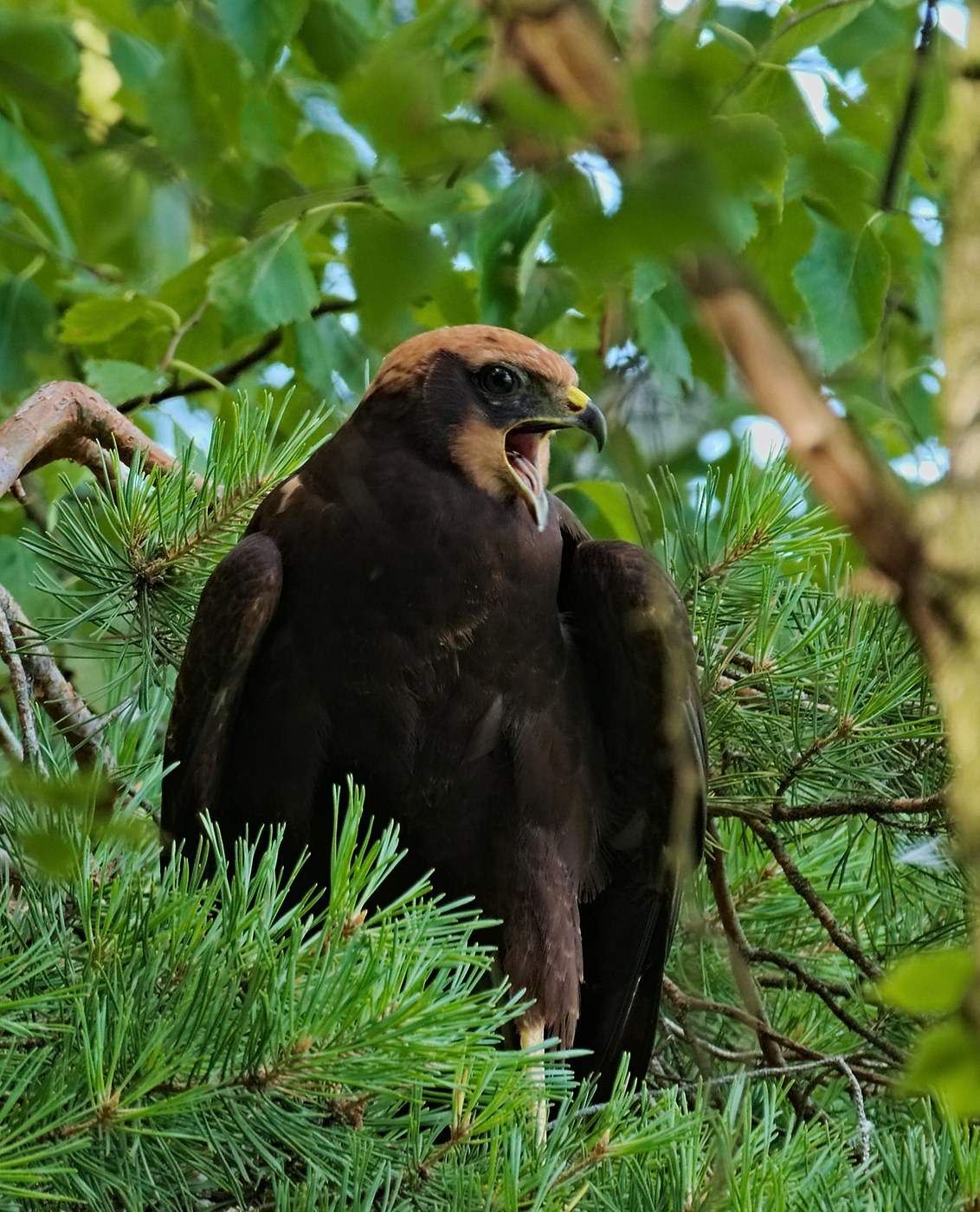
What Western Marsh Harrier Feathers Look Like
Western Marsh Harriers are large, long-winged raptors (48–56 cm body length, wingspan up to 1.3 m), and their feathers reflect that size and their low, quartering flight style over reedbeds. Adult male flight feathers (primaries and secondaries) are pale silvery-gray, contrasting with jet-black wingtips (outer primaries) — a two-tone effect unusual among harriers. Female and juvenile flight feathers are uniformly dark chocolate-brown with no strong contrast.
Tail feathers are long and rounded, an important marsh-harrier trait (harriers in general have proportionately longer tails than most other raptors of similar size). Male tail feathers are pale gray with faint, narrow dusky barring; female and juvenile tail feathers are warm brown, more distinctly barred.
Body (contour) feathers vary sharply by plumage: adult males show a chestnut-rust belly and pale gray head/throat; females and juveniles are dark blackish-brown overall except for a creamy-buff crown and throat patch — feathers from this "cream cap" area are pale straw-buff, a useful, unmistakable find if you come across one. Juveniles can look almost entirely blackish-brown with just this cream patch and sometimes cream shoulder patches.
Step-by-Step: Is This Feather From a Western Marsh Harrier?
- Measure length. Primaries typically run 9–13 inches on this large raptor; a feather this long from a marsh habitat is a good starting clue.
- Check for a two-tone wing feather. Pale silvery-gray body with black tip strongly suggests an adult male; uniform dark brown suggests a female or juvenile — not species-diagnostic alone, but consistent.
- Look for the cream throat/crown patch. A pale creamy-buff feather found alongside otherwise all-dark chocolate-brown feathers is a strong clue for female/juvenile Western Marsh Harrier.
- Note feather shape. Harrier flight feathers are notably long and slim relative to width, built for slow, buoyant flight — bulkier, broader feathers suggest a buteo or eagle instead.
- Confirm the setting. Reedbeds, marshes, wet grassland, or riverside vegetation across Europe, Asia, or Africa fit this species; harriers roost and nest on the ground in reeds, leaving feathers scattered at ground level rather than under trees.
Similar Species & How to Tell Them Apart
- Hen (Northern) Harrier — smaller and paler overall in males, with a crisp white rump patch (feathers from the rump are pure white, unlike Marsh Harrier's dark rump), and cleaner black wingtip contrast confined to fewer feathers.
- Montagu's Harrier — slimmer build, males show an extra dark bar across the secondaries (visible as a dark band on an otherwise pale gray flight feather) that Marsh Harrier lacks.
- Pallid Harrier — very pale male plumage with narrow black wedge at the wingtip, more contrast than Marsh Harrier's broader black tip.
- Common Buzzard — broader, shorter flight feathers with heavier barring throughout, not the plain pale gray or uniform brown of a harrier.
Where & When You'll Find Them
Western Marsh Harriers breed in reedbeds and marshy wetlands across Europe, western Asia, and parts of Africa, hunting low over vegetation for small mammals, birds, and amphibians. Many European populations migrate to sub-Saharan Africa for winter, while others are resident. Adults undergo a complete molt after breeding, from summer into autumn, and migratory birds often pause or slow their molt during migration, resuming on the wintering grounds — so fresh flight feathers are most likely to turn up near breeding reedbeds in late summer, while worn or part-grown feathers may appear during the migration period.
Frequently asked questions
How do I tell a male from a female Western Marsh Harrier feather?
Male flight and tail feathers are pale silvery-gray with a black wingtip and narrow dark tail barring; female and juvenile feathers are uniformly dark chocolate-brown, often with a creamy throat/crown patch.
What is the cream patch feather people mention?
It's the buff-cream crown and throat patch unique to females and juveniles — a pale straw-colored feather found among otherwise all-dark brown feathers strongly suggests this species.
Could this feather be from a Hen Harrier instead?
Check the rump — Hen Harrier has a bright white rump patch feather-for-feather, while Western Marsh Harrier's rump area is dark, matching the rest of the body.
Are Western Marsh Harrier feathers found on the ground or in trees?
Almost always on the ground, since harriers nest and roost in low reed and marsh vegetation rather than perching or nesting in trees.
When are fresh feathers most likely to appear near breeding marshes?
Late summer into autumn, during and after the post-breeding molt, before migratory birds depart for African wintering grounds.