
How to Identify Western Scrub-Jay Feathers
A guide to identifying Western Scrub-Jay (California Scrub-Jay) feathers using their unbarred blue wing and tail feathers, gray-brown back, and white eyebrow, distinguishing them from Steller's Jay and Woodhouse's Scrub-Jay.
Read the full Western Scrub-Jay encyclopedia entry →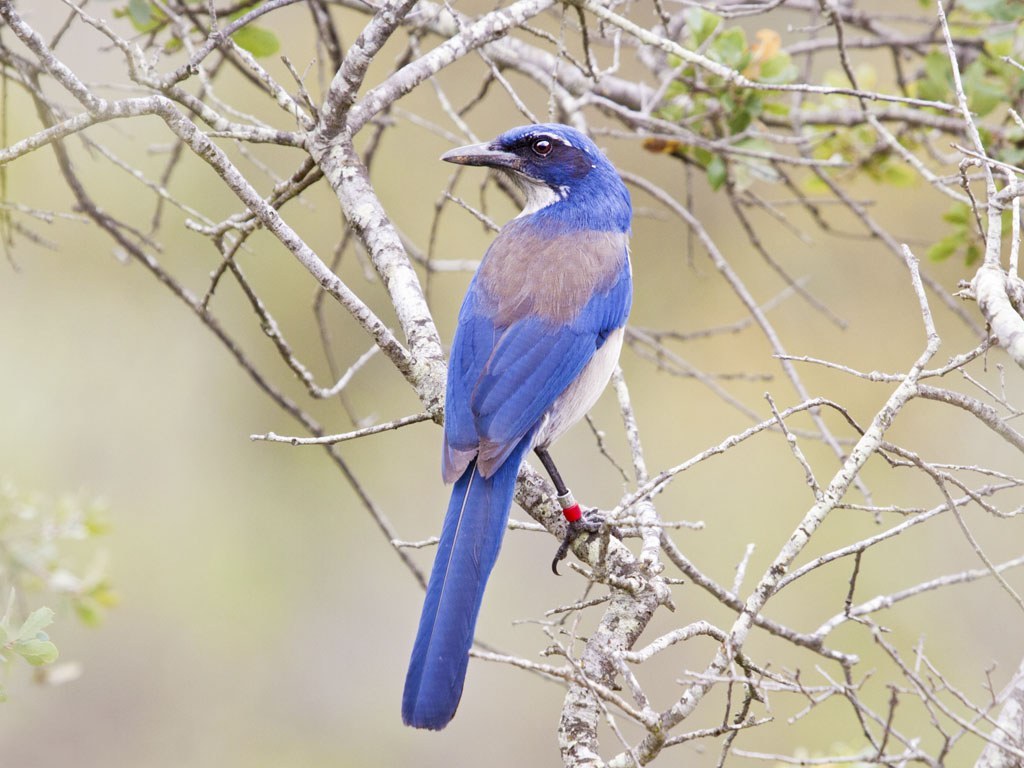
What Western Scrub-Jay Feathers Look Like
Western Scrub-Jay (the widely used name for what taxonomists now often split as California Scrub-Jay) has one of the most recognizable feather colors in North American backyards: a clean, unbarred blue on the wings and tail. Unlike blue jays or Steller's Jays, this species' blue flight and tail feathers show no dark barring at all — just solid, saturated blue, sometimes with a faint darker shaft streak, which is a genuinely useful diagnostic when comparing jay feathers.
Back and mantle feathers are a contrasting grayish-brown, giving the bird its distinctive two-toned look in life (blue head/wings/tail against a drab brown back). Underparts feathers are dull whitish-gray, with a pale blue-gray necklace/breast band of feathers across the upper chest, faint but noticeable when feathers are laid out together.
Face feathers include a distinct white eyebrow (supercilium) stripe over a blue-tinged face and a whitish throat, streaked faintly with blue-gray. Feather shafts throughout are pale, not dark or blackish.
Step-by-Step: Is This Feather From a Western Scrub-Jay?
- Check for solid, unbarred blue. A clean blue flight or tail feather without dark crossbars is the strongest single clue for this species over other North American jays.
- Measure the feather. Tail feathers run roughly 4–5.5 inches, flight feathers somewhat shorter — consistent with a robin-to-jay-sized bird.
- Look for the brown-gray back contrast. If you have multiple feathers from the same bird, a mix of vivid blue wing/tail feathers with dull grayish-brown back feathers is very characteristic.
- Check for a white eyebrow feather or whitish throat feather. These pale facial feathers alongside blue ones support this species.
- Confirm the setting. Oak woodland, chaparral, and suburban yards with oaks or scattered trees along the Pacific coast and California fit this species; wide-open conifer forest suggests a different jay.
Similar Species & How to Tell Them Apart
- Steller's Jay — has a prominent black crest and much darker, sootier body feathers (blackish head/chest grading into blue body), plus fine dark barring on the wings and tail that Western Scrub-Jay lacks.
- Woodhouse's Scrub-Jay (the interior/Great Basin counterpart, sometimes still lumped colloquially) — paler and grayer overall with less contrast between back and underparts; ranges are mostly separated by the Sierra Nevada/desert divide.
- Pinyon Jay — entirely blue-gray with no contrasting brown back and no white eyebrow, and lacks a long graduated tail.
- Blue Jay — eastern species with obvious black barring and a white wingbar/tail tips, plus a prominent crest, unlike scrub-jay's crestless head.
Where & When You'll Find Them
Western Scrub-Jays are non-migratory residents of oak woodland, chaparral, and increasingly suburban gardens throughout California and the Pacific coast, often visiting yards and feeders where feathers are readily found year-round. As a resident species, there's no strong migratory molt-suspension pattern — adults undergo a complete molt after the breeding season in summer, so the freshest feathers appear in late summer, while feathers found earlier in spring may show wear from a full year (or more) of use.
Frequently asked questions
What's the single best clue to separate this from other blue jays?
Solid, unbarred blue on the flight and tail feathers — Steller's Jay and Blue Jay both show fine dark barring that Western Scrub-Jay lacks entirely.
Does a black crest feather rule this species out?
Yes — Western Scrub-Jay has no crest at all, so a crest feather points instead to Steller's Jay or Blue Jay.
How do I tell this apart from Woodhouse's Scrub-Jay?
Feather-level differences are subtle (Woodhouse's is paler and grayer with less back/underparts contrast); range is the more reliable clue, since Woodhouse's occupies the interior Great Basin and Southwest rather than the Pacific coast.
Why does one feather from this bird look brown and another look bright blue?
Scrub-jays are strongly two-toned: brownish-gray on the back and mantle, vivid blue on the wings, tail, and head, so feathers from different body regions can look like they came from different birds.
When are feathers most likely to be fresh and vividly colored?
Late summer and into fall, right after the annual post-breeding molt, before a year of wear starts to dull and fray the feather edges.