
How to Identify Whiskered Screech-Owl Feathers
How to identify Whiskered Screech-Owl feathers by their fine, delicate gray vermiculation and small size, and how to separate them from the larger, coarser-patterned Western Screech-Owl.
Read the full Whiskered Screech-Owl encyclopedia entry →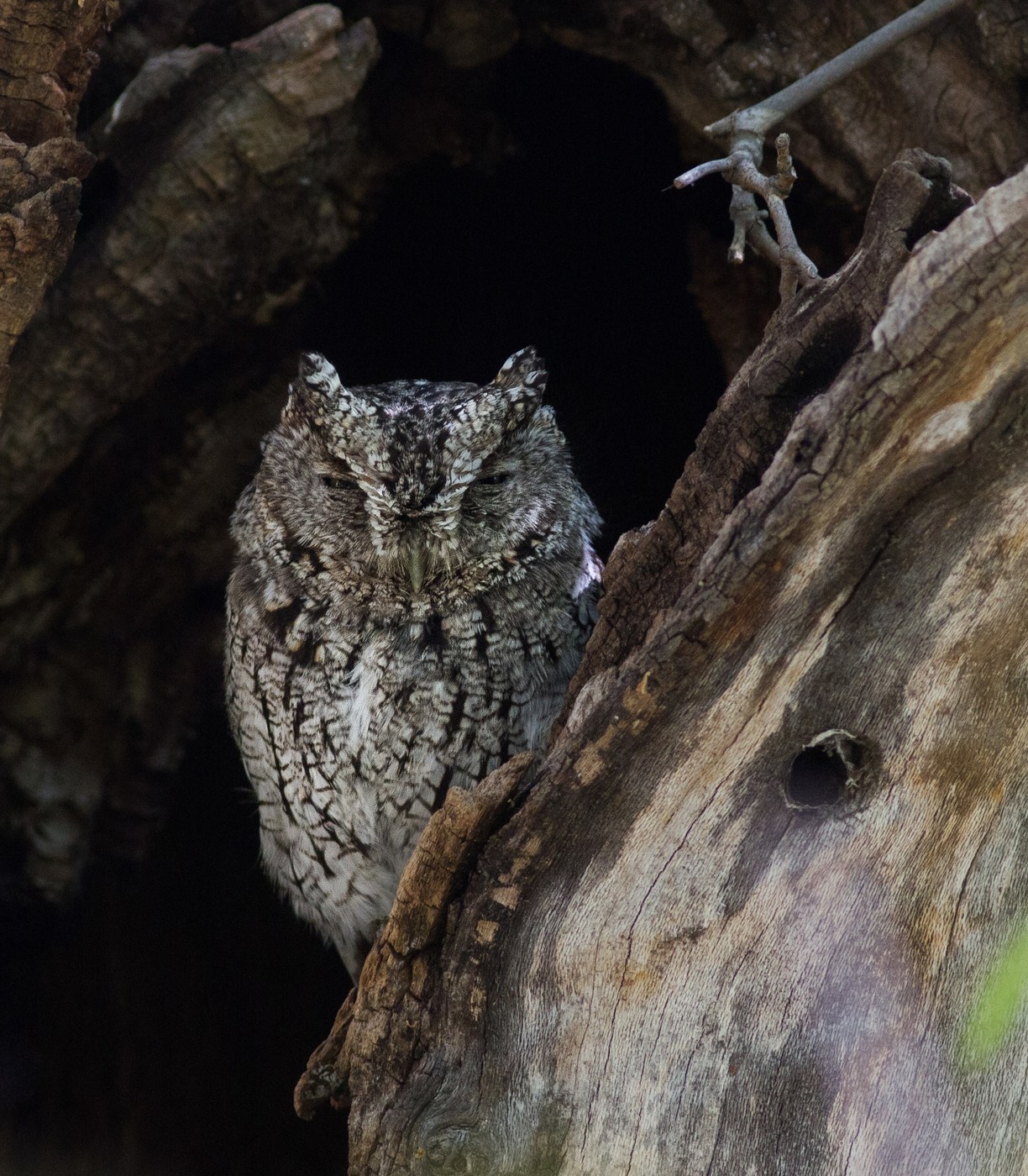
What Whiskered Screech-Owl Feathers Look Like
Whiskered Screech-Owl is one of the smallest screech-owls, and its feathers reflect both its diminutive size and its need for fine camouflage in oak-pine woodland. Body (contour) feathers are gray-brown with very fine, delicate vermiculations — thin wavy lines and cross-hatching that are noticeably finer and denser than the coarser pattern seen on the larger Western Screech-Owl. Held closely, the pattern looks almost powdery or lace-like rather than boldly streaked.
Flight feathers show the classic owl combination of alternating light-and-dark barring and soft, comb-like fringing along the leading edge of the outer primaries, which enables silent flight — a trait shared across all owls but a useful confirmation that you're looking at an owl feather at all.
Facial disc feathers are pale gray with fine concentric barring, and the disc has a subtly less bold dark rim than some other screech-owls. Ear-tuft feathers are present, elongated and dark-centered with pale edges, but proportionally smaller than those of Western Screech-Owl given the bird's smaller overall size (Whiskered Screech-Owl is noticeably petite, generally under 7 inches).
Step-by-Step: Is This Feather From a Whiskered Screech-Owl?
- Confirm owl origin. Soft fringed leading edges on a flight feather and cryptic bark-like patterning point to the owl family generally.
- Check the size carefully. Feathers noticeably smaller than a typical screech-owl's — flight feathers well under 4 inches — support this species over the larger Western Screech-Owl.
- Assess pattern fineness. Very fine, dense vermiculation with little bold contrast supports Whiskered Screech-Owl; coarser, more boldly barred patterning suggests Western Screech-Owl instead.
- Note elevation and habitat. Mid-to-high elevation oak-pine or pine-oak canyon woodland in the southwestern US and Mexican highlands fits this species better than low desert scrub.
- Consider range overlap carefully. In the limited zone where both screech-owls occur (notably southeastern Arizona canyons), size and fineness of pattern become the deciding factors since ranges alone won't separate them.
Similar Species & How to Tell Them Apart
- Western Screech-Owl — larger overall with coarser, bolder vermiculation and barring; typically found at lower elevations, though the two overlap in some montane canyons.
- Flammulated Owl — smaller still, but shows more contrasting rufous-and-gray streaking rather than fine, even vermiculation, and has dark eyes (not visible from feathers, but associated with different facial disc tone).
- Elf Owl — even tinier, with plainer, less patterned feathers and a much shorter tail, occupying similar desert and canyon habitat in places.
- Northern Pygmy-Owl — has bold white spotting on a browner background rather than screech-owl's fine gray vermiculation, and lacks ear tufts entirely.
Where & When You'll Find Them
Whiskered Screech-Owls are year-round residents of oak-pine and pine-oak woodland in mountain canyons of the southwestern US (notably southeastern Arizona) south through the Mexican and Central American highlands. As non-migratory birds tied to specific canyon woodland, feathers are most likely found near dependable roost sites and tree cavities used across multiple seasons. The complete post-breeding molt occurs in summer, so the freshest, cleanest-patterned feathers are most likely to be found in late summer near nest and roost sites, with more worn feathers accumulating over the rest of the year.
Frequently asked questions
How is this species' feather different from Western Screech-Owl's?
Whiskered Screech-Owl feathers are smaller overall and show finer, more delicate vermiculation, versus the coarser, bolder pattern and larger size of Western Screech-Owl.
Where do the two screech-owl species overlap, making feather ID trickier?
Mainly in montane oak-pine canyons of southeastern Arizona, where both occur; in that zone, feather size and pattern fineness matter more than location alone.
What confirms a feather is from an owl before narrowing species?
Soft, fringed leading edges on flight feathers for silent flight, combined with a cryptic, bark-like mottled pattern typical of small forest owls.
Does elevation help with identification?
Yes — Whiskered Screech-Owl tends toward higher-elevation oak-pine woodland compared to Western Screech-Owl's broader range including lower desert riparian habitat.
When are feathers freshest for this species?
Late summer, following the annual post-breeding molt, since this is a non-migratory species tied to consistent roost sites year-round.