
How to Identify Whistling Kite Feathers
How to identify Whistling Kite feathers by their pale buffy-brown body tone, streaked shafts, and the pale wing panel formed against darker flight feather tips, distinguishing them from Black Kite and juvenile Brahminy Kite.
Read the full Whistling Kite encyclopedia entry →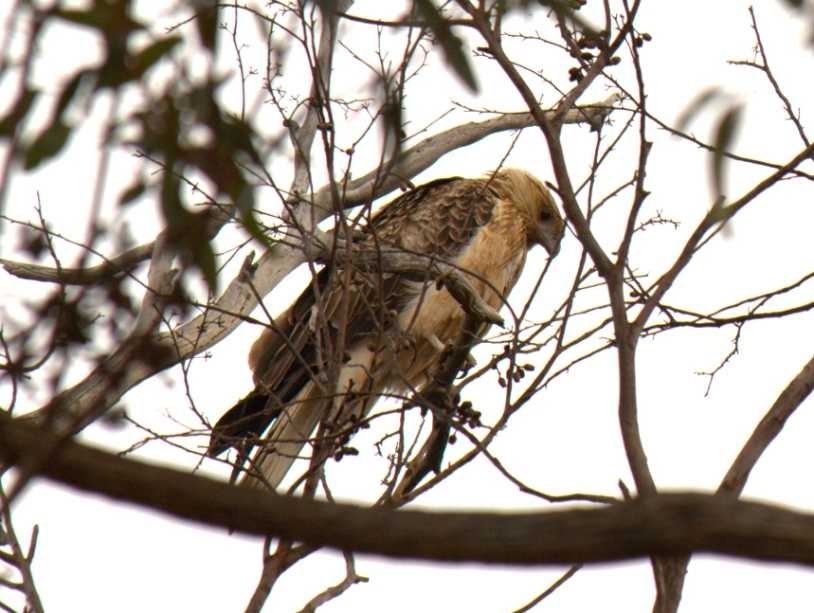
What Whistling Kite Feathers Look Like
Whistling Kite is a common Australian raptor with a soft, pale look that's quite different from the sharper contrast of many other kites. Body (contour) feathers are pale buffy-brown overall, each with a darker shaft streak, giving the plumage a subtly streaky rather than blotched appearance from head to belly. The head, in particular, is notably pale and unmarked compared to the streakier back and chest.
Wing covert feathers are pale buff-brown, while the flight feathers (primaries/secondaries) are darker brown, especially toward their tips — this two-tone arrangement creates the species' signature pale wing panel effect (visible in flight as a light "M" or "W" shape across the underwing), and is a useful clue if you find both covert and flight feathers from the same bird: pale coverts paired with darker-tipped flight feathers is characteristic.
Tail feathers are pale brownish and long and rounded in shape (kites generally have long, less squared tails than many hawks), with faint darker banding rather than bold barring.
Step-by-Step: Is This Feather From a Whistling Kite?
- Check for a shaft-streaked, buffy-brown body feather. Pale brown with a fine darker central streak (rather than barring, spotting, or blotching) fits this species well.
- Look for two-tone wing feathers. Pale covert feathers alongside darker-tipped flight feathers support the pale wing panel this species is known for.
- Assess tail shape. Long and rounded rather than short and squared fits typical kite proportions.
- Measure overall size. Mid-sized raptor feathers, smaller than a large eagle's but bigger than a small falcon's, consistent with this kite's size (troopial range roughly 50-60cm body length).
- Confirm the setting. Open woodland, wetlands, grassland, and coastal areas across Australia (and parts of New Guinea) fit this species; it's also frequently seen scavenging near roads and settlements.
Similar Species & How to Tell Them Apart
- Black Kite — noticeably darker brown overall with much less pale wing-panel contrast, and a distinctly forked tail versus Whistling Kite's rounded tail tip.
- Brahminy Kite (juvenile) — similar streaky brown plumage as an immature, but Brahminy Kite juveniles typically show a shorter, more squared tail and will molt into a very different white-headed, chestnut-bodied adult plumage that Whistling Kite never acquires.
- Square-tailed Kite — paler head and more contrastingly patterned underwing, with (as the name suggests) a squarer tail tip rather than Whistling Kite's rounded shape.
- Little Eagle — bulkier overall with broader flight feathers and a shorter tail relative to wing length, lacking the fine shaft-streaking typical of Whistling Kite body feathers.
Where & When You'll Find Them
Whistling Kites are widespread across Australia (and into New Guinea and nearby islands), found in open woodland, grassland, wetlands, and along coastlines, and are notably tolerant of human-modified landscapes including farmland and roadsides where they scavenge carrion. As a species with breeding tied to the Australian seasons (broadly austral spring through summer), the complete annual molt typically follows breeding, though timing can vary regionally across this species' broad range. Feathers are most likely to be found near nest sites, regular perches, and areas where kites scavenge or hunt, with the freshest feathers appearing in the months following the local breeding season.
Frequently asked questions
What is the most distinctive feather trait for this species?
A pale buffy-brown body feather with a fine darker shaft streak, combined with a two-tone wing pattern of pale coverts against darker-tipped flight feathers that creates the species' signature pale wing panel.
How do I tell this apart from Black Kite?
Black Kite is notably darker overall with far less pale wing contrast, and has a forked tail, while Whistling Kite shows a rounded tail tip and a much paler, streakier body.
Could a streaky brown feather be a juvenile Brahminy Kite instead?
It's possible — juvenile Brahminy Kites look similar, but they typically show a shorter, squarer tail and will eventually molt into a very different white-and-chestnut adult plumage that Whistling Kite never develops.
Where in the landscape are these feathers usually found?
Near open woodland, wetlands, farmland, roadsides, and coastal areas across Australia, since this kite readily scavenges in human-modified landscapes.
Is there a clear molt season?
Molt generally follows the local breeding season (broadly spring through summer in Australia), though exact timing varies across the species' wide range.