
How to Identify White Stork Feathers
A guide to the large snow-white body feathers, jet-black flight feathers, and red bill/leg color clues that identify a White Stork feather.
Read the full White Stork encyclopedia entry →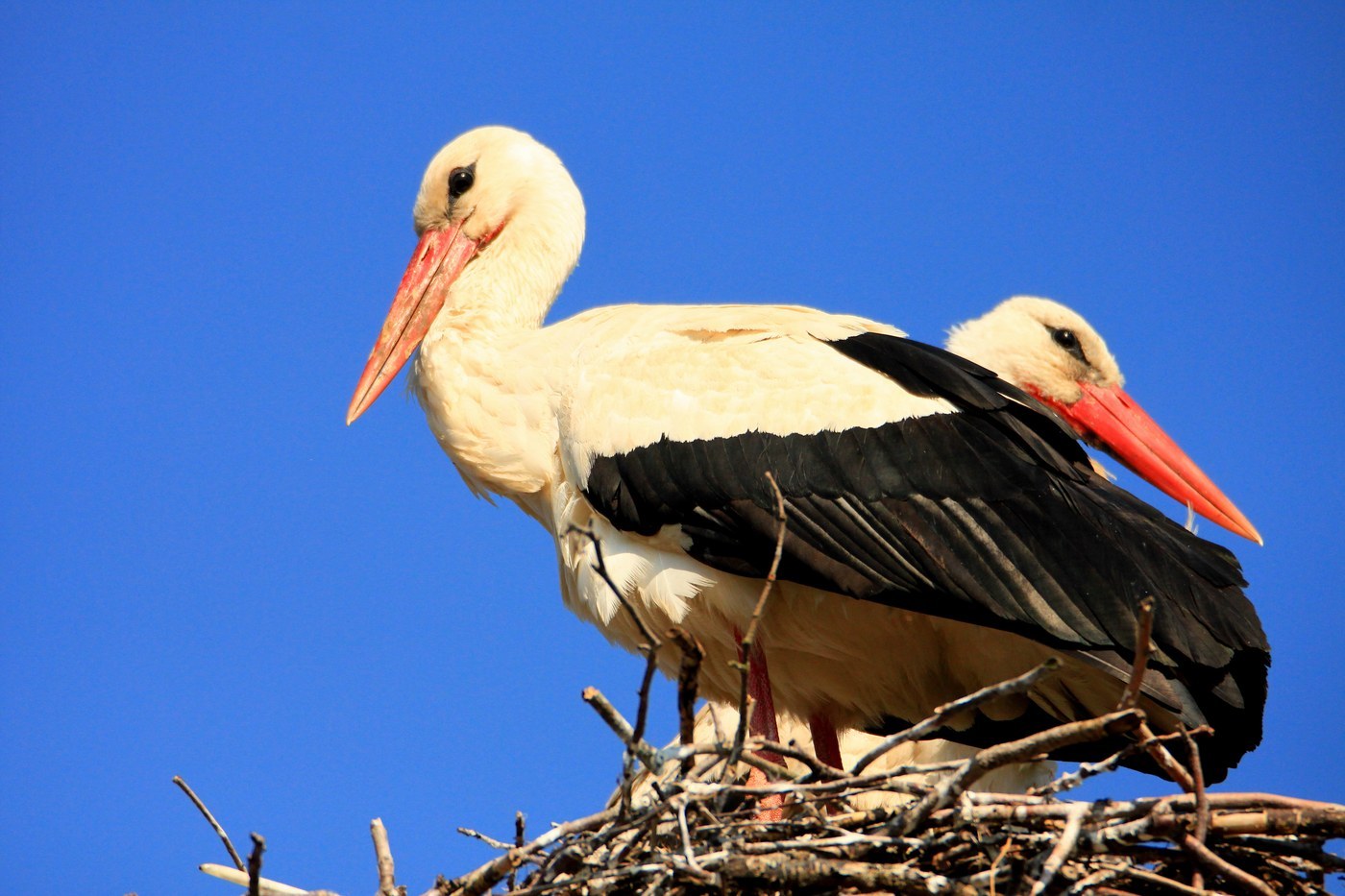
What White Stork's Feathers Look Like
White Stork is a large, unmistakable bird (up to 100-115 cm tall with a wingspan over 2 meters), and its feathers are correspondingly large and boldly two-toned. Body contour feathers — back, neck, breast, belly — are pure snow-white, smooth, dense, and moderately stiff, quite different from the softer down of smaller birds. In sharp contrast, the flight feathers (primaries and secondaries) are solid glossy black, long and broad, creating the stork's famous black-and-white wing pattern that's visible both at rest (as a black trailing patch on the folded wing) and dramatically in flight (white body with black flight feathers along the trailing and outer wing edge).
Because White Stork feathers are so large, even a single primary feather is a strong identifier: black flight feathers can run 40-55 cm long, far bigger than almost any other black-and-white bird likely to be confused with it. Tail feathers are white, short relative to the huge wings, and unremarkable in pattern. The bill and legs are bright red (bare parts, not feathers), so while not directly a feather clue, a red bill or leg found with white and black feathers strongly reinforces the identification. Juvenile birds show duller, brownish-black (rather than glossy jet-black) flight feathers and a duskier bill, so a slightly less glossy black flight feather can still belong to a young bird of this species.
Step-by-Step: Is This Feather From a White Stork?
- Check the size first. Flight feathers 40+ cm long and body feathers 10-15+ cm are consistent with a very large bird — few backyard or common birds produce feathers this size.
- Confirm the stark black-and-white split. Pure white body feathers alongside solid black (not barred, not brown-streaked) flight feathers is the core pattern for this species.
- Look for a red bill or leg fragment if any bare parts are present alongside the feathers — a strong confirming clue given the color is so distinctive.
- Rule out barring or mottling. Neither the white nor the black feathers of this species show barring, spotting, or streaking; any patterning suggests a different species.
- Consider juvenile duller tones. A brownish-black rather than glossy jet-black flight feather, combined with large size and white body feathers nearby, may still indicate an immature White Stork.
Similar Species & How to Tell Them Apart
The main similar species is the Black Stork, which has the reverse pattern — a mostly black body with white confined to the belly and undertail — so a mostly white body feather set immediately favors White Stork instead. Large white waterbirds like Great Egret lack any black in the wings at all, remaining entirely white throughout, so the presence of solid black flight feathers rules out an egret. Whooper and other white swans are much bigger still and lack black flight feathers entirely, keeping their wings white throughout, another easy point of separation from White Stork.
Where & When You'll Find Them
White Storks breed across much of Europe, parts of North Africa, and western Asia, nesting conspicuously in large stick nests on rooftops, poles, and trees, and undertake long migrations to winter in sub-Saharan Africa (with some populations wintering in the Iberian Peninsula and North Africa). Because of this strong migratory pattern, feathers appear seasonally: fresh feathers near breeding colonies in Europe from spring through summer (with a molt peak after breeding), and again on the African wintering grounds from autumn through winter. Look for feathers near large stick nests on rooftops and poles in villages and farmland during the breeding season, or around wetlands and open farmland on the wintering grounds in Africa.
Frequently asked questions
What is the single most distinctive feature of a White Stork feather?
The stark contrast between pure white body feathers and solid glossy black flight feathers, in feathers considerably larger than almost any common look-alike bird.
How long are the black flight feathers?
Primaries typically run 40 to 55 centimeters, reflecting the bird's large size and wide wingspan.
How do I tell this apart from Black Stork?
Black Stork has the reverse pattern — mostly black body with white confined to the belly — so a predominantly white feather set favors White Stork instead.
Are juvenile feathers different from adult ones?
Yes, juveniles show duller, more brownish-black flight feathers rather than the glossy jet-black of adults, though the overall white-and-black pattern remains similar.
When are feathers most likely to be found near breeding sites?
Spring through summer near nesting colonies in Europe, coinciding with the post-breeding molt period.