
How to Identify White-tailed Eagle Feathers
A guide to the massive dark brown body feathers and wedge-shaped white tail that identify Europe's largest eagle from a feather find.
Read the full White-tailed Eagle encyclopedia entry →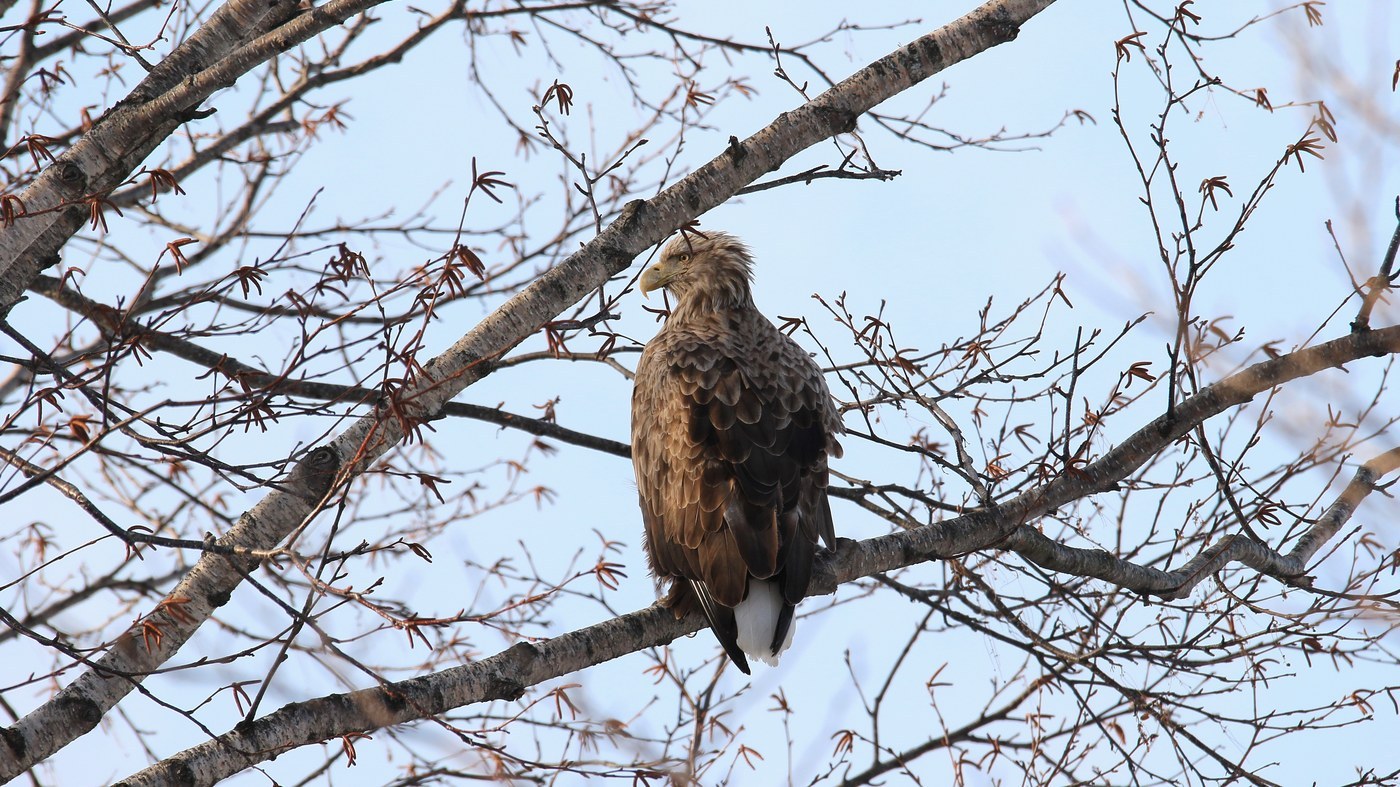
What White-tailed Eagle's Feathers Look Like
White-tailed Eagle is one of the largest eagles in the world, with a wingspan that can exceed 2.4 meters, and its feathers are correspondingly enormous — this is one of the biggest feathers you're likely to encounter outside of a swan or large vulture. Body contour feathers are an overall dark brown, somewhat variable in shade from chocolate-brown to a paler, more washed-out brown, with the head and upper neck feathers noticeably paler, almost straw-colored to whitish-buff in mature adults, creating a distinctive pale-headed, dark-bodied look. Flight feathers (primaries and secondaries) are long, broad, and dark blackish-brown, showing the deeply "fingered" primary tips typical of large soaring eagles when the wing is spread.
The single most diagnostic feather is a tail feather: adult White-tailed Eagles have a short, wedge-shaped, entirely white tail, and a large white feather with this distinctive broad, rounded-wedge shape (as opposed to a long, narrow, evenly-tipped tail feather) is close to a guaranteed match for this species among large raptors in its Eurasian range. Immature birds show a duller, mottled dark brown tail with only partial white mottling that increases with age over about 4-5 years before reaching the clean white adult tail, so a mostly brown tail feather with some white flecking can still belong to a younger White-tailed Eagle.
Step-by-Step: Is This Feather From a White-tailed Eagle?
- Check the size. Flight feathers can exceed 45-55 cm and tail feathers 25-30 cm, consistent with one of the largest raptors in Eurasia.
- Look for a white, wedge-shaped tail feather. This is the single best clue for an adult bird — the short, broad, rounded-wedge tail shape combined with pure white color is distinctive.
- Check head/neck feathers for a pale straw color contrasting with darker brown body feathers, typical of mature adults.
- Consider immature mottling. A mostly dark brown tail feather with scattered white flecks may still indicate a younger bird of this species working toward adult plumage.
- Rule out barring. Flight and tail feathers of this species are not barred; heavy barring suggests a different, often smaller, raptor species.
Similar Species & How to Tell Them Apart
The closest look-alike across much of the range is the Golden Eagle, which is similar in size but has a dark tail with pale grey banding (not solid white) and golden-buff feathering on the nape, rather than White-tailed Eagle's short white wedge tail and paler overall head. In North America, the Bald Eagle — a close relative — has a similar white tail, but Bald Eagle's tail feathers are more evenly rectangular rather than broadly wedge-shaped, and the two species' ranges don't naturally overlap (White-tailed Eagle is Eurasian, Bald Eagle North American), so geography alone usually settles the question. Vultures found in the same Eurasian range, such as Griffon Vulture, lack any white tail and show a more uniform brown or grey-brown coloring throughout.
Where & When You'll Find Them
White-tailed Eagles are found across a broad swath of Eurasia, from Greenland and Iceland through Scandinavia, continental Europe, and Russia to parts of East Asia, favoring coastlines, large lakes, and major rivers where they hunt fish and waterbirds. Many populations are resident or only make short-distance movements, though northern and Arctic populations may move south in winter when waters freeze. Because of this largely resident pattern, feathers can be found across the year, with the main molt (a slow, multi-year process typical of large eagles) contributing feathers gradually rather than in a single sharp seasonal pulse. Look for feathers near large nest platforms in tall trees or cliffs along coastlines and major waterways, and below regular perching and feeding sites where these eagles process prey.
Frequently asked questions
What is the single fastest way to identify an adult White-tailed Eagle feather?
A large, pure white, wedge-shaped tail feather is close to a guaranteed match among large Eurasian raptors.
How do immature birds' tail feathers differ from adults?
Immatures show mostly dark brown tail feathers with only scattered white mottling, gradually gaining more white over 4-5 years before reaching the clean white adult tail.
How is this different from a Golden Eagle feather?
Golden Eagle has a dark tail with pale grey banding rather than solid white, and shows golden-buff nape feathering rather than the pale straw-colored head of White-tailed Eagle.
Could this be confused with a Bald Eagle feather?
The two species look similar, but their ranges don't naturally overlap — White-tailed Eagle is Eurasian and Bald Eagle is North American — and Bald Eagle's tail feathers are more evenly rectangular rather than broadly wedge-shaped.
Is there a strong seasonal pattern to finding feathers?
Not sharply — molt in large eagles is a slow, multi-year process, so feathers can turn up across the year rather than in one concentrated period.
White-tailed Eagle identified by the community
Recent White-tailed Eagle feathers identified with Feather Identifier.


