
How to Identify Williamson's Sapsucker Feathers
How to identify the strikingly different male (black-and-white with a red throat) and female (barred brown) feathers of Williamson's Sapsucker.
Read the full Williamson's Sapsucker encyclopedia entry →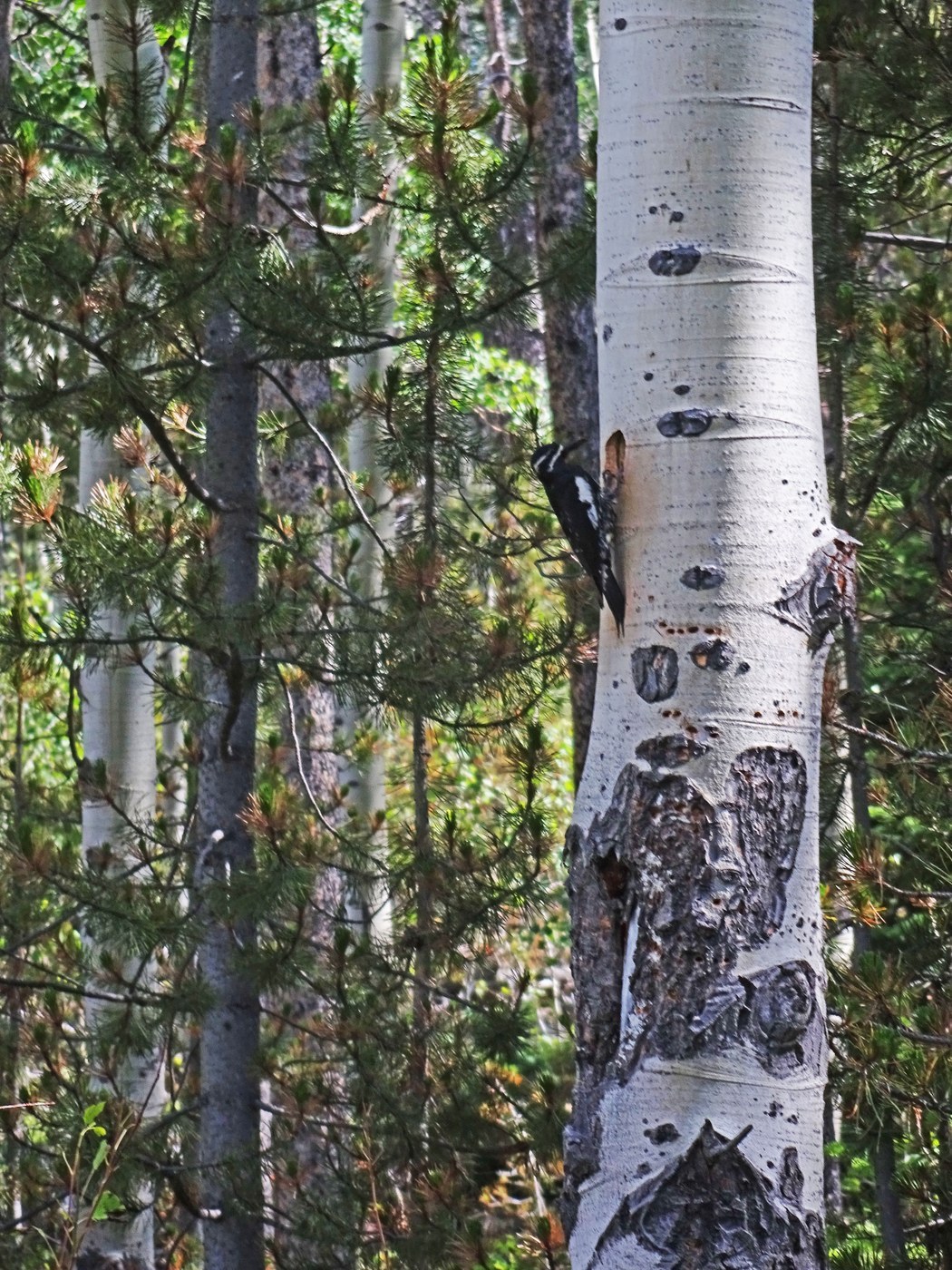
What Williamson's Sapsucker's Feathers Look Like
Williamson's Sapsucker shows one of the most extreme cases of male-female plumage difference of any North American woodpecker, so feathers from the two sexes can look like they belong to entirely different species.
- Male body feathers: mostly glossy black, with bold white facial stripes, a small red throat patch, and a bright yellow belly patch — a black feather with a crisp white stripe or a small red or yellow patch is very characteristic of an adult male.
- Male wing feathers: black with a large white patch on the wing coverts, forming a bold white wing panel visible at rest and in flight.
- Female body feathers: entirely different — finely barred brown and blackish across the head, back, and breast, with a plain brown head (no white stripes) and a white rump patch, plus a yellow wash on the belly similar to the male's.
- Female wing feathers: barred brown-and-black, lacking the male's bold white wing patch.
- Tail feathers: black in both sexes, stiff and pointed like other woodpeckers, used for bracing against tree trunks.
- Size: contour feathers 2.5-4 cm, flight feathers 9-11 cm, consistent with a medium-sized woodpecker.
Step-by-Step: Is This Feather From a Williamson's Sapsucker?
- Sort by pattern type first. A black feather with white stripes, or a small red/yellow patch, suggests a male; a finely barred brown-and-black feather suggests a female — both fit this species given its unusual sexual dimorphism.
- Look for a yellow belly patch. Both sexes show a yellow wash on the belly, so a yellow-tinged feather is a useful clue regardless of which sex it came from.
- Check for a white rump feather. Present in females especially, a clean white rump feather paired with otherwise barred brown body feathers supports a female Williamson's Sapsucker.
- Confirm woodpecker structure. Stiff, pointed tail feathers with reinforced shafts support a woodpecker ID in general before narrowing down to species.
- Consider elevation and habitat. Feathers found in montane conifer forest, especially where firs and pines mix, in the western United States and Canada fit this species' preferred breeding habitat.
Similar Species & How to Tell Them Apart
- Red-naped Sapsucker: males show a red crown and nape along with a red throat, plus black-and-white barring on the back, rather than Williamson's solid black male body — check for barring versus solid black.
- Red-breasted Sapsucker: has an entirely red head and breast in adults, very different from Williamson's male pattern of black body with limited red confined to the throat.
- Hairy Woodpecker (female): shows a plain white back stripe and lacks any yellow belly wash, unlike the barred brown female Williamson's Sapsucker.
- Northern Flicker (yellow-shafted): has barred brown upperparts too, but shows bright yellow flight-feather shafts throughout the wing and tail, a pattern not present in Williamson's Sapsucker.
Where & When You'll Find Them
Williamson's Sapsucker breeds in montane conifer forests of the western United States and southwestern Canada, particularly in mixed stands of larch, fir, and pine, and withdraws to lower elevations or migrates short distances south (into Mexico and the southwestern US) for winter. Feathers are most likely to be found near breeding territories in mountain forest during the summer molt period, while wintering-ground feathers may turn up at lower elevations or farther south from fall through early spring.
Frequently asked questions
Why do male and female feathers look so different?
Williamson's Sapsucker shows extreme sexual dimorphism — males are mostly glossy black with white stripes and small red/yellow patches, while females are finely barred brown-and-black with a plain head.
Is a yellow-tinged feather useful for identification?
Yes, both sexes show a yellow wash on the belly, so a feather with even a faint yellow tint is a supporting clue for this species.
How do I rule out Red-naped Sapsucker?
Check for barring on the back — Red-naped Sapsucker shows black-and-white barring on a male's back, while Williamson's male back is solid black.
At what elevation should I expect to find this feather?
Typically in montane conifer forest during the breeding season, with birds moving to lower elevations or migrating a short distance south for winter.