
How to Identify Willow Warbler Feathers
How to identify the olive-green upperparts, yellowish underparts, and pinkish-orange legs that distinguish a Willow Warbler from the nearly identical Common Chiffchaff.
Read the full Willow Warbler encyclopedia entry →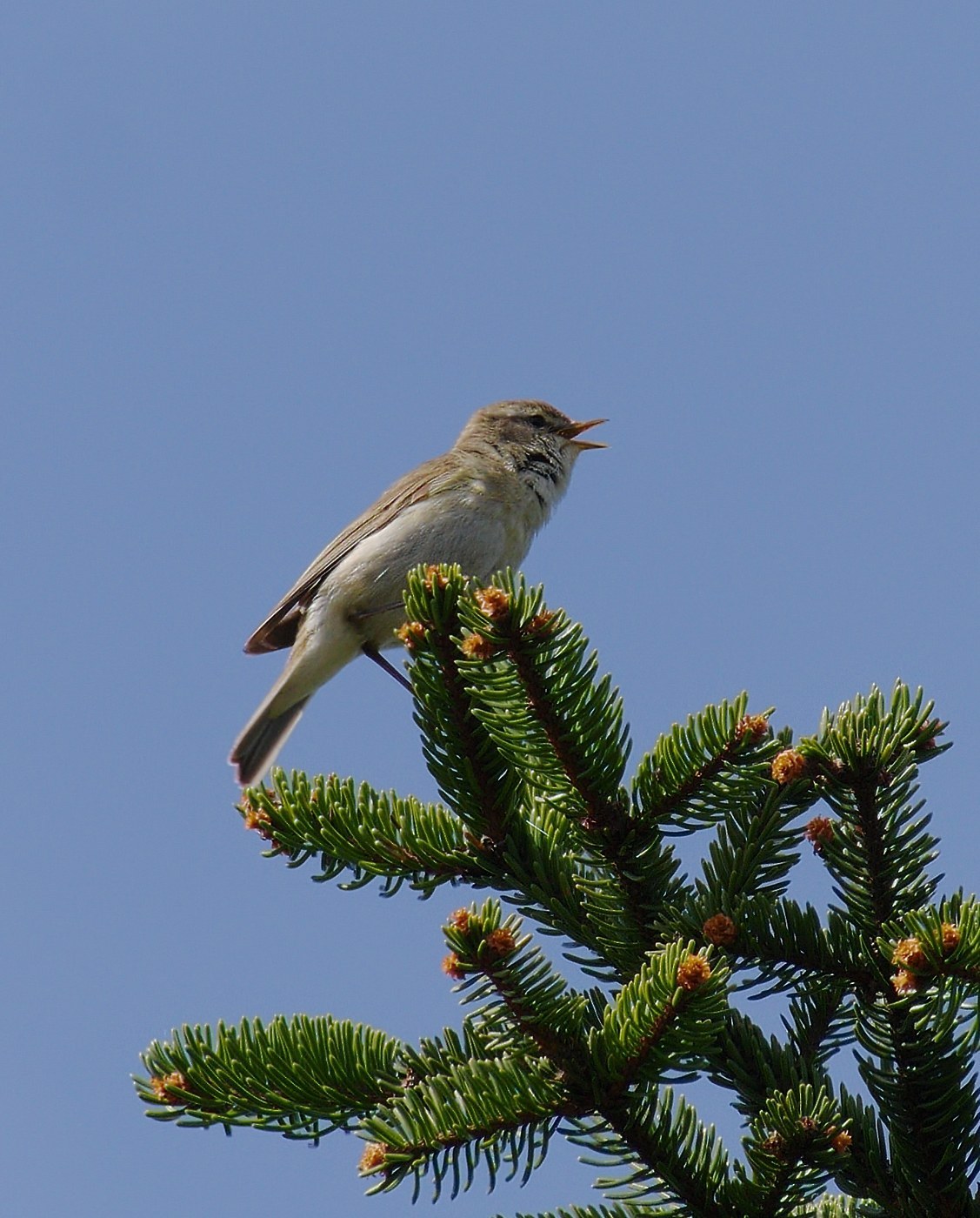
What Willow Warbler's Feathers Look Like
Willow Warbler is one of Europe's most abundant long-distance migrant warblers, and while its plumage overlaps heavily with its close relative the Common Chiffchaff, a few details help separate the two.
- Upperpart feathers: olive-green to yellowish-green, unstreaked, covering the crown, back, and wings — generally a bit brighter and greener in tone than the duller, browner-olive Chiffchaff.
- Underparts feathers: pale yellowish-white, often with a cleaner, more evenly yellow wash across the breast and flanks compared to Chiffchaff's typically duller, buffier underparts.
- Supercilium (eyebrow) feathers: a distinct pale yellowish eyebrow stripe, generally a bit longer and more prominent than in Chiffchaff.
- Wing feathers: plain olive-brown flight feathers with a fairly long primary projection (the primaries extend well past the tertials on a folded wing), longer than the shorter primary projection typical of Chiffchaff — a helpful structural clue if a full wing or several flight feathers are found together.
- Leg color note: while not a feather trait, pinkish to pale orange-brown legs (versus Chiffchaff's typically dark blackish-brown legs) are one of the most reliable clues if a foot or leg fragment is attached to a feather.
- Size: contour feathers 1.3-1.8 cm, flight feathers 4.5-5.5 cm, consistent with a small leaf warbler.
Step-by-Step: Is This Feather From a Willow Warbler?
- Check leg color if any leg fragment is present. Pale pinkish or orange-brown legs strongly favor Willow Warbler; dark blackish legs favor Chiffchaff instead — this is often the single most decisive clue between the two.
- Assess the green/yellow saturation. Brighter olive-green upperparts and cleaner yellow underparts lean toward Willow Warbler; duller, browner-olive tones with buffier underparts lean toward Chiffchaff.
- Look at the eyebrow stripe. A longer, more distinct pale supercilium supports Willow Warbler.
- Compare primary projection, if multiple flight feathers are available — a long primary projection (primaries extending well beyond the tertials) fits Willow Warbler's more pointed, migration-adapted wing, versus Chiffchaff's shorter, more rounded wing.
- Consider season and habitat. Feathers found in open woodland, scrub, and birch/willow edge habitat across Europe and western Asia in spring and summer fit this highly migratory species' breeding range.
Similar Species & How to Tell Them Apart
- Common Chiffchaff: the primary look-alike; separated by darker legs, duller olive-brown (less green) upperparts, a shorter primary projection, and a shorter, less distinct eyebrow stripe.
- Wood Warbler: shows a much more saturated, almost lemon-yellow throat and breast contrasting with a pure white belly, unlike Willow Warbler's more evenly pale yellowish underparts.
- Chiffchaff/Willow Warbler hybrids and intergrades: rare but possible in overlap zones, showing intermediate leg color and tone — worth noting as a source of ambiguity even for careful observers.
- Bonelli's Warblers (Western/Eastern): show a plainer face without a strong eyebrow and a pale, unmarked wing panel, distinct from Willow Warbler's more uniformly olive wing.
Where & When You'll Find Them
Willow Warbler breeds across a huge swath of Europe and western Asia, from open birch and willow scrub to woodland edge and heathland, and undertakes one of the longest migrations of any small European songbird, wintering broadly across sub-Saharan Africa. Molt is split unusually between locations: a partial molt often occurs on the breeding grounds, while a more complete molt frequently happens on or near the African wintering grounds, so fresh feathers can be found on breeding territory in mid-to-late summer and again in African wintering habitat later in the year.
Frequently asked questions
What's the most decisive clue if a leg fragment is attached?
Leg color — pale pinkish to orange-brown legs strongly favor Willow Warbler, while dark blackish legs favor Common Chiffchaff.
How do I compare this to a Chiffchaff feather without a leg attached?
Look at overall tone and eyebrow length — Willow Warbler tends to be brighter olive-green with cleaner yellow underparts and a longer, more distinct eyebrow stripe than the duller Chiffchaff.
Does wing shape help at all?
Yes, if multiple flight feathers are available — Willow Warbler has a longer primary projection suited to long-distance migration, versus Chiffchaff's shorter, more rounded wing.
Where would fresh feathers most likely be found?
On European or western Asian breeding territory in mid-to-late summer, or in sub-Saharan African wintering habitat later in the year, since molt is split between the two.