
How to Identify Yellow-headed Amazon Feathers
A guide to the green body plumage, bright yellow head feathers, and colorful wing speculum that identify Yellow-headed Amazon feathers.
Read the full Yellow-headed Amazon encyclopedia entry →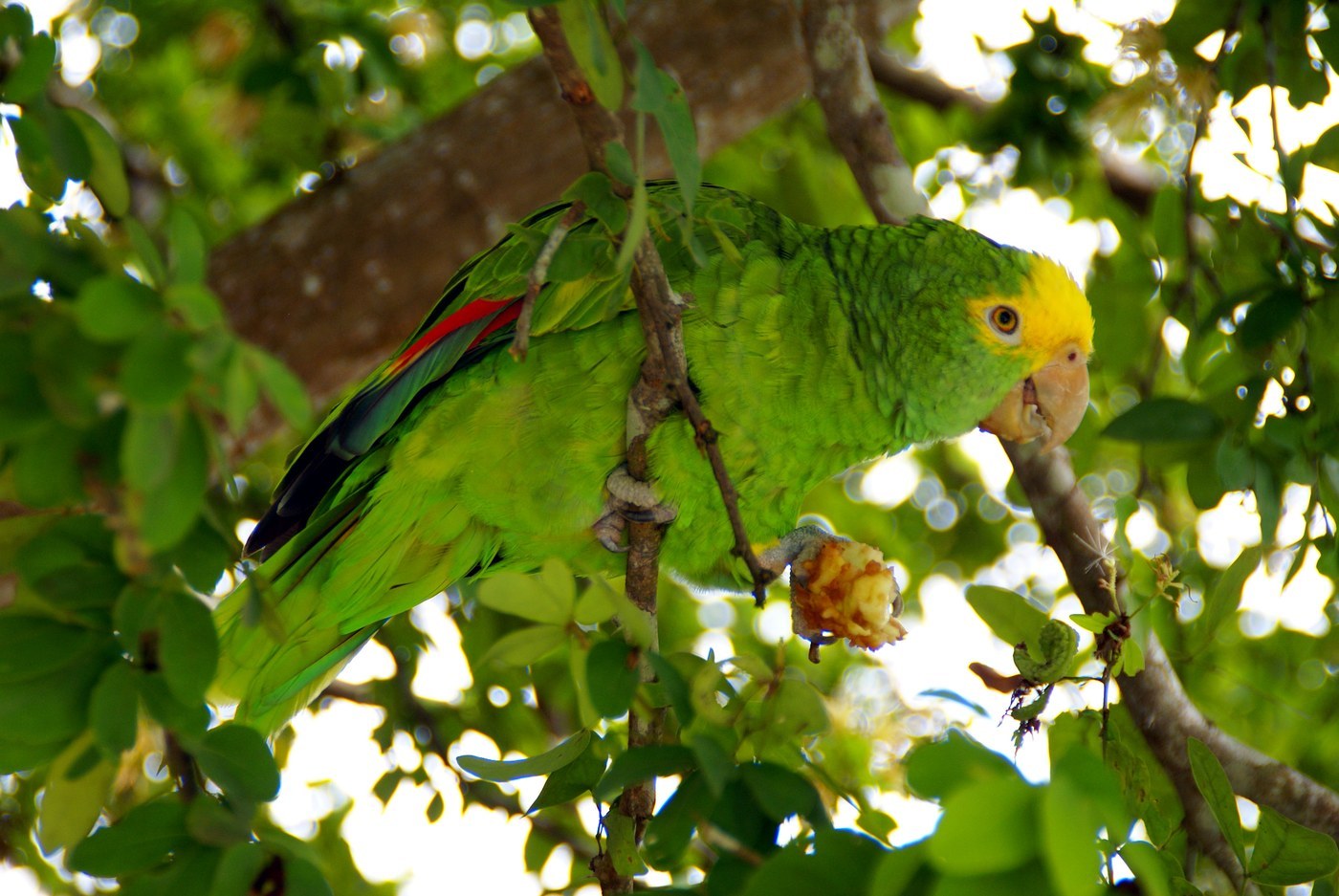
What Yellow-headed Amazon's Feathers Look Like
The Yellow-headed Amazon is a large, robust parrot, and its feathers show the thick, waxy quality typical of Amazon parrots. Flight feathers measure 15-20 cm, mostly green with a distinctive colorful speculum — a patch combining red and blue on the secondary feathers, visible as a flash of color on the closed wing. Body feathers covering the back, belly, and wings are a uniform bright green, each often edged with a thin darker outline giving a subtly scalloped look. The signature feathers come from the head: adults show extensive bright yellow feathers covering the entire head and upper neck, brighter and more saturated than the green body, with the amount of yellow increasing with age (young birds show only a small yellow patch on the forehead that expands over several years). Some individuals show a red patch at the bend of the wing (wing covert), adding another bold color block. Tail feathers are green with red bases visible when spread. All feathers are thick, stiff, and slightly glossy.
Step-by-Step: Is This Feather From a Yellow-headed Amazon?
- Look for extensive yellow head feathers: a large area of bright yellow feathering, more than just a small patch, suggests a mature adult of this species.
- Check flight feathers for red-and-blue speculum coloring: this combination on an otherwise green secondary feather is highly diagnostic for Amazon parrots generally.
- Assess overall green tone: a uniform, slightly glossy green on body feathers fits the Amazon parrot group.
- Measure size: 15-20 cm flight feathers indicate a large parrot, consistent with this species' roughly 35-38 cm body length.
- Note red wing covert patches if present: an isolated red feather from the wing bend supports this species over plainer green Amazons.
- Consider captive context: as a popular and widely kept pet, feathers are commonly found near homes and aviaries outside its native range.
Similar Species & How to Tell Them Apart
Yellow-naped Amazon shows yellow restricted mainly to the nape (back of the neck) rather than the whole head, so a feather with yellow limited to a neck patch rather than covering the crown and face points to that species instead. Yellow-crowned Amazon shows yellow only on the crown/forehead with a green face, a much more limited yellow area than the extensively yellow head of Yellow-headed Amazon. Blue-fronted Amazon shows a blue forehead patch and orange in the wing rather than yellow head feathering, making head color the fastest way to distinguish it.
Where & When You'll Find Them
In the wild, Yellow-headed Amazons are native to Mexico and parts of Central America, favoring lowland forest, mangroves, and riverine woodland, though wild populations have declined significantly due to the pet trade. As a widely kept captive species, most feather finds occur near homes, aviaries, and urban feral populations established in parts of the southern United States. Molting in captivity occurs gradually year-round, while wild birds molt on a cycle tied to the regional breeding season, typically following nesting in spring and early summer.
Frequently asked questions
What is the clearest identifying feature for this species?
Extensive bright yellow feathering covering the whole head and upper neck, rather than just a small patch, is the strongest sign of a mature Yellow-headed Amazon.
How do I tell this apart from Yellow-naped Amazon?
Yellow-naped Amazon shows yellow concentrated on the back of the neck (nape), while Yellow-headed Amazon has yellow spread across the crown, face, and neck more broadly.
What does the colorful patch on the wing feather mean?
A red-and-blue speculum patch on the secondary flight feathers is typical of Amazon parrots generally, and combined with extensive yellow head feathers points specifically to this species.
Is a small yellow patch enough to confirm this species?
Not definitively on its own — young birds show only a small yellow forehead patch that expands with age, so a limited patch could indicate an immature bird of this or a related species.
Is it more likely I found a captive or wild bird's feather?
Given how widely this parrot is kept as a pet and its declining wild numbers, a feather found outside its native Mexican/Central American range most likely comes from a captive or feral urban population.
Yellow-headed Amazon identified by the community
Recent Yellow-headed Amazon feathers identified with Feather Identifier.
