
How to Identify Yellow-headed Blackbird Feathers
A guide to the jet-black body feathers, bright yellow head plumage, and white wing patch that identify Yellow-headed Blackbird feathers.
Read the full Yellow-headed Blackbird encyclopedia entry →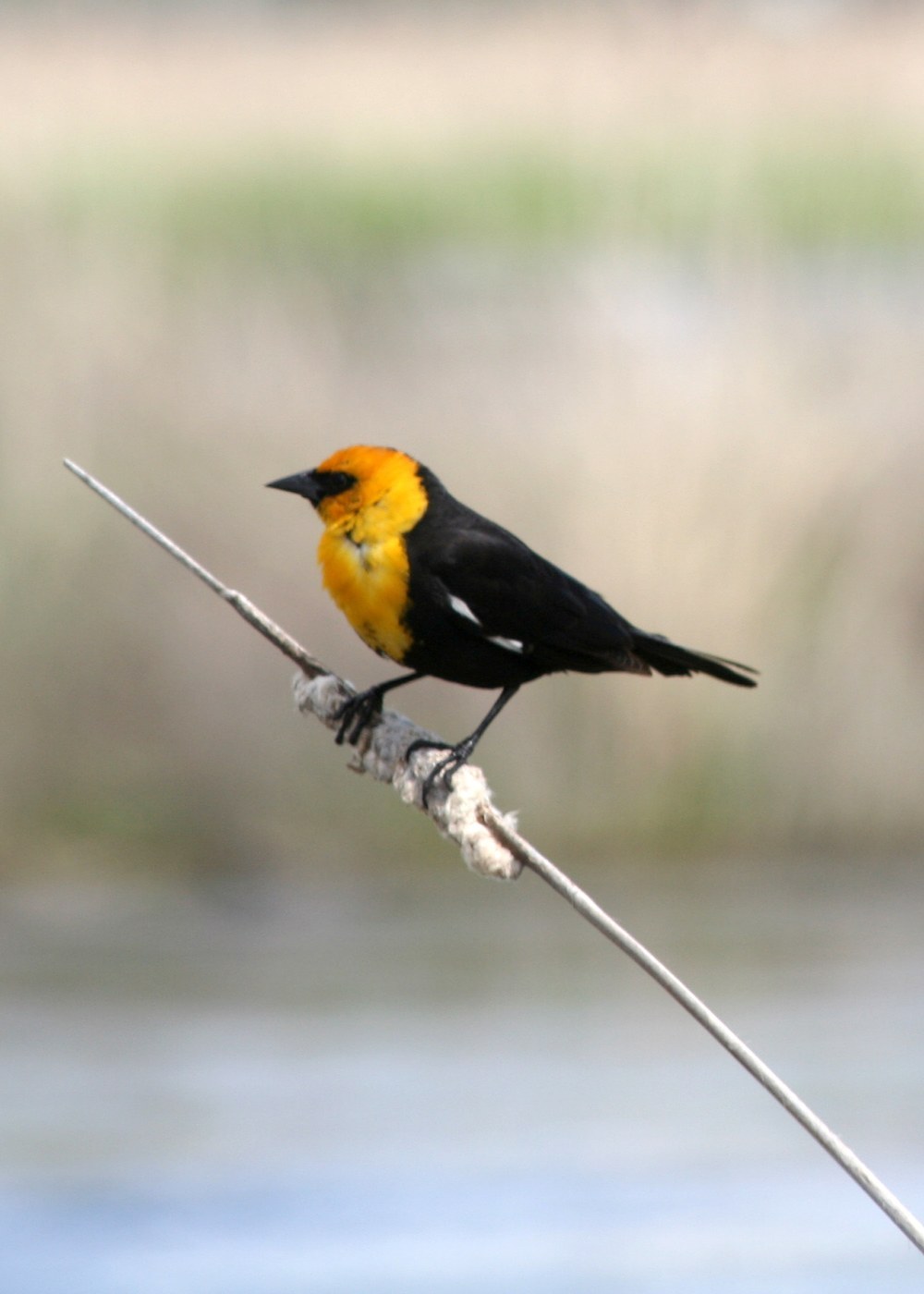
What Yellow-headed Blackbird's Feathers Look Like
The Yellow-headed Blackbird is a large, boldly patterned marsh blackbird, and its feathers show strong, clean color blocks. Flight feathers measure 9-11 cm, solid black except for a crisp white patch at the base of the primaries, visible as a bold wing flash in flight and a strong diagnostic on a shed feather. Body feathers on the back, belly, and tail are uniformly glossy black. The head, throat, and upper breast, however, are covered in bright golden-yellow feathers, sharply demarcated from the black body — males show a small black patch around the eye and lores within the yellow head, called a mask, adding a fine black-within-yellow detail. Females and immature birds are duller overall, showing a brownish-black body with a paler, more muted yellow restricted mainly to the throat and eyebrow area rather than the whole head. Tail feathers are black, moderately long and squared at the tip. All feathers are firm-vaned with a glossy sheen typical of blackbirds.
Step-by-Step: Is This Feather From a Yellow-headed Blackbird?
- Look for a bright yellow feather from the head/throat area: golden-yellow, sharply bordered by black, is the strongest single clue.
- Check flight feathers for a white patch: a crisp white patch at the feather base on an otherwise black primary is highly diagnostic.
- Assess gloss: black body feathers should show a moderate glossy sheen typical of blackbirds, not a flat matte black.
- Consider duller yellow-brown feathers: muted brownish body feathers with a paler yellow throat patch suggest a female or immature bird.
- Measure size: 9-11 cm flight feathers fit a fairly large blackbird around 22-27 cm long.
- Match habitat: cattail marshes and reedy wetlands in the western and central US and Canada support this identification.
Similar Species & How to Tell Them Apart
Red-winged Blackbird shares marsh habitat and glossy black body feathers, but shows red-and-yellow shoulder patches (epaulets) rather than a yellow head, and lacks the white wing patch entirely — checking whether the colored patch is on the shoulder versus the head is the quickest separator. Brewer's Blackbird and Common Grackle lack any yellow feathering at all, showing iridescent black or purple-green tones instead, so any yellow feather rules them out immediately. Bullock's Oriole and other orioles show yellow-orange body feathering more broadly distributed rather than concentrated on just the head, with orange rather than pure gold-yellow tones and a different overall wing pattern.
Where & When You'll Find Them
Yellow-headed Blackbirds breed in dense cattail and bulrush marshes across the western and central United States and Canada, often in large colonies alongside other marsh blackbirds. They winter in Mexico and the southwestern US, often in agricultural fields. Feathers are most likely found near breeding marshes in late spring and summer during the post-breeding molt, and in winter around feeding flocks in open fields and feedlots within their wintering range.
Frequently asked questions
What is the single best clue for identifying this species?
A feather that is bright golden-yellow, sharply bordered by black, taken from the head or throat, is the most diagnostic single feature.
How do I tell this from Red-winged Blackbird?
Red-winged Blackbird's colored patch is on the shoulder (epaulet) and is red-and-yellow, not a yellow head, and it lacks the white wing patch seen in Yellow-headed Blackbird.
What does a white patch on a black flight feather indicate?
A crisp white patch at the base of an otherwise solid black primary feather is a strong, specific marker for this species among marsh blackbirds.
Can duller brownish feathers still belong to this species?
Yes, females and immature birds are duller and browner overall, with yellow limited mainly to the throat and eyebrow rather than the whole head.
When and where are these feathers most likely found?
Near cattail marshes in the western and central US/Canada during the breeding season molt, or in agricultural fields within the wintering range in Mexico and the southwestern US during winter.