
How to Identify Yellow-hooded Blackbird Feathers
A guide to the black body feathers and bright yellow hood that identify Yellow-hooded Blackbird feathers from South American marshes.
Read the full Yellow-hooded Blackbird encyclopedia entry →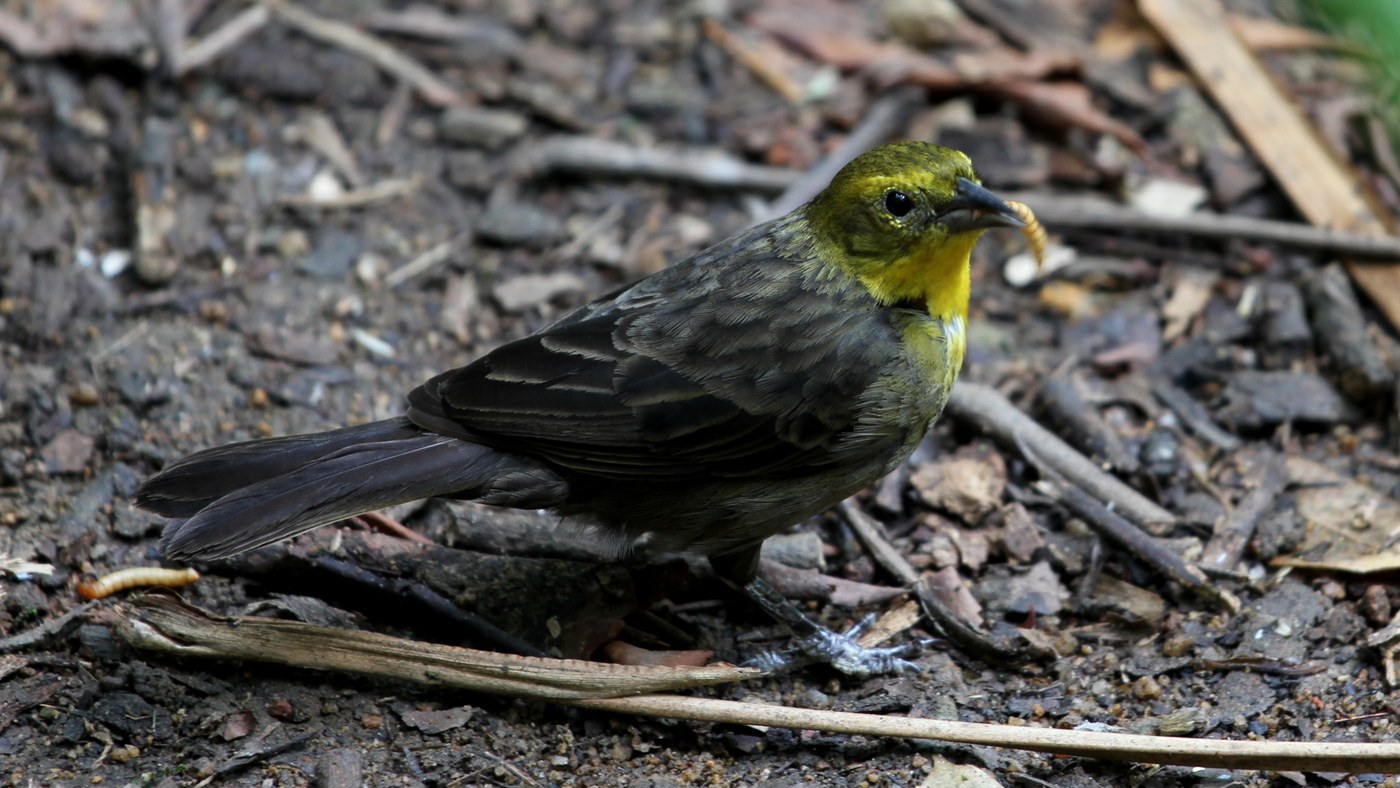
What Yellow-hooded Blackbird's Feathers Look Like
The Yellow-hooded Blackbird is a marsh-dwelling songbird with a striking two-tone plumage pattern. Flight feathers measure 7-9 cm, solid black, occasionally with a small white patch at the base of the primaries in males, forming a subtle wing flash. Body feathers on the back, belly, and tail are uniformly glossy black. The head, throat, and upper breast, however, form a distinct bright yellow hood, sharply demarcated from the black body at the lower breast — this "hood" shape, covering the head and chest but stopping cleanly before the belly, is the species' signature and a strong diagnostic when a yellow feather with a clean black border is found. Females and immature birds are considerably duller, showing an olive-brown body with a more muted yellowish throat and face rather than the male's crisp black-and-yellow contrast. Tail feathers are black, of moderate length. All feathers are fairly firm-vaned with a modest gloss typical of icterids (the blackbird-oriole family).
Step-by-Step: Is This Feather From a Yellow-hooded Blackbird?
- Look for a yellow feather with a sharp black border below: this pattern matches the hood-to-body transition unique to males of this species.
- Check flight feathers for a small white patch: present in males at the primary base, though sometimes faint or absent.
- Consider dull olive-brown feathers with muted yellow: these likely indicate a female or immature bird rather than ruling out the species.
- Measure size: 7-9 cm flight feathers fit a mid-sized blackbird around 18-20 cm long, smaller than Yellow-headed Blackbird.
- Assess gloss: black body feathers show a moderate sheen, less glossy than a grackle but more than a sparrow.
- Match habitat: South American freshwater marshes and reedbeds support this identification.
Similar Species & How to Tell Them Apart
Yellow-headed Blackbird, found further north in the Americas, is notably larger with a more extensive white wing patch and does not overlap in range with this species in most of its core South American range, making size and geography useful separators. Saffron-cowled Blackbird shows yellow on the head and shoulders but retains more black on the face/mask area, creating a less clean hood-to-body break than Yellow-hooded Blackbird. Unicolored Blackbird and similar all-black marsh blackbirds lack any yellow feathering at all, so the presence of any yellow immediately rules those species out.
Where & When You'll Find Them
Yellow-hooded Blackbirds inhabit freshwater marshes, reedbeds, and wet grasslands across northern and central South America, often nesting in loose colonies over water. Feathers are most likely found near marsh vegetation during the breeding season molt, which follows the regional wet-season breeding period and can vary somewhat by latitude across this species' range; outside the breeding season, feathers from duller female and juvenile plumage are more commonly encountered as young birds complete their first molt.
Frequently asked questions
What is the best clue for identifying a male's feather?
A bright yellow feather with a sharp, clean black border along one edge reflects the hood-to-body transition unique to adult males of this species.
How do I tell this from Yellow-headed Blackbird?
Yellow-headed Blackbird is noticeably larger with a more extensive white wing patch, and the two species have largely non-overlapping ranges, with Yellow-hooded confined to South America.
Can a dull olive-brown feather still belong to this species?
Yes, females and immature birds show much duller olive-brown plumage with only a muted yellowish throat, quite different from the bold male hood pattern.
Does this species show a white wing patch like its northern relative?
Males may show a small, sometimes faint white patch at the base of the primaries, but it is less extensive than in Yellow-headed Blackbird.
When are these feathers most likely to be found?
Near marsh vegetation during the local breeding season molt, which follows the regional wet season and can vary by latitude across the species' South American range.