
How to Identify Alpine Swift Feathers
A guide to the long, scythe-shaped flight feathers and distinctive white belly patch of the Alpine Swift, the largest swift in much of its range.
Read the full Alpine Swift encyclopedia entry →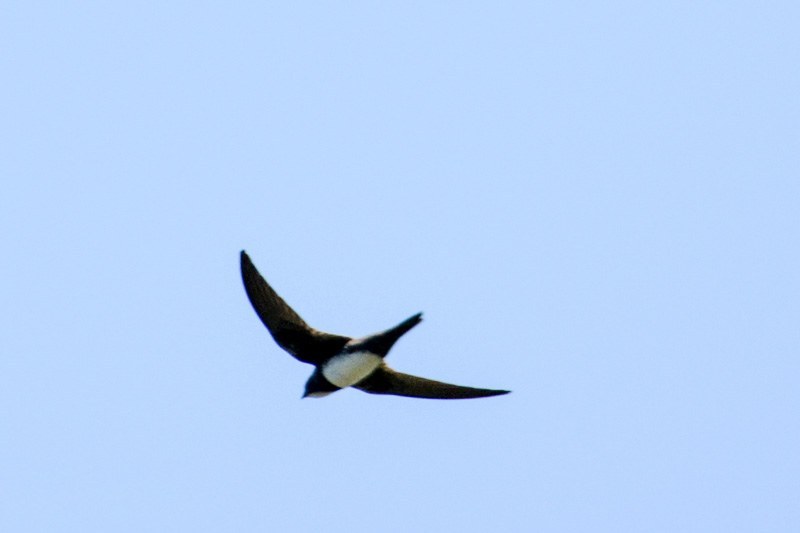
What Alpine Swift's Feathers Look Like
Alpine Swift is a large, powerful flier, and its feathers are built for a life spent almost entirely on the wing. Upperparts are brown to grayish-brown, while the underparts show a distinctive pattern: a white belly patch bordered above by a brown breast band and below by more brown, creating a two-tone brown-white-brown effect unusual among swifts. Flight feathers are exceptionally long, narrow, and curved into a scythe or sickle shape, often 12-18 cm for primaries — stiff and rigid, reflecting the demands of near-continuous flight. The tail is brown and only slightly forked.
Step-by-Step: Is This Feather From a Alpine Swift?
- Check for a scythe-shaped flight feather. A long, narrow, curved primary feather with a rigid, stiff structure is characteristic of swifts generally, and this species' feathers are notably larger than other swifts'.
- Look for a white belly feather bordered by brown. If you can find both a white belly feather and a brown breast-band feather from the same bird, that combination is highly distinctive for this species.
- Measure the primary. 12-18 cm is unusually long, consistent with Alpine Swift being one of the larger swifts in its range.
- Check overall color. Brown-gray rather than the sooty blackish tone of most other swifts.
- Consider the setting. A feather found near cliffs, gorges, or tall buildings/towers in mountainous or urban areas fits this species' nesting habits.
Similar Species & How to Tell Them Apart
- Common Swift: Overall sooty-black to dark brown with no white belly patch, and noticeably smaller flight feathers — the absence of white on the underparts is the fastest way to rule this species in favor of Alpine Swift.
- Pallid Swift: Similarly all-dark brown without a white belly, and also smaller than Alpine Swift.
- White-rumped Swift: Shows a white band across the rump rather than a white belly patch, and has a more deeply forked tail.
Where & When You'll Find Them
Alpine Swift nests colonially on cliffs, in gorges, and increasingly on tall buildings, church towers, and bridges across southern Europe, parts of Africa, and Asia. It is highly migratory in its European populations, arriving in spring and wintering in sub-Saharan Africa. Because swifts spend the overwhelming majority of their lives in flight, feeding, and even sleeping on the wing, and only land to nest or incubate, feathers from this species are rarely found compared to more ground- or perch-based birds — the best chance is directly beneath active nesting cliffs or buildings during the spring and summer breeding season. Most molt occurs on the wintering grounds in Africa rather than during the busy breeding season in Europe.
Frequently asked questions
Why are swift feathers so hard to find compared to other birds?
Swifts spend nearly their entire lives airborne, only landing to nest on cliffs or buildings, so there's very little opportunity for feathers to accumulate on the ground the way they do for more terrestrial or perching birds.
What's the fastest way to rule out Common Swift?
Check for a white belly patch bordered by brown bands — Common Swift lacks this entirely and is uniformly sooty-dark below, while Alpine Swift shows the clear two-tone pattern.
How long is a typical Alpine Swift flight feather compared to other swifts?
Alpine Swift is one of the larger swifts in its range, with primaries commonly reaching 12-18 cm, noticeably longer than the flight feathers of Common or Pallid Swift.
Where should I look for this species' feathers?
Focus on the base of cliffs, gorges, or tall buildings and towers where colonies nest, since that's where feathers are most likely to accumulate during the breeding season.