
How to Identify Altamira Oriole Feathers
A guide to identifying Altamira Oriole feathers by their deep orange-yellow body color, black bib, and white-edged wings, and how to separate them from Baltimore and Hooded Orioles.
Read the full Altamira Oriole encyclopedia entry →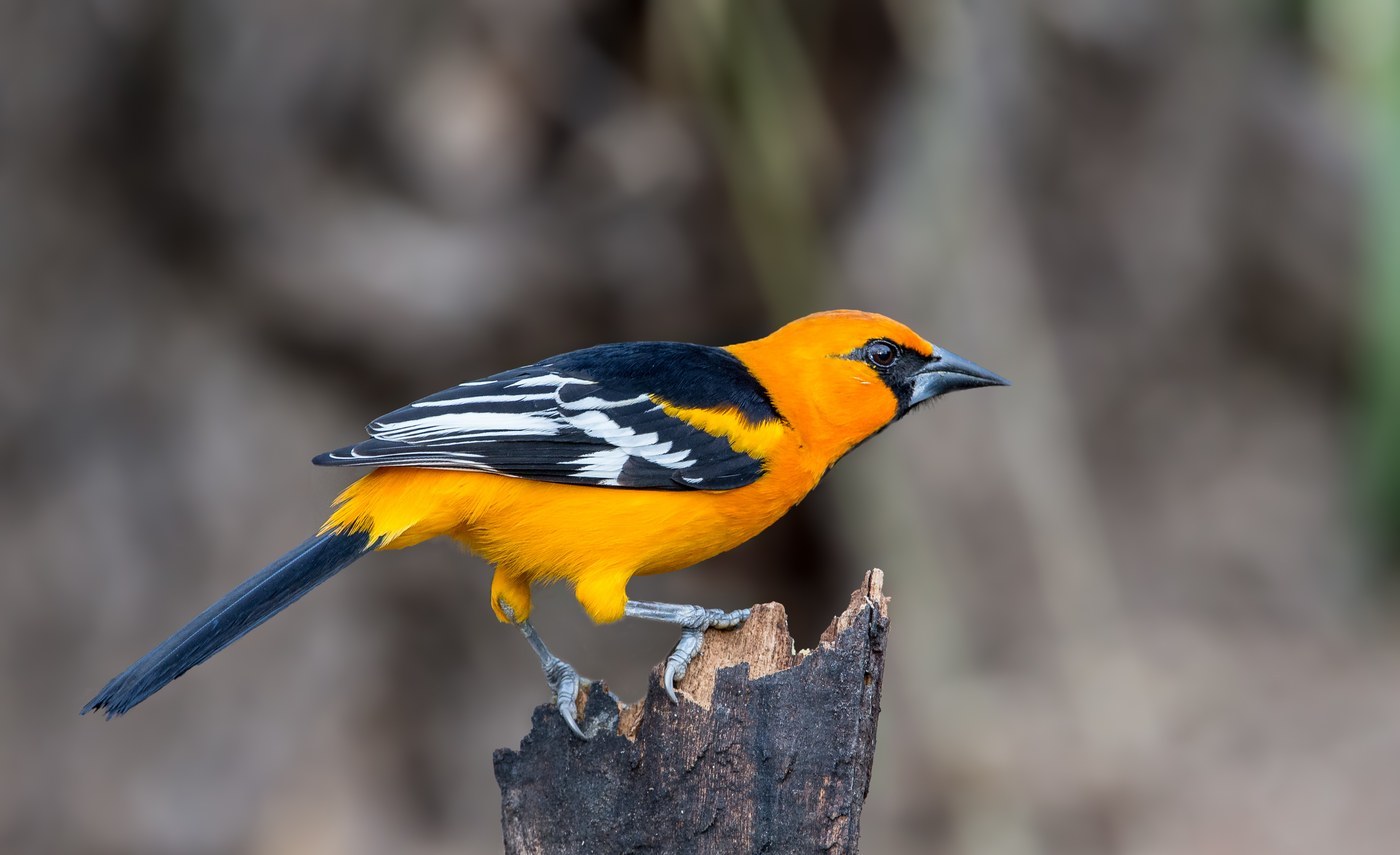
What Altamira Oriole's Feathers Look Like
Altamira Oriole is the largest oriole found in the United States, and its feathers are correspondingly large and richly colored. Body feathers are a deep orange-yellow, notably richer and more saturated toward orange than the paler yellow-orange of some related orioles. The back is black, and a small black triangular bib (throat patch) is present but does not extend into a full hood over the head as in some relatives. Wings are black with crisp white edging forming two wing bars on the flight feathers. Tail feathers are black. A black mask around the eye and lores contrasts with the orange face. Flight feathers run 7-9 cm, notably larger than those of smaller oriole species.
Step-by-Step: Is This Feather From a Altamira Oriole?
- Check overall size first. A large oriole-type flight feather (7-9 cm) with white edging suggests this species over smaller orioles.
- Look at body feather color. Deep, saturated orange-yellow rather than a paler lemon-yellow or a more fiery red-orange helps narrow things down.
- Check the extent of black. A small black triangular bib on the throat, without black extending up over the entire head, distinguishes this species from hooded relatives.
- Look for double white wing bars. Crisp white edging on black wing covert and flight feathers, forming two visible bars.
- Check the face. A black mask confined to the area around the eye and lores, set against an otherwise orange face.
Similar Species & How to Tell Them Apart
- Baltimore Oriole: Shows a solid black hood covering the entire head, throat, and back in males, rather than Altamira's black confined mostly to the back and small throat bib — head pattern is the key difference. Baltimore Oriole feathers are also smaller overall.
- Audubon's Oriole: Tends toward a more yellow-olive tone rather than deep orange, and shows black extending further over the head as a more complete hood.
- Hooded Oriole: More yellow-orange overall with a thinner black bib and a longer, more slender tail proportionally; also a smaller bird with smaller feathers throughout.
Where & When You'll Find Them
Altamira Oriole is a non-migratory resident of dense woodland, riparian areas, and resacas (oxbow lakes) in the extreme southern tip of Texas' Rio Grande Valley, ranging south through eastern Mexico and Central America. It is known for building unusually long, pendulous woven nests, sometimes exceeding two feet in length, often visible hanging conspicuously from the outer branches of tall trees near its territory. Because it doesn't migrate, feathers can be found year-round in its core range, with the heaviest feather turnover following the post-breeding molt in late summer, once nesting duties and territory defense have wound down for the year.
Frequently asked questions
What's the best clue for separating this from a Baltimore Oriole feather?
Check how much black is present — Baltimore Oriole males have a solid black hood over the entire head and throat, while Altamira Oriole shows only a small black triangular bib with an otherwise orange face and head.
Why are this species' feathers larger than other orioles'?
Altamira Oriole is the largest oriole regularly found in the United States, so its flight and tail feathers are proportionally bigger than those of smaller relatives like Hooded or Bullock's Oriole.
Is this species likely to be found outside southern Texas?
Within the US, it's essentially restricted to the Rio Grande Valley of extreme southern Texas, so a matching feather found elsewhere in the US is unlikely to be this species; its range continues south through Mexico and Central America.
Do immature Altamira Orioles show duller feathers?
Yes, young birds are duller and more yellow-olive overall with less crisp black patterning, so a somewhat washed-out orange-yellow feather with a faint black bib could still belong to an immature bird.