
How to Identify Black Guillemot Feathers
A guide to the sooty-black body feathers and bold white wing patch that distinguish this North Atlantic seabird's plumage.
Read the full Black Guillemot encyclopedia entry →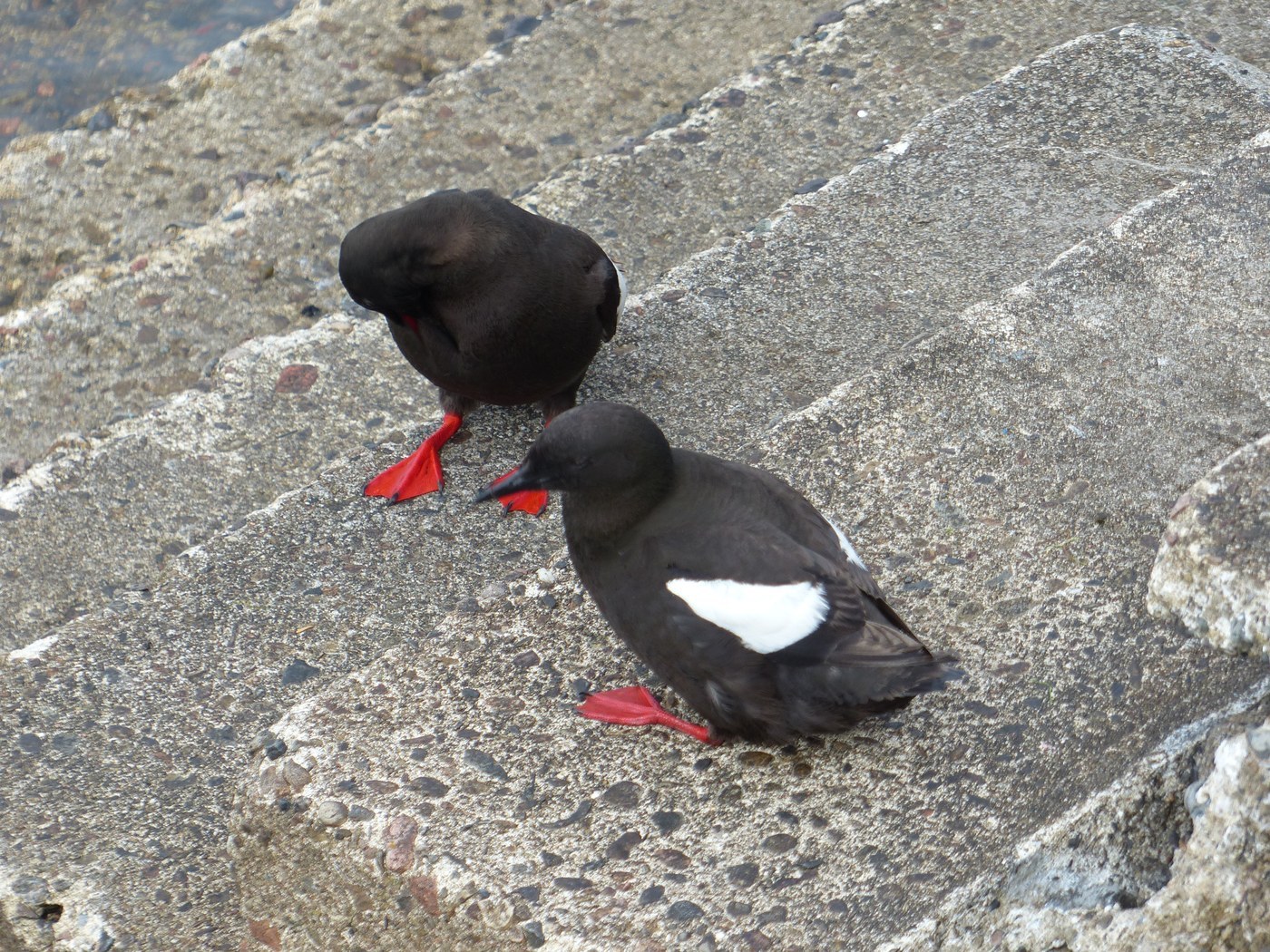
What Black Guillemot Feathers Look Like
In breeding plumage, this seabird is almost entirely sooty black to blackish-brown, dense and slightly glossy, with body feathers 3-6 cm — a striking, nearly monochrome look for a seabird. The single standout feature is a large, oval white patch on the upper wing coverts, formed by a block of pure white feathers set against the black — a wing-covert feather that is entirely white, clean-edged, and roughly 3-5 cm, unlike anything else in mixed black plumage. In winter, adults molt into a much paler plumage: body feathers become mottled grey and white, giving a scaly, barred appearance quite different from the solid black breeding look, though the white wing patch is retained year-round and remains the most reliable identifying feature.
Flight feathers are moderate length for an auk, around 12-16 cm, blackish-brown, stiff, and slightly rounded at the tip, built for the whirring wingbeats and underwater "flying" this family uses to pursue fish. Down and body feathers are dense and water-resistant, reflecting a life spent diving in cold coastal water.
Step-by-Step: Is This Feather From a Black Guillemot?
- Look for the white wing patch feathers first. A crisp, solid white feather with clean edges, medium-small size, found alongside black feathers, is the strongest single indicator for this species.
- Check overall color depending on season. Solid sooty black suggests breeding plumage; mottled grey-and-white scaly-looking feathers suggest winter plumage — both are normal for the same species at different times of year.
- Assess feather density and stiffness. A dense, slightly oily, stiff feather supports a diving seabird rather than a gull or tern.
- Measure flight feathers. Primaries in the 12-16 cm range with a rounded tip fit a small-to-mid auk.
- Consider the shaft. Shafts are typically pale to whitish, contrasting against the black vane, a helpful visual check when other clues are ambiguous.
Similar Species & How to Tell Them Apart
The Pigeon Guillemot, a close Pacific relative, looks extremely similar but usually shows a black wedge or bar cutting through its white wing patch, breaking up the solid white block seen in Black Guillemot. Common Murre and Razorbill are much larger auks with black-and-white patterning restricted mostly to the underparts (white belly, dark upperparts) rather than a discrete white wing patch, and their feathers are noticeably bigger overall. Black-legged Kittiwake and other gulls share some black wingtip patterning, but gulls are predominantly pale grey-and-white bodied, the opposite pattern from this mostly-black auk.
Where & When You'll Find Them
Black Guillemots are a North Atlantic and Arctic coastal species, nesting in rock crevices, boulder fields, and man-made structures like piers and breakwaters right along the shoreline, rarely venturing far out to sea compared to other auks. Feathers are most often found on rocky shorelines, near nesting crevices, and around harbor structures where the birds roost and loaf between dives. Molt happens twice a year — into duller winter plumage in autumn and back into striking black breeding plumage in spring — so both all-black feathers and mottled grey-white feathers can be found depending on the season, always with the diagnostic white wing patch feathers present year-round.
Frequently asked questions
What's the most reliable feather for identifying this species?
The solid white, clean-edged wing patch feather, present in both summer and winter plumage, is the most dependable single clue.
Why did I find mottled grey-and-white feathers instead of black ones?
That's normal winter plumage — Black Guillemots molt into a paler, scaly grey-white look outside the breeding season while keeping the white wing patch.
How do I tell this apart from a Pigeon Guillemot feather?
Pigeon Guillemot usually shows a black wedge cutting through its white wing patch, while Black Guillemot's patch is a solid, unbroken white block.
Is this a large or small feather compared to other auks?
Smaller — flight feathers run 12-16 cm, notably shorter than Common Murre or Razorbill feathers.
Where do these feathers typically wash up or get found?
Rocky shorelines, harbor structures, and nesting crevices right along the coast, since this auk rarely ranges far offshore.