
How to Identify Black Stork Feathers
A guide to the glossy black flight feathers and pure white belly plumage that distinguish this large Eurasian stork from its all-white relative.
Read the full Black Stork encyclopedia entry →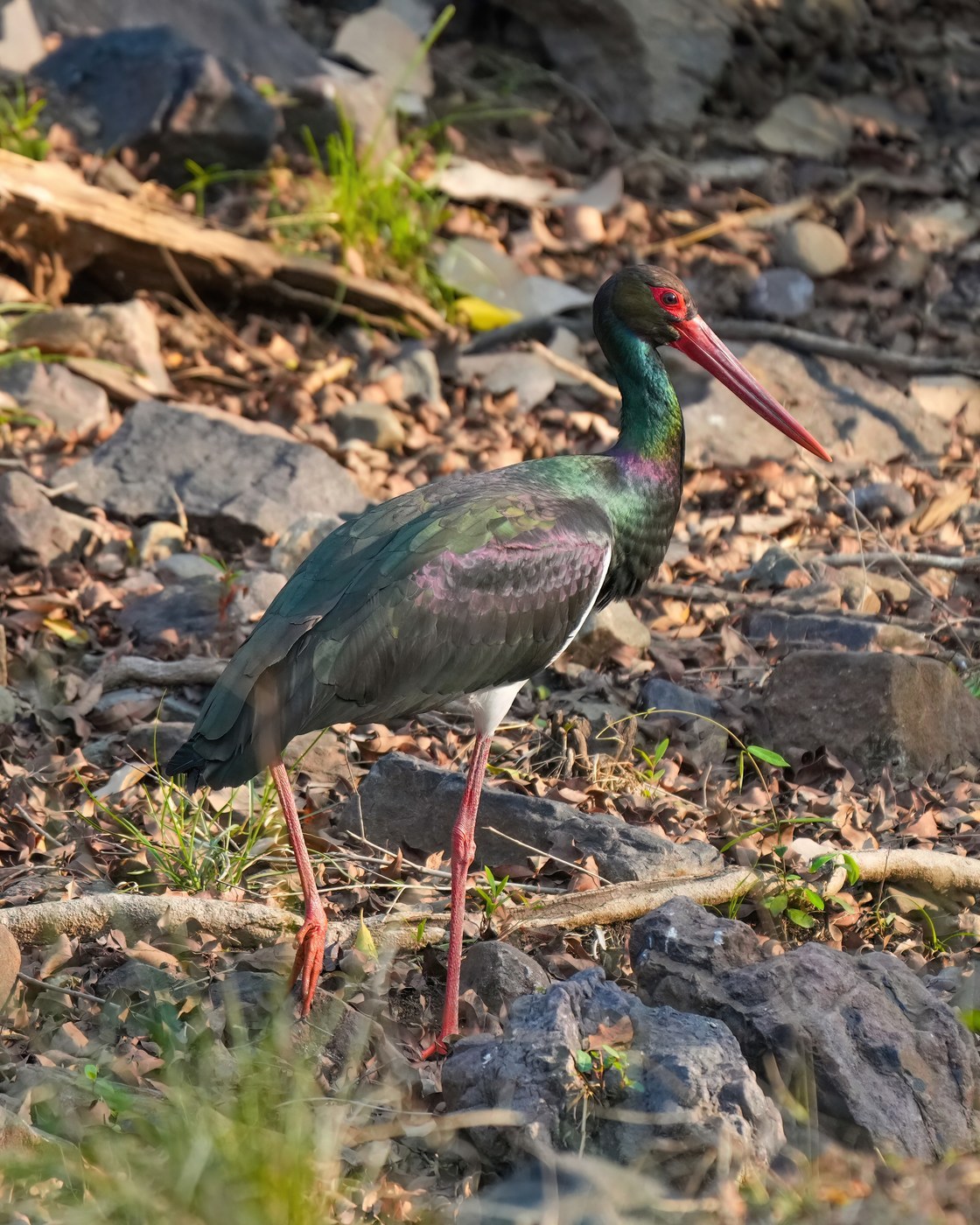
What Black Stork Feathers Look Like
Black Stork feathers are large, reflecting the bird's size, and show a striking two-tone pattern: head, neck, back, and wing feathers are glossy black, often showing an iridescent green, purple, or bronze sheen in good light, while belly, lower breast, and underwing covert feathers are pure white. Flight feathers (primaries and secondaries) are broad and long — often 40-50 cm on a large adult — glossy black, consistent with a big soaring wading bird. Tail feathers are also black. The combination of a large glossy black covert or flight feather alongside a pure white belly feather from the same bird is a strong pairing for this species.
Step-by-Step: Is This Feather From a Black Stork?
- Measure it. Large flight feathers in the 40-50 cm range point to a large soaring bird such as a stork rather than a heron or ibis.
- Check for iridescence. A glossy black feather with a green, purple, or bronze sheen in the light supports this species specifically.
- Look for a paired white feather. Finding a pure white belly or underwing feather alongside black wing/back feathers matches this species' two-tone pattern.
- Assess overall size versus black coloring. If most of the bird's feathers would be black with only the belly white, that favors Black Stork over the mostly-white White Stork.
- Rule out cormorants. If the feather is smaller, more slender, and pointed with a duller matte-black sheen (rather than a broad, glossy, iridescent one), consider a cormorant instead.
Similar Species & How to Tell Them Apart
White Stork is the most important comparison: it is mostly white overall, with black restricted to the flight feathers and wingtips, the opposite proportion from Black Stork, which is mostly black with white confined to the belly and underwing. Cormorants are also glossy black, but they are smaller birds with more slender, pointed feathers and a duller sheen from constant water contact, lacking the broad, iridescent flight feathers of a large stork. Glossy Ibis shares an iridescent dark sheen but is much smaller, with correspondingly smaller feathers than a stork's.
Where & When You'll Find Them
Black Storks breed in remote forests near rivers and wetlands across Europe and Asia and winter in Africa and South Asia, making them long-distance migrants. Feathers are most likely to be found near nesting rivers and forest wetlands in summer during and after the breeding season, or around wintering wetlands in Africa during the dry season. Molt is concentrated on the breeding grounds in summer, so that is the best window for finding fresh feathers near known nest sites.
Frequently asked questions
Why is the feather black with a green or purple sheen?
Black Stork feathers, especially from the back and wings, are glossy black with iridescent green, purple, or bronze highlights in good light — a key identifying feature.
How is this different from a White Stork feather?
White Stork is mostly white with black confined to the flight feathers, the reverse of Black Stork, which is mostly black with white confined to the belly and underwing.
Could this be a cormorant feather instead?
Cormorant feathers are smaller, more slender and pointed, with a duller sheen, while Black Stork flight feathers are larger, broader, and more glossy.
Why are the flight feathers so large?
Black Storks are large soaring wading birds, and their primaries and secondaries can reach 40-50 cm on an adult.
When is the best time to find feathers?
During and after the breeding season in summer near forested rivers and wetlands, or during the dry season near African wintering wetlands.
Black Stork identified by the community
Recent Black Stork feathers identified with Feather Identifier.

